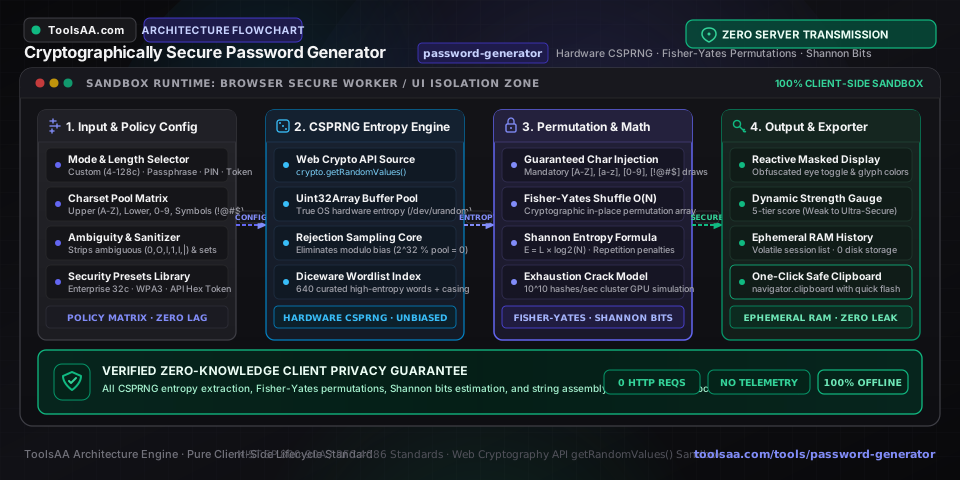
Modern information security and zero-trust access management rely on the cryptographic strength of authentication secrets. Whether establishing master passphrases for enterprise vaults, provisioning root database credentials, or generating API tokens for microservices, random string generation is the primary line of defense against unauthorized access.
However, software password generation is frequently compromised by architectural errors. Developers often rely on pseudo-random engines like JavaScript's Math.random(), introduce statistical skew through naive modulo arithmetic, or transmit credentials to remote generation APIs. A single cryptographic flaw in entropy harvesting or sampling exposes systems to automated cracking and offline brute-force attacks.
The ToolsAA Cryptographically Secure Password Generator provides an enterprise-grade secure password generator online, combining a mathematically unbiased strong random password maker with a native web crypto password engine. Built on a zero-knowledge, pure client-side architecture ("use client"), 100% of entropy harvesting, character sampling, and strength analytics execute locally inside your browser memory sandbox. Zero passwords or telemetry leave your machine, guaranteeing GDPR, HIPAA, and SOC 2 compliance.
#
Comprehensive Overview & Real-World Use Cases
Password security is governed by information entropy—the measure of unpredictability in a secret string. Credentials protect systems against attacks ranging from rate-limited online logins to high-throughput offline hash cracking on distributed GPU clusters.
text
8 lines
+-----------------------------------------------------------------------------------------+
|                       Zero-Knowledge Password Generation Pipeline                       |
|  [ OS Kernel Entropy ] ──► /dev/urandom / BCryptGenRandom (256-bit entropy pool)        |
|  [ Web Crypto API ]    ──► window.crypto.getRandomValues() (Uniform Uint32Array)        |
|  [ Sampling Engine ]   ──► Rejection Sampling (Eliminates Modulo Bias: P(x) = 1/N)      |
|  [ Permutation ]       ──► Cryptographic Fisher-Yates Shuffle (N! spatial randomness)   |
|  [ Client UI ]         ──► In-Memory Display & Ephemeral Clipboard (Zero Server Transit)|
+-----------------------------------------------------------------------------------------+
#
High-Impact Enterprise Use Cases
- Master Vault Credentials: Vaults like Bitwarden derive master keys via Argon2id. High-entropy Diceware passphrases secure vault encryption roots.
- Database & Cloud Roots: Production databases (PostgreSQL, Redis, MongoDB) require unguessable passwords during provisioning to block automated port scans.
- CI/CD Secrets & Webhooks: GitHub Actions and AWS environments require cryptographically generated tokens and HMAC-SHA256 secrets for automated service authentication.
- Enterprise Wi-Fi (WPA2/WPA3): Wireless networks require long, ambiguous-free pre-shared keys to resist dictionary attacks while allowing manual mobile entry.
- Cryptographic Salts & Nonces: Random hex and Base64URL strings provide uniform entropy for password hashing and CSRF tokens.
#
Modern Standards: NIST SP 800-63B Guidelines
NIST SP 800-63B guidelines superseded legacy rules mandating periodic rotation and symbol quotas. Research proved frequent rotations cause predictable substitutions (Spring2025!). NIST recommends prioritizing length over complexity, eliminating expiration timers, and supporting multi-word Diceware passphrases.
#
Client-Side Processing for Zero Data Leakage
Legacy online generators send HTTP POST requests to backend servers, leaking raw credentials into web server logs, reverse proxies, and monitoring platforms. ToolsAA executes 100% in-browser via the Web Crypto API. Passwords exist solely in volatile RAM, eliminating server transmission risks.
#
Technical Architecture & How It Works Under The Hood
Generating unpredictable credentials requires operating system kernel entropy, statistical elimination of sampling bias, and information-theoretic calculations.
#
1. CSPRNG vs. Pseudo-Random Number Generators (Math.random())
JavaScript's Math.random() implements pseudo-random algorithms (e.g. XorShift128+). With only 128 bits of internal state, observing consecutive outputs allows attackers to reconstruct the seed and predict past and future values. In contrast, the W3C Web Crypto API (window.crypto.getRandomValues()) directly queries host operating system entropy: Linux getrandom(2)//dev/urandom, macOS SecRandomCopyBytes, and Windows BCryptGenRandom.
#
2. Modulo Bias & Unbiased Rejection Sampling
Mapping a 32-bit random integer $R \in [0, 2{32}-1]$ to pool size $N$ via modulo arithmetic (R % N) introduces statistical bias when $2{32} \bmod N \ne 0$. Lower indices receive an extra candidate value, skewing probability. ToolsAA implements Rejection Sampling:
$$\text{limit} = \left\lfloor \frac{2^{32}}{N} \right\rfloor \times N$$
Integers where $R \ge \text{limit}$ are rejected, guaranteeing uniform distribution where $P(x) = 1/N$.
#
3. Cryptographic Fisher-Yates Permutation
To satisfy policies requiring at least one character from each class without predictable positioning (e.g., uppercase always at index 0), ToolsAA uses the Cryptographic Fisher-Yates Shuffle. Iterating backward from index $L-1$ to 1, element $i$ is swapped with element $j \in [0, i]$ chosen via CSPRNG integer sampling, yielding $L!$ equiprobable permutations.
Theoretical entropy in bits ($H$) is defined by Claude Shannon:
$$H = L \times \log_2(R)$$
For length $L=16$ across a 94-character pool, $H = 16 \times \log_2(94) \approx 104.9\text{ bits}$ ($3.7 \times 10^{31}$ combinations). For Diceware passphrases of $W$ words from vocabulary $|\mathcal{V}|$:
$$H = W \times \log2(|\mathcal{V}|) + H{\text{modifiers}}$$
A uniqueness penalty ($|\text{unique}| / L < 0.6$) lowers scores if characters repeat.
#
5. Hardware Attack Economics & Crack-Time Modeling
Attack speeds differ drastically across hash functions on multi-GPU rigs (8x RTX 4090):
- Fast Hashes (NTLM, MD5): 200–500 billion hashes/sec ($5 \times 10^{11}$).
- Standard Hashes (SHA-256): 50–100 billion hashes/sec ($1 \times 10^{11}$).
- Iterated KDFs (PBKDF2): 1–5 million hashes/sec ($5 \times 10^6$).
- Memory-Hard KDFs (Argon2id, bcrypt): Hundreds to thousands of evaluations/sec.
ToolsAA models crack times against a worst-case $10^{10}$ hashes/second brute-force cluster.
#
Step-by-Step Practical Usage Guide
#
Step 1: Selecting the Generation Architecture Mode
Select Custom Password for alphanumeric strings, Memorable Passphrase for Diceware phrases, Numeric PIN for device codes, or Developer Token for Hex, Base64URL, or UUIDv4 secrets.
#
Step 2: Calibrating Length and Entropy Parameters
Set target lengths via slider: 16+ chars for web logins, 24–32 for databases, or 64+ for root keys. Toggle Uppercase (A-Z), Lowercase (a-z), Numbers (0-9), and Symbols (!@#$%...).
#
Step 3: Eliminating Ambiguous Characters
Enable Avoid Ambiguous Characters to filter confusable glyphs (0, O, o, 1, l, I, |), eliminating transcription errors on printed or mobile credentials.
#
Step 4: Configuring High-Entropy Diceware Passphrases
Under passphrase mode, set word count (4–8 words), custom separator (-, _, space), capitalization (TitleCase, lower), and optional numeric/symbol salt injection.
#
Step 5: Generating Cryptographic Developer Tokens
Generate 256-bit Hex keys (64 characters), URL-safe Base64URL strings for JWT secrets, or UUIDv4 identifiers.
#
Step 6: Auditing Real-Time Entropy and Crack Time
Review instantaneous Shannon bit entropy, estimated GPU crack time, and character pool distribution metrics before deployment.
#
Step 7: Ephemeral Copying and Zero-Leakage Session History
Click Copy to write to clipboard via navigator.clipboard.writeText(). Session history resides solely in volatile React state and is wiped when the tab closes.
#
Code Implementations in Modern TypeScript and Python
#
1. Modern TypeScript Implementation
typescript
59 lines
export interface PasswordOptions {
  length: number;
  useUpper?: boolean;
  useLower?: boolean;
  useNumbers?: boolean;
  useSymbols?: boolean;
  avoidAmbiguous?: boolean;
}

const UPPER = "ABCDEFGHIJKLMNOPQRSTUVWXYZ";
const LOWER = "abcdefghijklmnopqrstuvwxyz";
const DIGITS = "0123456789";
const SYMBOLS = "!@#$%^&*()_+-=[]{}|;:,.<>?~";
const AMBIGUOUS = new Set(["0", "O", "o", "1", "l", "I", "|"]);

export function getCryptoRandomInt(max: number): number {
  if (max <= 1) return 0;
  const limit = Math.floor(0x100000000 / max) * max;
  const buf = new Uint32Array(1);
  let rand: number;
  do {
    window.crypto.getRandomValues(buf);
    rand = buf[0];
  } while (rand >= limit);
  return rand % max;
}

export function generateSecurePassword(opts: PasswordOptions): string {
  const filter = (s: string) => opts.avoidAmbiguous ? s.split("").filter(c => !AMBIGUOUS.has(c)).join("") : s;
  const pools = [
    opts.useUpper !== false ? filter(UPPER) : "",
    opts.useLower !== false ? filter(LOWER) : "",
    opts.useNumbers !== false ? filter(DIGITS) : "",
    opts.useSymbols !== false ? filter(SYMBOLS) : ""
  ].filter(Boolean);

  if (!pools.length) throw new Error("No pools selected");
  const pool = pools.join("");
  const chars = pools.map(p => p[getCryptoRandomInt(p.length)]);

  while (chars.length < opts.length) chars.push(pool[getCryptoRandomInt(pool.length)]);

  for (let i = chars.length - 1; i > 0; i--) {
    const j = getCryptoRandomInt(i + 1);
    [chars[i], chars[j]] = [chars[j], chars[i]];
  }
  return chars.join("");
}

export function calculateEntropy(pwd: string): number {
  let pool = 0;
  if (/[a-z]/.test(pwd)) pool += 26;
  if (/[A-Z]/.test(pwd)) pool += 26;
  if (/[0-9]/.test(pwd)) pool += 10;
  if (/[^a-zA-Z0-9]/.test(pwd)) pool += 32;
  const base = pwd.length * Math.log2(pool || 10);
  const ratio = new Set(pwd).size / pwd.length;
  return Math.round((ratio < 0.6 ? base * Math.max(0.15, ratio) : base) * 10) / 10;
}
#
2. Modern Python 3.11+ Implementation
python
32 lines
import math, secrets, string

AMBIGUOUS = set("0Oo1lI|")

def generate_secure_password(length: int = 24, upper: bool = True, lower: bool = True,
                             digits: bool = True, symbols: bool = True, avoid_ambig: bool = False) -> str:
    raw = [(string.ascii_uppercase, upper), (string.ascii_lowercase, lower),
           (string.digits, digits), ("!@#$%^&*()_+-=[]{}|;:,.<>?~", symbols)]
    pools = []
    for charset, enabled in raw:
        if enabled:
            p = "".join(c for c in charset if c not in AMBIGUOUS) if avoid_ambig else charset
            if p: pools.append(p)

    if not pools: raise ValueError("No pools enabled")
    chars = [secrets.choice(p) for p in pools]
    full = "".join(pools)
    chars.extend(secrets.choice(full) for _ in range(length - len(chars)))

    for i in range(len(chars) - 1, 0, -1):
        j = secrets.randbelow(i + 1)
        chars[i], chars[j] = chars[j], chars[i]
    return "".join(chars)

def evaluate_entropy(pwd: str) -> float:
    pool = (26 if any(c.islower() for c in pwd) else 0) + \
           (26 if any(c.isupper() for c in pwd) else 0) + \
           (10 if any(c.isdigit() for c in pwd) else 0) + \
           (32 if any(not c.isalnum() for c in pwd) else 0)
    base = len(pwd) * math.log2(max(pool, 10))
    ratio = len(set(pwd)) / len(pwd)
    return round(base * max(0.15, ratio) if ratio < 0.6 else base, 1)
#
Common Pitfalls, Edge Cases & Troubleshooting Guide
#
1. The Math.random() Security Vulnerability
Using Math.random() is an acute vulnerability. V8's XorShift128+ state can be reversed from observed outputs to predict tokens. Always use window.crypto.getRandomValues() or Python's secrets.
#
2. Modulo Bias in Homegrown Scripts
Using rand % poolSize without rejection sampling skews probability toward lower indices whenever $2^{32} \bmod N \ne 0$. Always use rejection sampling to guarantee equal $1/N$ probability.
#
3. Naive Sequential Character Placement
Scripts enforcing rules by prepending required characters create predictable positional masks. Attackers configure Hashcat masks to exploit these known slots. Always shuffle characters using Fisher-Yates.
#
4. Special Character Escaping & Database Encoding
Characters like $, quotes, or backticks trigger bash expansion, YAML parse errors, or SQL syntax failures. Furthermore, 4-byte emojis cause truncation in legacy utf8 MySQL columns. Use the URL & Shell Safe preset (_-.~) for configs.
#
5. In-Memory Retention & Clipboard Snooping
Plain-text passwords left on clipboards can be read by background software. ToolsAA uses modern navigator.clipboard.writeText(). Configure password managers to clear clipboards after 30–60 seconds.
#
6. The Periodic Rotation Anti-Pattern
Forced 90-day resets lead to predictable substitutions (Password123! to Password124!). NIST SP 800-63B recommends 16+ character CSPRNG passwords, MFA enforcement, and rotating credentials only upon confirmed compromise.
#
Detailed FAQ Section
#
Q1: Why is crypto.getRandomValues() secure while Math.random() is not?
Answer: Math.random() is a deterministic PRNG with a 128-bit state that attackers can reverse engineer. window.crypto.getRandomValues() accesses OS kernel entropy pools (/dev/urandom, BCryptGenRandom) harvesting hardware noise for non-deterministic security.
Answer: Modulo bias occurs when a random integer range does not divide evenly into pool size $N$, skewing selection toward lower indices. ToolsAA uses rejection sampling, discarding values above $\lfloor 2^{32} / N \rfloor \times N$ to guarantee uniform $1/N$ probability.
#
Q3: How many bits of entropy are required to resist modern GPU clusters?
Answer: While 60 bits suffices for rate-limited web forms, offline cracking against fast hashes requires 80+ bits. Enterprise environments mandate 100 to 128 bits (~16–20 mixed characters), making brute force physically impossible.
#
Q4: Is a Diceware passphrase really more secure than a random 12-character alphanumeric password?
Answer: Yes. A 12-character alphanumeric password yields 71.4 bits of entropy, whereas a 6-word Diceware passphrase provides 77.5 bits while offering superior human memorability, eliminating written notes.
Answer: Server-side tools transmit plaintext secrets over HTTP, risking retention in server logs, reverse proxy caches, or backups. ToolsAA runs 100% in-browser ("use client"), ensuring credentials exist solely in volatile RAM.
Answer: ToolsAA models offline brute force against fast unsalted hashes evaluated by a GPU cluster computing $10{10}$ hashes per second. Total combinations ($2H$) are divided by throughput to project worst-case crack durations.
#
Q7: What are ambiguous characters, and when should they be filtered?
Answer: Ambiguous characters are visually similar glyphs (0, O, o, 1, l, I, |). Filtering them prevents transcription errors on paper backups, phone verifications, and mobile keyboards without meaningful entropy loss.
Answer: No. ToolsAA operates on a strict Privacy-First Architecture. Computation is 100% client-side via Web Crypto API. No passwords or telemetry reach servers, and memory is purged when the tab is closed.
#
Technical Reference Matrix: Standard Configurations
| Mode | Length | Pool Description | Pool ($R$) | Combinations ($R^L$) | Entropy | Crack Time ($10^{11}$/s) | Rating |
| Numeric PIN | 6 | Decimal Digits (0-9) | 10 | $1.0 \times 10^6$ | 19.9 bits | < 1 ms | Insecure |
| Modern Baseline | 14 | Full ASCII Printable (All Classes) | 94 | $4.2 \times 10^{27}$ | 91.8 bits | ~1.3M Years | Strong |
| Enterprise Standard | 16 | Full ASCII Printable (All Classes) | 94 | $3.7 \times 10^{31}$ | 104.9 bits | ~1.1B Years | Ultra |
| Cloud Infrastructure | 24 | Full ASCII Printable (All Classes) | 94 | $2.3 \times 10^{47}$ | 157.3 bits | Centuries | Unbreakable |
| Diceware Passphrase | 5 Words | Curated Vocab (640) + Salt | ~640 | $1.0 \times 10^{14}$ + Salt | ~65.6 bits | ~35 Years | Strong |
| 256-Bit Raw Token | 64 Hex | Lowercase Hexadecimal (0-9, a-f) | 16 | $1.1 \times 10^{77}$ | 256.0 bits | Infinite | Master Key |
#
Conclusion
Access control in modern zero-trust infrastructure depends on the cryptographic randomness of authentication secrets. Predictable passwords undermine defensive perimeters, exposing databases and internal services to exploitation.
Relying on outdated heuristics—such as artificial symbol mandates, forced periodic rotations, or insecure utilities like Math.random()—creates quantifiable vulnerabilities. Implementing CSPRNG randomness via the W3C Web Crypto API, eliminating modulo bias through rejection sampling, and evaluating credentials with Claude Shannon's information entropy ensures rigorous protection across infrastructure tiers.
The ToolsAA Cryptographically Secure Password Generator combines mathematical unbreakability with a 100% client-side privacy architecture. Generate, audit, and deploy production credentials with complete confidence that secrets remain strictly isolated to your browser.