Bcrypt Hash Generator & Password Verifier
Eksblowfish (RFC OpenBSD)Generate cryptographically secure Eksblowfish password hashes with adjustable salt rounds (4-16) and verify candidates locally in browser memory.
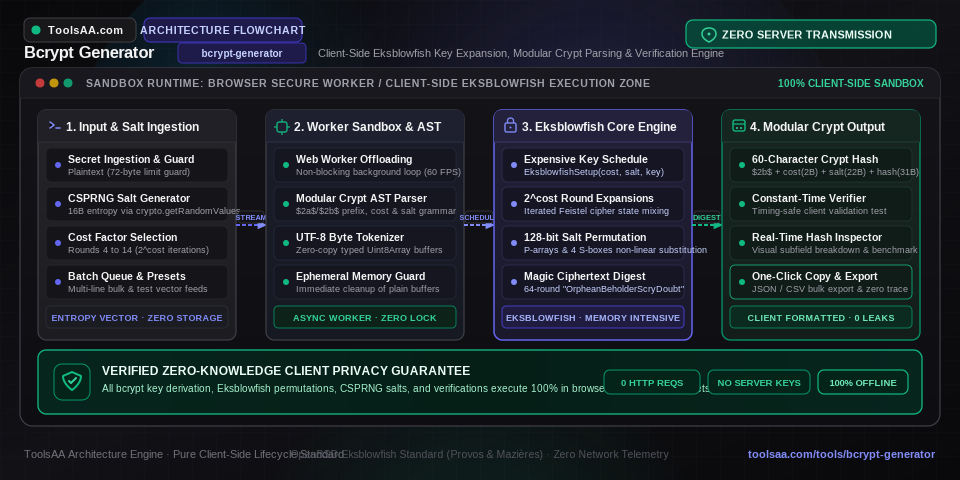
Unlike fast digest algorithms like MD5 or SHA-256 (designed for file checksums and vulnerable to high-throughput GPU attacks), bcrypt uses Eksblowfish key schedule. Each increment in salt rounds doubles the required computation time, rendering offline brute-force attacks infeasible.
Zero-Knowledge Local Execution
All data processing, parsing, and compilation execute strictly inside your local browser memory. Zero external server uploads.
Instant Local Cryptography
Instant real-time reactive computation delivers immediate feedback on every keystroke with zero network latency.
Production Standards & Compliance
Follows modern browser Web Crypto and security practices for safe client-side inspection.
Bcrypt Generator Developer Reference
Developer utility for bcrypt-generator.
Bcrypt Work Factor (Cost Rounds) vs Hash Latency Table
Bcrypt cost work factors (2^N iterations), average server CPU hashing latency, security level assessments, and production workload recommendations.
| Cost Factor ($2^N$) | Key Iteration Count | Approx CPU Hash Time | Security Assessment | Recommended Production Scenario |
|---|---|---|---|---|
| Cost 8 | 256 rounds | ~15 ms | Weak | Local unit testing / CI test suites only |
| Cost 10 | 1,024 rounds | ~60 ms | Minimum Baseline | High-throughput public APIs with tight latency budgets |
| Cost 12 | 4,096 rounds | ~250 ms | OWASP Recommended | Standard modern user authentication and login systems |
| Cost 13 | 8,192 rounds | ~500 ms | High Assurance | Sensitive financial portals, admin accounts |
| Cost 14 | 16,384 rounds | ~1,000 ms (1.0s) | Very High | Enterprise master passwords; risk of CPU starvation under DoS |
| Cost 15 | 32,768 rounds | ~2,000 ms (2.0s) | Extreme | Cold storage archival encryption, high security master vaults |
Key Parameters & Controls
| Parameter | Type / Unit | Description | Default |
|---|---|---|---|
| password | string | Plaintext secret to hash or verify against an existing modular crypt format bcrypt string; truncated to 72 bytes. | — |
| rounds | number (4-31) | Logarithmic work factor determining key expansion iterations (computed as 2^rounds cycles, default 2^10 = 1024). | 10 |
| prefix | "$2a$" | "$2b$" | "$2y$" | Bcrypt specification version prefix; $2b$ is the modern OpenBSD standard addressing high-bit sign extension. | "$2b$" |
| hash | string | Standard 60-character modular crypt format bcrypt string containing identifier, cost factor, salt, and checksum. | — |
Pro Tips & Best Practices
Bcrypt strictly hashes the first 72 bytes of plaintext. Pre-hash long passwords using SHA-256 or BLAKE2b into Base64 before passing them into bcrypt to eliminate truncation vulnerabilities without loss of entropy.
Calibrate the cost rounds so individual hash operations take 250ms to 500ms on production authentication nodes. Rounds 10 to 12 provide strong brute-force resistance while remaining resilient against login denial-of-service.
Always verify credentials using constant-time comparison methods like bcrypt.compare(). Standard strict equality checks (===) terminate on the first mismatched byte, creating timing side-channels.
Common Gotchas & Troubleshooting
⚠️Passwords Exceeding 72 Bytes Match Different Strings
Bcrypt ignores all bytes after the 72nd byte. Passwords sharing the exact first 72 bytes will evaluate as identical. Apply SHA-256 pre-hashing before bcrypt, or enforce maximum input length validation in your request schema.
⚠️Cost Factor 13 or Higher Freezes UI Thread
Rounds >= 13 require over 8,192 Blowfish key expansions and block single-threaded event loops. Offload benchmark calculations to a Dedicated Web Worker, or keep client-side exploration between rounds 10 and 12.
⚠️Unrecognized Salt Revision Error on $2y$ Hashes
The $2y$ identifier is specific to PHP and is rejected by strict Go or Java bcrypt parsers. Normalize the string by replacing the $2y$ prefix with $2b$ prior to verification, as the salt and cipher payload are mathematically identical.
Frequently Asked Questions
Why does bcrypt truncate input passwords at exactly 72 bytes?▼
The underlying Blowfish cipher key schedule (EksBlowfishSetup) accepts up to 448 bits (56 bytes) and processes cyclical password expansion up to 72 bytes. Characters beyond byte 72 are completely ignored during key state initialization.
What is the technical difference between $2a$, $2b$, and $2y$ prefixes?▼
$2a$ is the original OpenBSD implementation, which contained a bug handling characters with the high bit set. PHP introduced $2y$ to fix sign extension. OpenBSD released $2b$ in 2014 as the official revision fixing both sign extension and buffer wraparound bugs across all architectures.
Why is client-side bcrypt hashing insufficient for zero-knowledge auth?▼
Sending a client-computed bcrypt hash directly to the server turns the hash into the effective password, leaving the account vulnerable to Pass-the-Hash attacks if the database leaks. Secure architectures use client-side PBKDF2/Argon2id for transport and perform bcrypt salt stretching server-side.
How does bcrypt compare to Argon2id regarding GPU cracking resistance?▼
Bcrypt requires 4KB of memory for Blowfish S-boxes that fit directly into CPU L1 cache, making FPGA attacks harder than on PBKDF2. However, Argon2id can be configured with hundreds of megabytes of RAM and multiple parallel threads, providing significantly higher resistance against modern GPU clusters.
Related Tools & Utilities
All Tools →Compute instant cryptographic hashes entirely in browser with zero server transmission.
Generate ultra-secure passwords using Web Crypto API with custom length, symbols, and memorability.
Evaluate password resilience against brute-force attacks with Shannon entropy calculations, zxcvbn pattern matching, crack time estimates, and zero server transmission.
Calculate cryptographically secure SRI SHA-256, SHA-384, and SHA-512 hashes and generate HTML <script> and <link> integrity tags.
Generate secure HTTP Basic Authentication passwords and .htpasswd entries with Bcrypt, Apache MD5 (APR1), and SHA-1 hashing.
Generate cryptographically secure, memorable multi-word passphrases using EFF Diceware wordlists, custom delimiters, number injection, and instant Shannon entropy calculation.