Unix Timestamp Converter & Date Formatter
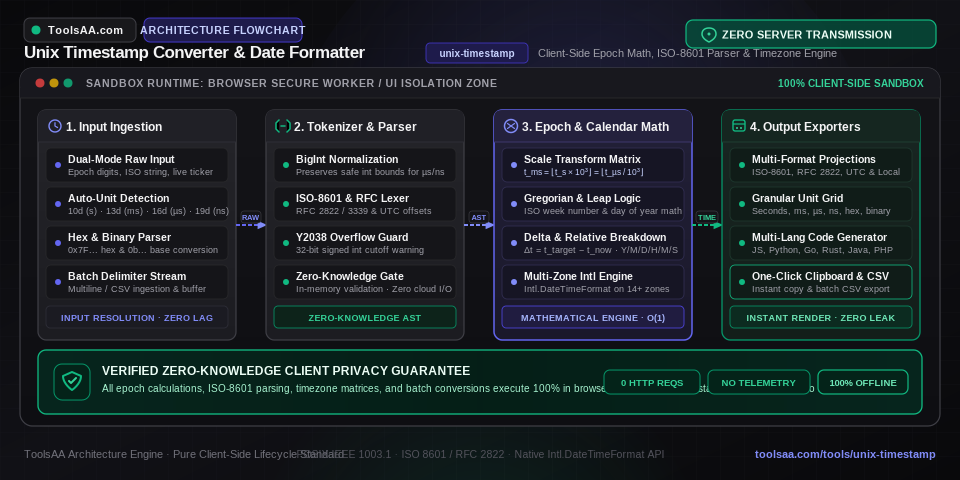
POSIX Epoch & ISO 8601 StandardsConvert seconds, milliseconds, microseconds, and nanoseconds to human-readable dates (ISO 8601, RFC 2822) with real-time clock ticker and multi-timezone comparative inspector.
Milliseconds: 1774000000000 | UTC: Fri, 20 Mar 2026 09:46:40 GMT
Standard international representation formatted for JSON payloads and database records.
Coordinated Universal Time (Zero meridian offset, RFC 7231 HTTP-date).
Exact offset: 0s (synchronous)
Multi-Precision Representation Breakdown
Global Timezone Comparison
| City / Region | Offset | Formatted Local Date & Time | Copy |
|---|---|---|---|
Universal UTC / GMT (UTC) | GMT+0 | Mar 20, 2026, 09:46:40 UTC | |
New York US Eastern (America/New_York) | EDT/EST (UTC-4/5) | Mar 20, 2026, 05:46:40 EDT | |
Chicago US Central (America/Chicago) | CDT/CST (UTC-5/6) | Mar 20, 2026, 04:46:40 CDT | |
Denver US Mountain (America/Denver) | MDT/MST (UTC-6/7) | Mar 20, 2026, 03:46:40 MDT | |
Los Angeles US Pacific (America/Los_Angeles) | PDT/PST (UTC-7/8) | Mar 20, 2026, 02:46:40 PDT | |
London UK / Ireland (Europe/London) | BST/GMT (UTC+1/0) | Mar 20, 2026, 09:46:40 GMT | |
Paris / Berlin Central Europe (Europe/Paris) | CEST/CET (UTC+2/1) | Mar 20, 2026, 10:46:40 GMT+1 | |
Dubai Gulf Standard (Asia/Dubai) | GST (UTC+4) | Mar 20, 2026, 13:46:40 GMT+4 | |
New Delhi / Mumbai India Standard (Asia/Kolkata) | IST (UTC+5:30) | Mar 20, 2026, 15:16:40 GMT+5:30 | |
Singapore Singapore (Asia/Singapore) | SGT (UTC+8) | Mar 20, 2026, 17:46:40 GMT+8 | |
Beijing / Shanghai China Standard (Asia/Shanghai) | CST (UTC+8) | Mar 20, 2026, 17:46:40 GMT+8 | |
Tokyo Japan Standard (Asia/Tokyo) | JST (UTC+9) | Mar 20, 2026, 18:46:40 GMT+9 | |
Sydney Eastern Australia (Australia/Sydney) | AEST/AEDT (UTC+10/11) | Mar 20, 2026, 20:46:40 GMT+11 | |
Auckland New Zealand (Pacific/Auckland) | NZST/NZDT (UTC+12/13) | Mar 20, 2026, 22:46:40 GMT+13 |
100% Private Browser Execution
All data processing, parsing, and compilation execute strictly inside your local browser memory. Zero external server uploads.
Instant Timezone & Date Math
Instant real-time reactive computation delivers immediate feedback on every keystroke with zero network latency.
Production Standards & Compliance
Respects IANA time zones, leap years, and variable month lengths for accurate schedule math.
Unix Timestamp & Epoch Time Conversion Cheat Sheet — Reference Guide
POSIX epoch time reference guide: second, millisecond, microsecond, and nanosecond timestamp conversions, timezone math, and ISO 8601 formatting.
Unix epoch timestamps count non-leap seconds (or milliseconds) elapsed since 1970-01-01T00:00:00Z (UTC). Convert 10-digit seconds, 13-digit JavaScript milliseconds, and ISO 8601 strings across IANA time zones immediately in your browser, accounting cleanly for 32-bit Y2038 integer limits.
Unix Time Units & Epoch Milestones Reference Table
Standard second durations for time calculation, common cache expiration constants, and historical/future Unix Epoch milestone timestamps.
| Time Unit / Epoch Milestone | Seconds | Human Readable Duration / Date | System & Software Significance |
|---|---|---|---|
| 1 Minute | 60 | 60 seconds | Short-lived API cache, OTP token validity windows |
| 1 Hour | 3,600 | 60 minutes | OAuth access token TTL, standard DNS TTL baseline |
| 1 Day | 86,400 | 24 hours | Daily cron intervals, authentication session lifetime |
| 1 Week | 604,800 | 7 days | Remember-me cookie duration, weekly data rollup |
| 1 Month (Average) | 2,629,743 | 30.44 days | Monthly subscription billing period, rolling log retention |
| 1 Year (Standard) | 31,536,000 | 365 days | HSTS max-age, immutable static asset Cache-Control |
| Unix Epoch Origin | 0 | 1970-01-01T00:00:00Z | Universal POSIX base timestamp; default fallback for uninitialized dates |
| 1 Billion Seconds (1G) | 1,000,000,000 | 2001-09-09T01:46:40Z | Celebrated milestone in early modern internet computing |
| 2 Billion Seconds (2G) | 2,000,000,000 | 2033-05-18T03:33:20Z | Next major round Unix milestone before 32-bit ceiling |
| Y2038 Overflow Limit | 2,147,483,647 | 2038-01-19T03:14:07Z | Maximum signed 32-bit integer (INT32_MAX); wraps to 1901 if not upgraded to 64-bit |
Key Parameters & Controls
| Parameter | Type / Unit | Description | Default |
|---|---|---|---|
| Timestamp Epoch Input | number / string | Epoch integer representation in seconds (10 digits), milliseconds (13 digits), microseconds (16 digits), or nanoseconds (19 digits). | 1700000000 |
| Target Timezone | string | IANA timezone identifier for bidirectional date and time calculations. | UTC |
| ISO 8601 String | string | Standardized UTC/local datetime string (e.g. 2026-10-14T00:00:00Z). | Current Date |
Pro Tips & Best Practices
POSIX timestamp measures elapsed SI seconds since 1970-01-01T00:00:00Z UTC, deliberately ignoring leap seconds to preserve continuous arithmetic.
Distributed databases and message brokers (e.g. Kafka, Cassandra, Go) utilize microsecond (16 digits) or nanosecond (19 digits) timestamps for deterministic transaction ordering.
Legacy 32-bit signed integers overflow on 2038-01-19T03:14:07Z. Modern 64-bit platforms ensure safe timestamp operations for billions of years.
Common Gotchas & Troubleshooting
⚠️10-Digit vs 13-Digit Magnitude Errors in JavaScript
Backend languages (Python, Go, C) typically return 10-digit epoch seconds, whereas JavaScript Date.now() requires 13-digit milliseconds. Multiply backend timestamps by 1000 before passing to new Date().
⚠️Daylight Saving Time Boundary Discrepancies
Local wall clocks jump backward or forward during DST transitions. Always persist timestamps in UTC epoch in databases and apply timezone offsets solely at the presentation layer.
Frequently Asked Questions
What is the Unix Epoch and how is it defined?▼
The Unix Epoch is the benchmark moment of 1970-01-01T00:00:00Z UTC. It serves as the global reference point for POSIX time across computing architectures.
Why does JavaScript Date.now() use 13 digits while Python time.time() uses 10 digits?▼
JavaScript measures epoch time in milliseconds (13 digits) for UI rendering granularity, while Python and POSIX APIs use seconds (10 digits) with floating-point decimals.
What is the Year 2038 Problem and are modern systems affected?▼
Y2038 occurs when signed 32-bit integers overflow on January 19, 2038. All modern 64-bit operating systems, databases, and JavaScript runtimes have transitioned to 64-bit time representations, fully eliminating this limitation.
Does Unix timestamp take leap seconds into account?▼
No. By POSIX specification, every day contains exactly 86,400 seconds. When UTC introduces a leap second, the POSIX clock repeats or slews the 86,400th second to maintain linear calendar synchronization.
Related Tools & Utilities
All Tools →Interactive international time coordinator with live UTC offset comparison, daylight saving time (DST) awareness, military time toggle, and distributed team meeting slot planner.
Calculate exact days, weeks, months, business workdays, and weekend days between any two dates with custom holiday exclusions. 100% private in-browser time cockpit.
Calculate business days and working days between dates, or add business days to find a target deadline with holidays, custom weekends, and working hours.
Free live event countdown timer and days until clock. Track days, hours, minutes, and seconds to any target date with timezone shift and business day calculation.
Calculate your exact age in years, months, weeks, days, hours, and minutes with leap year accuracy, next birthday countdown, and planetary ages. 100% private in-browser time cockpit.
Tea steeping timer and brew calculator for green, black, oolong, and herbal teas. Calculate water temperature, leaf-to-water ratio, and multi-steep infusions.