Header title

Business Days Calculator (Working Days)

Calculate business days and working days between dates, or add business days to find a target deadline with holidays, custom weekends, and working hours.

Lbl include terminal dateHint include terminal
Lbl intake after cutoff
Lbl custom holidays0 Unit dates
Kpi total duration

30 Unit workdays (44 Unit calendar days)

Mon, Nov 2, 2026 Txt to Wed, Dec 16, 2026

Lbl prorated hours
240.0 Unit hours($22,800)
Kpi net business days30Desc active workdays
Kpi calendar days446Unit weeks short 2Unit days short Txt elapsed
Kpi non working days1412Unit weekends short · 2Unit holidays short · 0Unit blackouts short
Kpi workday ratio68%Desc of calendar time

Title velocity curve

30 Unit days / 44 Unit calendar days
Lbl cumulative daysBadge holidayBadge custom blackout

Title schedule breakdown

US · 8Unit hours per day · $95/hr
Lbl weekends count12 Unit days
Lbl holidays count2 Unit days
Lbl blackouts count0 Unit days

Hint cockpit summary

Stat active workdays30
Stat excluded days14
Stat workday ratio68.2%
Stat labor value$22,800
Technical Reference & Architecture Guide

Business Days Calculator (Working Days) Guide

Calculate business days and working days between dates, or add business days to find a target deadline with holidays, custom weekends, and working hours.

Business Days Calculator (Working Days) Guide — Client-Side In-Memory Architecture & Data Flow

Key Parameters & Controls

Start Date (Baseline Calendar Day)Calendar Date

The initial calendar anchor day from which your timeline begins. In legal civil procedure (such as US Federal Rule 6) and business contracts, the event trigger day is typically excluded from workday counts so day one begins the next morning.

Default: Current Date (Today)
End Date (Target Completion Day)Calendar Date

The concluding calendar date of your timeframe. For standard 30-day billing cycles or sprint milestones, this bounds the date range to isolate working days from weekend recovery periods.

Default: 30 Calendar Days from Today
Business Days to Add (Turnaround Timeline)Working Day Count (Integer Days)

The required number of active working days to project forward or backward to pinpoint an exact delivery deadline, accounting for weekly rest cycles and bank holidays.

Default: 10 Business Days
Statutory Holiday Schedule (Public & Bank Holidays)Jurisdiction Calendar (US, UK, CA, AU, DE, JP)

Official national holiday calendar that identifies legal non-working weekdays, incorporating statutory weekend observation shift rules (such as Friday or Monday observations for weekend holidays).

Default: United States (Federal Reserve Calendar)
Weekly Rest Schedule (Custom Weekend Days)Weekly Non-Working Day Mask

The recurring rest days in each seven-day cycle, accommodating standard Saturday-Sunday weekends, international Friday-Saturday schedules, or compressed four-day workweeks.

Default: Saturday and Sunday (5-Day Workweek)
End Date Counting Rule (Inclusive vs Exclusive)Boundary Inclusion Mode

Determines whether the target completion date is counted as a billable working day (inclusive, common in payroll and rental agreements) or marked as the delivery deadline (exclusive, standard in court filings).

Default: Exclusive (Final Day Serves as Deadline)
Daily Shift Hours (Standard Operating Duration)Operational Hours per Day (e.g. 7.5 or 8.0)

Standard daily labor commitment, ranging from standard 7.5-hour European schedules to 8.0-hour North American shifts, used to compute cumulative productive work hours.

Default: 8.0 Hours per Day
Custom Blackout Dates (Organizational Closures)Specific Calendar Dates

Designated company shutdown periods, school recesses, or collective maintenance windows that are deducted from productive working day totals.

Default: None Configured
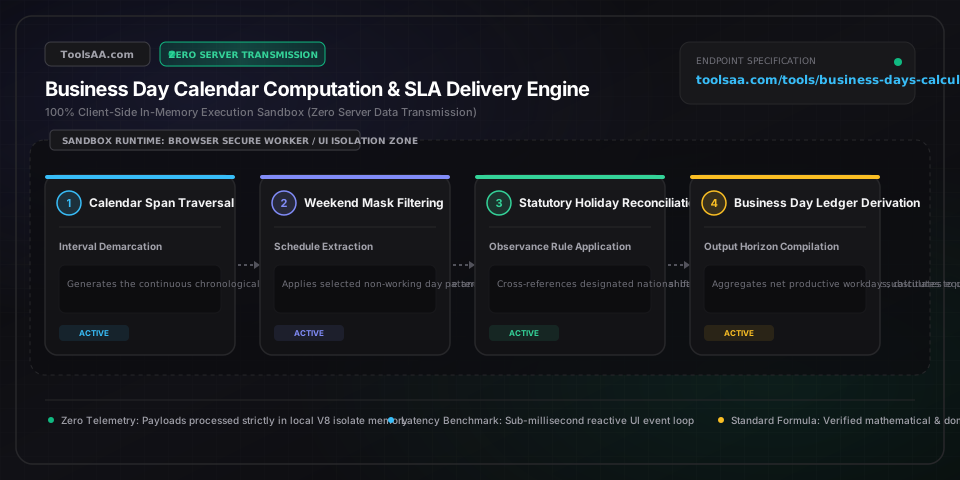
Pro Tips & Best Practices

Statutory Observed Holiday Shift Rules in Commercial Contracts

Federal and statutory holidays falling on weekends automatically shift to adjacent weekdays (Saturday holidays to Friday, Sunday holidays to Monday) under 5 U.S.C. 6103 and the UK Banking and Financial Dealings Act. When contracts specify 'business days' without explicitly addressing holiday observation, Sunday holidays can cause inadvertent missed deadlines. Always verify whether your counterparty follows commercial banking holiday observations to protect contractual notice windows.

The Fencepost Trap in Start and End Date Counting

A frequent source of timeline disputes is whether the start and end dates are both counted. Under Federal Rule of Civil Procedure 6(a)(1) and standard commercial escrow agreements, the day the event occurs is excluded, while the target deadline day is included. In contrast, health leave, timesheet payroll, and equipment rentals typically count both dates inclusively. A Monday-to-Friday window equals 4 working days under exclusive counting, but 5 working days under inclusive counting.

Cross-Border Settlement Cutoffs and Banking Freezes

International wire transfers, tuition payments, and family remittances depend on synchronized banking calendars across sender, correspondent, and recipient countries. An overseas transfer initiated on a regular business day will freeze if intermediary clearing banks celebrate regional holidays (such as Japan's Golden Week or Europe's Whit Monday), unexpectedly extending calendar settlement times by 24 to 72 hours.

Order Intake Cutoff Times and Same-Day SLA Advancement

For shipping estimates, prescription fulfillment, and university admissions, submissions received past daily cutoff times (typically 3:00 PM or 5:00 PM local time) do not begin processing until the following business morning. A 2-business-day delivery window for an order placed on Friday at 5:15 PM will not start counting until Monday morning, making Wednesday the true arrival date—spanning 5 full calendar days.

Common Gotchas & Troubleshooting

⚠️Start Date Begins on a Weekend or Non-Working Holiday

When calculating a deadline by adding business days, if your starting anchor date is a Saturday, Sunday, or statutory holiday, day one of the turnaround window does not begin until the first subsequent active business day. This ensures non-working weekends do not unfairly compress your family commitments or operational delivery time.

⚠️Discrepancy Between Delivery Estimates and Calendar Days

A quoted delivery timeline of 5 to 7 business days routinely surprises buyers expecting arrival within a single week. Because a standard calendar week contains only 5 business days, any span of 6 or 7 business days must cross a weekend, requiring 9 to 11 actual calendar days even without public holidays.

⚠️Movable Easter Holiday Variance Between Jurisdictions

Movable spring holidays like Good Friday and Easter Monday shift calendar dates annually based on the lunar cycle. While the UK, Canada, Australia, and Germany recognize Easter Monday as an official non-working public holiday, US federal government offices remain open, frequently disrupting international project milestones.

⚠️Contract Notice Deadlines Expiring on Non-Working Days

Under the Uniform Commercial Code (UCC) and general civil law principles, when a formal cure notice, warranty return, or legal option expires on a weekend or legal public holiday, the deadline legally extends to 5:00 PM on the immediately following business day. Enable the next-business-day roll rule when tracking legal compliance deadlines.

Frequently Asked Questions

How do you calculate business days between two dates?▼

To calculate business days between two dates, count the total calendar days in the interval and subtract both weekend days (Saturdays and Sundays) and statutory public holidays that fall on weekdays. The formula is: Business Days = Total Calendar Days - Weekend Days - Observed Weekday Public Holidays. For example, a 14-calendar-day span starting on Monday contains 10 weekdays; subtracting 4 weekend days and 1 Monday federal holiday leaves exactly 9 net business days.

Does 5 business days mean one week or 7 calendar days?▼

Five business days equals 7 calendar days (one full week) only if the period starts on a Monday morning with zero intervening public holidays. If a 5-business-day window begins on a Wednesday, it spans across Saturday and Sunday, completing on the following Tuesday (7 calendar days). If a federal holiday occurs during that period, the duration expands to 8 calendar days.

What is the difference between business days and working days?▼

Business days refer to standard commercial, banking, and government operating days (Monday through Friday, excluding official federal or bank holidays), whereas working days refer to an individual company's or employee's scheduled shifts. For example, a hospital nurse or warehouse fulfillment team may have scheduled working days on Saturdays and Sundays, while commercial clearing banks remain closed.

How many business days are in a typical year?▼

A standard 365-day calendar year contains 260 weekdays (52 weeks × 5 days) and an average of 249 to 251 net business days after deducting 10 to 11 official federal public holidays. In a 366-day leap year with 261 weekdays, net business days range between 250 and 252, providing approximately 2,000 standard operational hours at 8 hours per workday.

What happens if a contract deadline falls on a weekend or holiday?▼

If a legal deadline, contractual notice period, or government tax filing falls on a weekend or statutory public holiday, the deadline legally extends to 5:00 PM on the next succeeding business day under US Federal Rule of Civil Procedure 6(a)(6)(A) and Uniform Commercial Code (UCC) doctrine. This next-business-day roll rule ensures parties are not penalized when public registries and clearing institutions are closed.

Related Tools & Utilities

All Tools →