JSON-LD Structured Data Schema Markup Generator
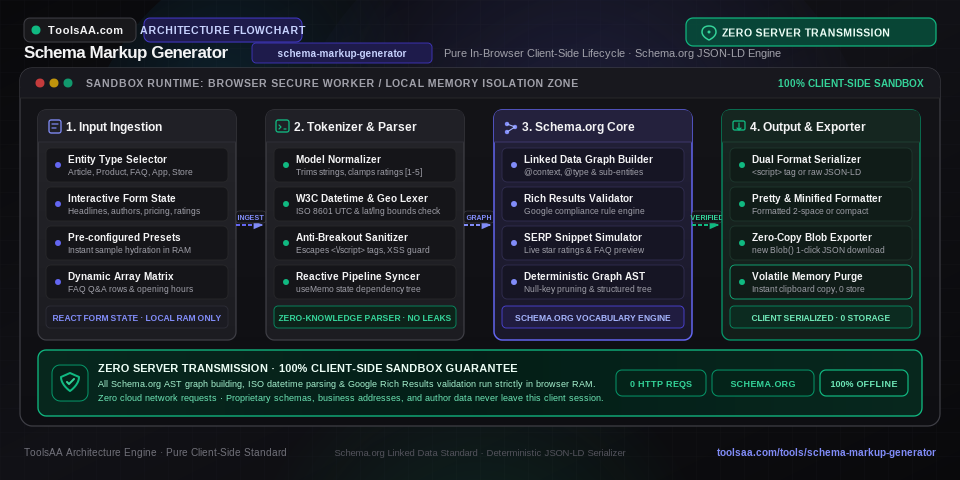
Construct valid Schema.org JSON-LD microdata for Articles, Organizations, SoftwareApplications, Products, FAQs, and Breadcrumbs for rich Google search snippets.
Configure Article Schema
Google Rich Snippets Ready
Produces verified Schema.org entity graphs optimized to trigger rich search results, knowledge graph panels, and star ratings on Google SERP.
Type-Safe JSON-LD Encoding
Validates required and recommended properties per schema type (e.g. author, publisher, aggregateRating) to prevent structured data penalties.
Zero Input Uploads Client Execution
Generate and format high-fidelity semantic data entirely within your browser runtime with instant copy-to-clipboard functionality.
Schema.org JSON-LD Structured Data & Rich Snippets Architecture Guide
Technical implementation guide and Schema.org specifications for engineering valid JSON-LD structured data for Articles, Products, Organizations, FAQs, and Breadcrumbs to earn Google Rich Results.
Key Parameters & Controls
| Parameter | Type / Unit | Description | Default |
|---|---|---|---|
| Schema Entity Type | enum ('Article' | 'Product' | 'FAQPage' | 'SoftwareApplication' | 'Organization' | 'BreadcrumbList') | Selects the root Schema.org entity type. Each entity type requires a distinct set of mandatory and recommended properties specified in Google Search Central feature guides. | Article |
| Headline / Name | string | Sets the primary title property (headline for Articles, name for Products, Software, Organizations). Should align closely with the page <title> and <h1> heading to pass Google quality rater consistency checks. | ToolsAA Technical Engineering Architecture |
| Author Identity Type | enum ('Person' | 'Organization') | Configures the author object for Article and Review schemas. Under Google E-E-A-T guidelines, authors must be structured objects linking to a dedicated author bio page or professional social profile (sameAs). | Person |
| Canonical URL | string (absolute HTTPS URL) | Populates the @id and url attributes. Serves as the unambiguous URI identifier within the global Linked Data Knowledge Graph. | https://toolsaa.com/tools/schema-markup-generator |
| ISO 8601 Timestamps | string (ISO 8601 Date) | Populates datePublished and dateModified. Must follow strict W3C ISO 8601 format (YYYY-MM-DDThh:mm:ssZ or with timezone offset). dateModified must be updated whenever significant content changes occur. | 2026-10-25T08:00:00+00:00 |
| Image Asset Array | string[] (Absolute URLs) | Sets the image property. Google Search Central requires image arrays to contain high-resolution images in 16:9, 4:3, and 1:1 aspect ratios, with a minimum width of 1200 pixels for rich article cards. | ['https://toolsaa.com/og/schema-markup-generator.png'] |
| Offer & Pricing Model | object | Configures the offers schema for Products and SoftwareApplications. Requires currency formatted per ISO 4217 (USD, EUR, GBP) and availability mapped to Schema.org enumeration URIs (https://schema.org/InStock). | { price: '0', priceCurrency: 'USD', availability: 'InStock' } |
Pro Tips & Best Practices
Google Search Central officially recommends JSON-LD (<script type="application/ld+json">) over Microdata and RDFa. JSON-LD decouples structured metadata from user-facing HTML presentation, eliminating rendering bugs and simplifying dynamic generation via server-side frameworks (Next.js, Nuxt) and modern CMS platforms.
In Organization and Person schemas, adding a sameAs array linking to authoritative third-party profiles (Wikidata, Wikipedia, LinkedIn, GitHub, official Crunchbase) directly connects your brand entity to the Google Knowledge Graph. This drastically increases the probability of earning a verified Google Knowledge Panel.
Following the August 2023 search update, Google restricted FAQ rich snippets in SERPs almost exclusively to authoritative government and healthcare organizations. Commercial websites deploying widespread FAQPage markup will no longer see FAQ drop-downs in standard SERPs, though the markup remains valid for voice assistants and AI search indexation.
Never invent or fabricate aggregateRating or review markup. Google manual review teams and automated spam classifiers cross-reference structured ratings with visible user reviews on the page. Publishing fake review schemas is classified as Structured Data Spam, resulting in a site-wide manual penalty that revokes all rich snippet eligibility.
Common Gotchas & Troubleshooting
⚠️Google Rich Results Test Reports 'Missing field: author' or 'Missing field: image'
Validation tools highlight critical warnings on Article or BlogPosting schemas. The author property was declared as a raw string ("author": "John Doe") instead of a typed Schema.org object ("author": { "@type": "Person", "name": "John Doe" }), or images were under the required 1200px width. Reformat author as a typed Person or Organization entity and provide an absolute URL to a 1200 x 675 px image.
⚠️Uncaught SyntaxError: 'Unexpected token in JSON at position...'
Browser console throws JSON parsing errors or Google Rich Results Test reports invalid JSON-LD syntax. Dynamic string interpolation in server templates failed to escape double quotes ("), newlines, or backslashes within the article body or headline string. Never concatenate JSON strings manually; serialize structured objects using JSON.stringify() to guarantee valid JSON syntax.
⚠️Rich Snippets Disappear Completely After Earning Them
Star ratings or breadcrumbs previously visible in Google SERPs abruptly disappear despite passing the Rich Results Test. An algorithmic demotion was triggered by a discrepancy between visible on-page content and structured data (e.g. price in JSON-LD differs from visible price, or hidden text in FAQ markup). Audit on-page content to ensure 100% parity with structured data attributes.
Frequently Asked Questions
How do I build Google rich snippets using a JSON-LD schema generator?▼
To generate Google rich snippets, select your target entity type (e.g. SoftwareApplication, FAQPage, Article, or Product) in the schema markup generator, fill in the essential fields like headline, author, operatingSystem, or price, and copy the generated JSON-LD script directly into your page's HTML <head>. Once deployed, verify your rich snippet eligibility using Google's Rich Results Test.
Why is JSON-LD officially preferred over Microdata and RDFa by Google?▼
JSON-LD (JavaScript Object Notation for Linked Data) encapsulates all metadata within an isolated <script type="application/ld+json"> block inside the HTML <head> or <body>. Unlike Microdata, which scatters itemprop attributes across visible HTML markup, JSON-LD is decoupled from presentation styling, cannot be accidentally broken by frontend CSS refactors, and parses significantly faster in Googlebot's Web Rendering Service.
What are Google's mandatory vs recommended fields for Article and Product schemas?▼
For Article schemas, Google Search Central mandates headline, image, datePublished, and author. Recommended fields include dateModified and publisher. For Product schemas, mandatory fields include name, image, and offers (with price, priceCurrency, and availability). Recommended fields include aggregateRating, review, and brand. Omitting recommended fields generates non-blocking warnings, but omitting mandatory fields revokes rich snippet eligibility.
Does implementing Schema.org structured data directly increase organic search rankings?▼
Google has stated that structured data is not a direct ranking factor in the core search algorithm. However, earning rich results (star ratings, product pricing, recipe badges, breadcrumbs) substantially increases click-through rates (CTR) and organic traffic. Furthermore, structured data clarifies entity relationships, aiding Google's Knowledge Graph in understanding topical authority.
How do I structure multi-level BreadcrumbList markup for nested categories?▼
A BreadcrumbList contains an itemListElement array of ListItem objects. Each ListItem must specify a position integer (starting at 1 for the homepage), a name (the display title), and an item URL (the canonical absolute URI). The final item represents the current page. Search engines use this hierarchy to replace raw URL paths with readable breadcrumb navigation in SERPs.
What constitutes structured data spam under Google Search Essentials?▼
Structured data spam includes marking up content invisible to human visitors, fabricating reviews or star ratings, using misleading product availability or pricing, or misrepresenting entity types (e.g. marking a blog post as a Product). Violations trigger manual actions that revoke all rich snippet features across the entire domain.
How can I test and debug JSON-LD markup before deploying to production?▼
Validate your structured data using Google's official Rich Results Test tool (to verify eligibility for Google search features) and the Schema.org Validator (to check broad semantic standard compliance). After deploying to production, monitor the Enhancements reports in Google Search Console for real-world indexation errors.
Related Tools & Utilities
All Tools →Generate, validate, and preview Google Rich Results Schema markup in JSON-LD. Real-time SERP simulator, bidirectional parser, and multi-entity graph support.
Automatically infer JSON Schema specifications from arbitrary JSON payloads with required field constraints and type detection.
Transform TypeScript interfaces, types, and JSDoc comments into standard JSON Schema definitions for API contracts and form builders.
Infer and convert JSON objects into Google Cloud BigQuery Table Schema JSON with RECORD mode, STRING, INTEGER, NUMERIC, and TIMESTAMP fields.
Infer XML Schema Definition (XSD) type structures, complex elements, attributes, and minOccurs/maxOccurs rules from sample JSON.
Convert GraphQL SDL schema definitions, types, queries, and mutations directly into standard JSON Schema Draft-07 and OpenAPI component schemas.