Apache .htaccess to Nginx Rewrite Converter
AST Rewrite ConverterConvert legacy Apache mod_rewrite directives, 301 redirects, and header settings into idiomatic Nginx server block syntax.
server {
    listen 80;
    listen [::]:80;
    server_name example.com www.example.com;
    root /var/www/html;
    index index.php index.html index.htm;

    # WordPress Core Permalinks
    # Pass-through for index.php (handled natively by try_files / fastcgi)

    # Front Controller / Pretty Permalinks
    location / {
        try_files $uri $uri/ /index.php?$query_string;
    }

    # Prevent directory browsing
    autoindex off;

    # Protect sensitive files
    location ~* ^(wp-config\.php|xmlrpc\.php|\.env) {
        deny all;
    }

    # --- Security Hardening Baseline ---
    # Deny hidden files (e.g. .git, .env, .htaccess)
    location ~ /\. {
        deny all;
        access_log off;
        log_not_found off;
    }

    # Disable direct access to sensitive file types
    location ~* \.(log|sql|bak|sh|inc|config|env)$ {
        deny all;
    }

    # Suppress access and not-found logging for common root assets
    location = /favicon.ico {
        log_not_found off;
        access_log off;
    }
    location = /robots.txt {
        log_not_found off;
        access_log off;
        allow all;
    }

    # --- PHP-FPM FastCGI Handler ---
    location ~ \.php$ {
        try_files $uri =404;
        fastcgi_split_path_info ^(.+\.php)(/.+)$;
        fastcgi_pass unix:/run/php/php-fpm.sock;
        fastcgi_index index.php;
        include fastcgi_params;
        fastcgi_param SCRIPT_FILENAME $document_root$fastcgi_script_name;
        fastcgi_param PATH_INFO $fastcgi_path_info;
    }
}Rule AST Breakdown
Inspecting every matched directive and its corresponding Nginx translation rationale.
RewriteEngine On# (Native in Nginx)RewriteBase /# RewriteBase: /RewriteCond !-f & !-d -> RewriteRule . /index.phptry_files $uri $uri/ /index.php?$query_string;Options -Indexesautoindex off;<FilesMatch ^(wp-config\.php|xmlrpc\.php|\.env)>location ~* ^(wp-config\.php|xmlrpc\.php|\.env) { ... }Directives Translation Reference
Quick cross-comparison between Apache directives and idiomatic Nginx syntax equivalents.
Standard URL rewrite passing capture groups to query parameters.
Permanent 301 SEO redirection for moved page routes.
Pattern-based 301 redirect mapping path segments.
Temporary 302 redirect for marketing tests or maintenance.
Front Controller: check file and directory before routing to PHP handler.
Force HTTPS redirection for all incoming unencrypted requests.
Canonical domain redirect non-www to www host.
Block all incoming connections to a directory or location.
Deny access to hidden dotfiles (.git, .env, .htaccess).
Immediately reject request with HTTP 403 Forbidden.
Security header to prevent clickjacking in IFrames.
CORS header to allow cross-origin API access.
Browser caching directive for static image assets.
Default directory index files searched in specified priority order.
Disable directory listing index when no default file is found.
Custom HTTP error status page handler.
Why Nginx Does Not Support .htaccess Directly
In Apache, the web server looks for and executes .htaccess files in every directory along the document path on every single HTTP request. This causes excessive filesystem stat system calls, dramatically degrading I/O performance under high concurrency.
In contrast, Nginx compiles all server configuration directly into memory upon startup or reload. By eliminating runtime directory traversals, Nginx achieves sub-millisecond response latency and handles 10x-50x more concurrent connections per server.
In Nginx, using if inside a location block often leads to unexpected behavior or memory leaks due to how directives are evaluated.
Always prefer try_files over if (!-e $request_filename) for front-controllers (such as WordPress, Laravel, and Vue/React SPAs).
Before applying converted directives to a live production server, always verify the configuration syntax without stopping traffic:
Zero-Knowledge Local Execution
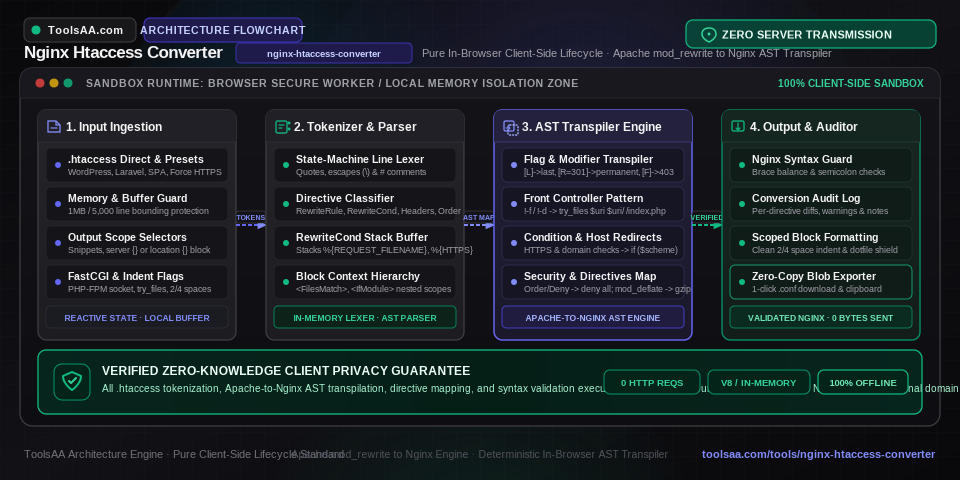
All data processing, parsing, and compilation execute strictly inside your local browser memory. Zero external server uploads.
Instant Client-Side Engine
Instant real-time reactive computation delivers immediate feedback on every keystroke with zero network latency.
Production Standards & Compliance
Strictly validates syntax, edge cases, and formatting rules for dependable production output.
Nginx Htaccess Converter Developer Reference
Developer utility for converting Apache .htaccess directives into high-performance Nginx server blocks and location rules.
Key Parameters & Controls
| Parameter | Type / Unit | Description | Default |
|---|---|---|---|
| format | "snippets" | "server_block" | "location_block" | Specifies configuration output wrapping: standalone directive snippets, an isolated location block, or a production-ready virtual host server block. | "server_block" |
| useTryFiles | boolean | Converts Apache RewriteCond/RewriteRule front controller patterns into native Nginx try_files directives to bypass regex engine overhead. | true |
| addSecurityBaseline | boolean | Injects security directives that deny access to hidden dotfiles (.env, .git, .htaccess) and turns off automatic directory listing via 'autoindex off'. | true |
| addPhpFastCgi | boolean | Appends a preconfigured location ~ \.php$ block pointing to a FastCGI daemon socket (/var/run/php/php-fpm.sock) with standard fastcgi_params. | false |
| indentSize | 2 | 4 | Sets the spacing indentation width (2 or 4 spaces) applied to nested configuration directives within the generated Nginx blocks. | 2 |
| serverName | string | Configures the virtual host 'server_name' directive identifying primary domain names, wildcards, or IP addresses. | "localhost" |
| documentRoot | string | Defines the absolute filesystem path for the 'root' directive where application public assets and entry scripts reside. | "/var/www/html" |
Pro Tips & Best Practices
Apache RewriteCond !-f and !-d combined with RewriteRule . /index.php should always be replaced by Nginx 'try_files $uri $uri/ /index.php?$args;'. Nginx evaluates try_files in the core file-lookup phase, eliminating regex engine overhead and internal redirect cycles.
When translating Apache 'DirectorySlash On' or trailing slash rewrites, avoid redundant Nginx rewrites if 'try_files $uri $uri/' is active. Nginx's ngx_http_index_module issues an automatic 301 redirect if a request matches a physical directory missing a trailing slash.
Convert Apache '<FilesMatch "^\.">' rules into a top-level regex location block: 'location ~ /\. { deny all; access_log off; log_not_found off; }'. Placing this early in server blocks protects hidden VCS metadata (.git, .env) before specific prefix matches execute.
Always test generated server blocks prior to deployment using 'nginx -t -c /path/to/test.conf'. This catches unclosed braces, conflicting listen ports, or duplicate location paths that static rule converters cannot detect without reading the global configuration context.
Common Gotchas & Troubleshooting
⚠️Rewrite cycle or 500 Internal Server Error when serving index.php
Ensure front-controller fallback uses 'try_files $uri $uri/ /index.php?$query_string;' rather than a recursive 'rewrite ^(.*)$ /index.php break;' inside a catch-all location block, and verify that the destination PHP script exists at the configured document root.
⚠️Nginx directive 'fastcgi_pass' is not allowed here or duplicate location ~ \.php$ error
FastCGI pass directives must reside strictly inside a dedicated location block, never in the top-level server context. If your existing master configuration already defines a PHP upstream handler, set 'addPhpFastCgi' to false to prevent duplicate location conflicts during reload.
⚠️Client-side input lag or browser freeze on massive multi-megabyte .htaccess files
Browsers experience memory pressure when parsing thousands of regex rules simultaneously. For massive legacy redirect lists, isolate bulk 301 tables into an Nginx 'map $request_uri $redirect_target' block in the http context using a stream-processing command-line utility.
Frequently Asked Questions
Why doesn't Nginx support per-directory .htaccess files natively?▼
Apache searches every directory in the document root hierarchy on every incoming HTTP request for .htaccess files, resulting in substantial filesystem stat calls and disk I/O penalties. Nginx intentionally architecture-locks all routing, access control, and rewrite logic into static master configuration files compiled in memory at startup, boosting concurrency and request throughput by orders of magnitude.
How are Apache RewriteCond HTTP variables mapped to Nginx embedded variables?▼
Standard Apache server variables map directly to Nginx core HTTP variables: '%{HTTP_HOST}' maps to '$http_host' or '$host', '%{REQUEST_URI}' maps to '$request_uri', '%{QUERY_STRING}' maps to '$args' (or '$query_string'), '%{REMOTE_ADDR}' maps to '$remote_addr', and '%{HTTPS}' (which yields 'on' or 'off') maps to Nginx's '$scheme' ('http' or 'https') or can be evaluated via '$https' flags.
Does converting Apache [L], [R=301], and [NC] flags maintain identical HTTP redirect behavior?▼
Yes, but with syntactic differences: '[L]' (Last) maps to the 'last' flag in server/location rewrites or 'break' inside location blocks; '[R=301]' maps to 'permanent' (HTTP 301 Moved Permanently) or an explicit 'return 301 target;'; '[R=302]' maps to 'redirect' (HTTP 302 Found); and '[NC]' (No Case) maps to case-insensitive regular expressions prefixed with '~*' instead of '~' in Nginx location or rewrite match statements.
Is converted configuration data processed on a remote server or retained in browser memory?▼
All parsing, regex transformation, and syntax generation execute 100% locally in the browser runtime via client-side JavaScript. No .htaccess rules, domain names, internal IP addresses, or proprietary directory structures are ever transmitted over the network or persisted to any remote server or third-party storage.
How should large lists of Apache Redirect 301 rules be optimized in Nginx?▼
Rather than converting hundreds of individual 'RewriteRule' or 'Redirect 301' directives into repetitive 'rewrite' or 'return' statements—which bloat the location lookup table—you should extract source and target paths into an Nginx 'map $request_uri $new_uri { ... }' block in the 'http' context. This uses hash-table lookups with O(1) time complexity, reducing CPU cycles significantly.
Related Tools & Utilities
All Tools →Build hardened Nginx configs for reverse proxies, modern SSL/TLS, HTTP/2 & HTTP/3, WebSockets, rate limits, and compression.
Test and simulate Nginx location block matching order (= exact, ^~ preferential prefix, ~ regex, ~* case-insensitive, / prefix) with request URIs.
Generate production-ready Nginx upstream blocks with round-robin, least_conn, ip_hash, keepalive, and health check parameters.
Analyze raw Nginx and Apache access logs locally with status code distributions, top requested URLs, unique client IPs, bandwidth metrics, and custom regex pattern matching.
Generate Kubernetes Ingress v1 specs with host rules, path routing, TLS cert-manager secrets, rewrite annotations, and backend services.
Convert JSON objects into standard Apache Avro schema definitions with record types, primitive fields, null union types, and doc annotations.