JSON to TypeScript Interface & Type Generator
Convert JSON payloads into clean, strongly typed TypeScript interfaces or type aliases with automatic nested object inference and union detection.
export interface Customer {
  /**
   * Example: 1042
   */
  id: number;
  /**
   * Example: "Sarah Connor"
   */
  name: string;
  /**
   * Example: "sarah.connor@cyberdyne.org"
   */
  email: string;
  /**
   * Example: true
   */
  isVip: boolean;
  /**
   * Example: 450
   */
  loyaltyPoints: number;
}

export interface Coordinates {
  /**
   * Example: 34.0522
   */
  lat: number;
  /**
   * Example: -118.2437
   */
  lng: number;
}

export interface ShippingAddress {
  /**
   * Example: "1204 Cyber Way"
   */
  street: string;
  /**
   * Example: "Los Angeles"
   */
  city: string;
  /**
   * Example: "CA"
   */
  state: string;
  /**
   * Example: "90210"
   */
  postalCode: string;
  /**
   * Example: "USA"
   */
  country: string;
  /**
   * Example: Object
   */
  coordinates: Coordinates;
}

export interface Item {
  /**
   * Example: "PRD-M65"
   */
  sku: string;
  /**
   * Example: "Tactical Field Jacket"
   */
  title: string;
  /**
   * Example: 1
   */
  quantity: number;
  /**
   * Example: 149.99
   */
  unitPrice: number;
  /**
   * Example: 0.1
   */
  discount: number | null;
  /**
   * Example: Array of 3 items
   */
  tags: string[];
}

export interface Payment {
  /**
   * Example: "credit_card"
   */
  method: string;
  /**
   * Example: "txn_9921_auth"
   */
  transactionId: string;
  /**
   * Example: true
   */
  paid: boolean;
}

export interface RootObject {
  /**
   * Example: "ord_98412849"
   */
  orderId: string;
  /**
   * Example: "2026-10-11T09:30:00Z"
   */
  createdAt: string;
  /**
   * Example: "shipped"
   */
  status: string;
  /**
   * Example: Object
   */
  customer: Customer;
  /**
   * Example: Object
   */
  shippingAddress: ShippingAddress;
  /**
   * Example: Array of 2 items
   */
  items: Item[];
  /**
   * Example: 308.99
   */
  subtotal: number;
  /**
   * Example: 27.81
   */
  tax: number;
  /**
   * Example: 336.8
   */
  totalAmount: number;
  /**
   * Example: Object
   */
  payment: Payment;
}Zero-Knowledge Local Execution
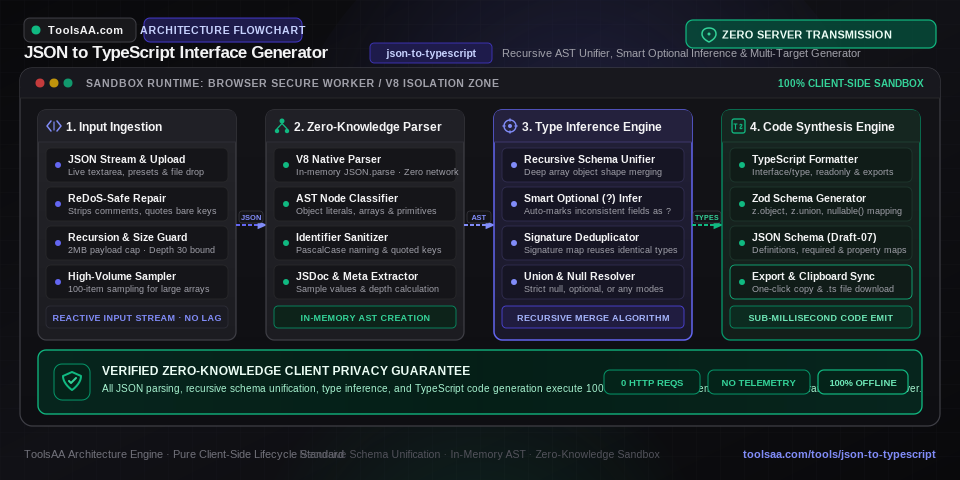
All data processing, parsing, and compilation execute strictly inside your local browser memory. Zero external server uploads.
Instant Client-Side Engine
Instant real-time reactive computation delivers immediate feedback on every keystroke with zero network latency.
Production Standards & Compliance
Strictly validates syntax, edge cases, and formatting rules for dependable production output.
JSON to TypeScript Interface & Type Alias Generator Technical Manual
Developer reference manual and AST specification for compiling JSON schemas into production TypeScript interfaces, type aliases, discriminated unions, and Zod runtime validators.
Key Parameters & Controls
| Parameter | Type / Unit | Description | Default |
|---|---|---|---|
| Root Interface Name | string | Sets the identifier for the top-level TypeScript interface or type alias. Automatically sanitized into PascalCase to conform with TypeScript naming conventions and language grammar rules. | RootObject |
| Declaration Style | enum ('interface' | 'type') | Chooses between TypeScript interface declarations and type alias definitions. Interfaces permit declaration merging and extension via extends, whereas type aliases support union types, intersections, tuples, and primitives. | interface |
| Optional Fields Mode | enum ('smart' | 'all-required' | 'all-optional') | In 'smart' mode, properties missing across some objects in an array or properties containing null/undefined are automatically marked with the optional modifier (?). 'all-required' enforces strict non-null keys, while 'all-optional' marks every field as optional. | smart |
| Null Value Handling | enum ('strict-null' | 'optional' | 'any') | Dictates typing when encountering null in JSON. 'strict-null' emits T | null (essential for strictNullChecks: true in tsconfig.json), 'optional' emits T?, and 'any' emits any as a loose fallback. | strict-null |
| Array Typing Format | enum ('brackets' | 'generic') | Governs syntax for array collections. 'brackets' emits shorthand syntax (e.g., string[], User[]), while 'generic' generates Array<string> or Array<User>. | brackets |
| Immutability Modifier | boolean | Prepends the readonly keyword to all generated interface properties, guaranteeing runtime state immutability for Redux reducers, React props, and functional programming paradigms. | false |
| Export Modifier | boolean | Prepends the export keyword before each interface and type declaration, making the output immediately suitable for modular TypeScript files and shared type libraries. | true |
Pro Tips & Best Practices
TypeScript interface constructs support declaration merging, meaning multiple interface declarations with the same name within the same scope will merge their properties. This makes interface ideal for public library APIs and extensible configurations. Conversely, type aliases cannot be re-opened for merging, but they natively support union types (A | B), intersections (A & B), and mapped types, making them preferable for state machines and discriminated payloads.
In real-world REST and GraphQL APIs, an array often contains polymorphic objects (e.g. [{ type: 'card', balance: 100 }, { type: 'crypto', address: '0x...' }]). A naive converter generates a single mangled interface with all optional keys. Advanced inference inspects discriminant properties (type, kind) to produce a clean discriminated union type PaymentMethod = CardPayment | CryptoPayment;.
JSON allows arbitrary strings as keys, such as hyphenated headers ("Content-Type"), numerical prefixes ("1st_choice"), or spaces ("full name"). TypeScript syntax forbids these characters in unquoted identifiers. The generator automatically wraps illegal identifier names in quotes (e.g. 'content-type': string;) or index signatures to prevent syntax compiler errors.
Static TypeScript types exist purely at compile-time and are completely erased during JavaScript transpilation. To validate incoming untrusted network payloads at runtime, pair generated TypeScript interfaces with runtime validation schemas like Zod (z.object({...})) to guarantee type safety at boundary layers.
Common Gotchas & Troubleshooting
⚠️Syntax Error: 'Identifier or string literal expected'
When TypeScript compiler fails on properties named with hyphens, slashes, or reserved keywords (e.g. switch, class, default), unescaped JavaScript reserved words and punctuation violate identifier grammar rules. Ensure property identifiers with special characters are wrapped in string quotes ("content-type": string; or "default": string;).
⚠️Overly Permissive 'any[]' Generated for Empty Arrays
An array field in the sample JSON is empty ("items": []), resulting in items: any[]; which degrades strict type safety. The AST inference engine cannot divine the type of items in an empty array without runtime data. Populate sample items in the input JSON array (e.g. "items": [{ "id": 1 }]) or manually refine any[] to unknown[] or the anticipated sub-interface.
⚠️Collision and Shadowing of Sub-Interface Names
Two distinct nested objects have the property name address (e.g., user.address and company.address), leading to duplicate interface Address declarations with clashing properties. Naive PascalCase naming based strictly on the immediate property name creates namespace collisions. Suffix sub-interfaces with their parent context (e.g. UserAddress and CompanyAddress) to maintain unique type boundaries.
Frequently Asked Questions
What are the structural differences between TypeScript 'interface' and 'type'?▼
An interface defines a named object type shape that can be extended via extends and re-opened for declaration merging across declaration files. A type alias can name any type including primitives, unions (A | B), intersections (A & B), tuples, and mapped types. The TypeScript compiler team generally recommends interface for object shapes in libraries due to slightly faster type-checking performance and clearer error diagnostics.
How does the generator infer types for heterogeneous arrays containing mixed objects?▼
When an array contains objects with differing schemas, the inference algorithm analyzes the union of all observed properties. If two objects share a property with different types (e.g. id: number vs id: string), the property is typed as a union (string | number). Properties present in only a subset of array items are automatically marked optional (?) under smart mode.
Why is 'strictNullChecks' important and how does this tool format nullable properties?▼
Under TypeScript's strictNullChecks compiler setting, null and undefined are not assignable to concrete types like string or number. If an API returns null, typing it simply as string triggers runtime TypeError crashes when attempting to invoke methods like .toUpperCase(). The generator's 'strict-null' mode emits string | null, forcing developers to handle null checks before accessing properties.
Can I export runtime validation schemas like Zod alongside TypeScript types?▼
Yes. Because TypeScript types are purely static and vanish at compile-time, network boundary validation requires runtime schemas. The tool supports generating equivalent Zod schemas (z.object({...})), from which TypeScript types can be inferred automatically using z.infer<typeof Schema>, eliminating duplicate maintenance of types and runtime validators.
How are deeply nested JSON objects split into modular sub-interfaces?▼
The generator executes a recursive Abstract Syntax Tree (AST) traversal. When encountering a nested object, it extracts the child shape into an independent top-level interface, assigning a PascalCase identifier derived from the parent property name. It then references that identifier in the parent interface, preventing unwieldy deeply nested inline definitions.
Is large API payload processing executed safely in local browser memory?▼
Yes. The entire Abstract Syntax Tree generation, property tokenization, type inference, and code formatting pipeline run 100% locally in your client-side browser engine. Zero API payloads, internal JSON structures, or proprietary schemas are sent over the network to external servers.
Related Tools & Utilities
All Tools →Transform TypeScript interfaces, types, and JSDoc comments into standard JSON Schema definitions for API contracts and form builders.
Format, beautify, validate, and repair dirty JSON online instantly. Clean syntax errors, fix unquoted keys, minify, and inspect tree nodes with zero server uploads.
Convert JSON payloads into strongly typed C# records, classes, and structs supporting System.Text.Json [JsonPropertyName] and Newtonsoft.Json attributes.
Automatically infer JSON Schema specifications from arbitrary JSON payloads with required field constraints and type detection.
Parse Protocol Buffers (proto2 & proto3) message definitions, enums, and nested fields into clean TypeScript interfaces.
Convert OpenAPI 3.0 and Swagger 2.0 schemas (JSON or YAML) into clean, type-safe TypeScript interfaces and types instantly in your browser.