TLS 1.2 / 1.3 Handshake & Cipher Suite Inspector
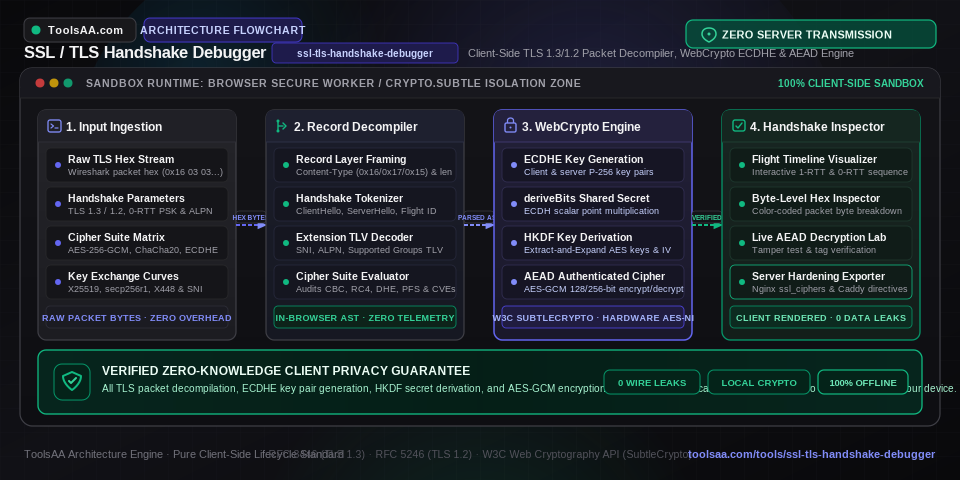
Simulate and debug modern TLS cryptographic handshakes, ECDHE key exchanges, ALPN protocol negotiation, and AES-GCM / ChaCha20 cipher suite security.
Flight Overview1 RTT
In TLS 1.3, key exchange occurs concurrently with the initial hello message. The server responds with encrypted extensions and certificate immediately.
Both client and server derive client_application_traffic_secret_0 and server_application_traffic_secret_0.
Version:TLS 1.3 (advertised via supported_versions extension 0x0304)Client Random:32 cryptographically secure random bytesSNI (Host):api.toolsaa.comCipher Suites:TLS_AES_256_GCM_SHA384Key Share Extension:Group: X25519 (Ephemeral Public Key)ALPN Extension:h2, http/1.1WebCrypto ECDH Key Exchange & AES-GCM Lab
Executed 100% locally in your browser using the W3C Web Cryptography API (`crypto.subtle`). Zero external server requests.
NIST P-256 Curve Point (65 bytes uncompressed)
NIST P-256 Curve Point (65 bytes uncompressed)
ECDH(Q_server, d_client) = ECDH(Q_client, d_server)
AES-GCM Authenticated Encryption & Anti-Tamper Verification
RFC 5116 AEAD StandardGold standard 256-bit Galois/Counter Mode AEAD cipher with SHA-384 PRF. Cloudflare & Google primary choice.
ssl_protocols TLSv1.3;
# In TLS 1.3, ciphers are negotiated automatically by default
tls {
    protocols tls1.3
}| OpenSSL / IANA Name | Protocol | Key Exchange (KEX) | Bulk Cipher | Cipher Mode | PFS | Grade | Actions |
|---|---|---|---|---|---|---|---|
TLS_AES_256_GCM_SHA384 TLS_AES_256_GCM_SHA384 | TLS 1.3 | None (TLS 1.3 Fixed) | AES-256-GCM | AEAD | Yes | A+ | | |
TLS_AES_128_GCM_SHA256 TLS_AES_128_GCM_SHA256 | TLS 1.3 | None (TLS 1.3 Fixed) | AES-128-GCM | AEAD | Yes | A+ | | |
TLS_CHACHA20_POLY1305_SHA256 TLS_CHACHA20_POLY1305_SHA256 | TLS 1.3 | None (TLS 1.3 Fixed) | ChaCha20-Poly1305 | AEAD | Yes | A+ | | |
TLS_AES_128_CCM_SHA256 TLS_AES_128_CCM_SHA256 | TLS 1.3 | None (TLS 1.3 Fixed) | AES-128-CCM | AEAD | Yes | A | | |
ECDHE-ECDSA-AES256-GCM-SHA384 TLS_ECDHE_ECDSA_WITH_AES_256_GCM_SHA384 | TLS 1.2 | ECDHE | AES-256-GCM | AEAD | Yes | A+ | | |
ECDHE-RSA-AES256-GCM-SHA384 TLS_ECDHE_RSA_WITH_AES_256_GCM_SHA384 | TLS 1.2 | ECDHE | AES-256-GCM | AEAD | Yes | A | | |
ECDHE-ECDSA-AES128-GCM-SHA256 TLS_ECDHE_ECDSA_WITH_AES_128_GCM_SHA256 | TLS 1.2 | ECDHE | AES-128-GCM | AEAD | Yes | A+ | | |
ECDHE-RSA-AES128-GCM-SHA256 TLS_ECDHE_RSA_WITH_AES_128_GCM_SHA256 | TLS 1.2 | ECDHE | AES-128-GCM | AEAD | Yes | A | | |
ECDHE-RSA-CHACHA20-POLY1305 TLS_ECDHE_RSA_WITH_CHACHA20_POLY1305_SHA256 | TLS 1.2 | ECDHE | ChaCha20-Poly1305 | AEAD | Yes | A | | |
ECDHE-ECDSA-CHACHA20-POLY1305 TLS_ECDHE_ECDSA_WITH_CHACHA20_POLY1305_SHA256 | TLS 1.2 | ECDHE | ChaCha20-Poly1305 | AEAD | Yes | A+ | | |
DHE-RSA-AES256-GCM-SHA384 TLS_DHE_RSA_WITH_AES_256_GCM_SHA384 | TLS 1.2 | DHE | AES-256-GCM | AEAD | Yes | A | | |
DHE-RSA-AES128-GCM-SHA256 TLS_DHE_RSA_WITH_AES_128_GCM_SHA256 | TLS 1.2 | DHE | AES-128-GCM | AEAD | Yes | A | | |
ECDHE-RSA-AES128-SHA256 TLS_ECDHE_RSA_WITH_AES_128_CBC_SHA256 | TLS 1.2 | ECDHE | AES-128-CBC | CBC | Yes | B | | |
ECDHE-RSA-AES128-SHA TLS_ECDHE_RSA_WITH_AES_128_CBC_SHA | TLS 1.2 | ECDHE | AES-128-CBC | CBC | Yes | B | | |
ECDHE-ECDSA-AES256-SHA384 TLS_ECDHE_ECDSA_WITH_AES_256_CBC_SHA384 | TLS 1.2 | ECDHE | AES-256-CBC | CBC | Yes | B | | |
AES128-GCM-SHA256 TLS_RSA_WITH_AES_128_GCM_SHA256 | TLS 1.2 | RSA | AES-128-GCM | AEAD | No | F | | |
AES128-SHA TLS_RSA_WITH_AES_128_CBC_SHA | TLS 1.2 | RSA | AES-128-CBC | CBC | No | F | | |
AES256-SHA256 TLS_RSA_WITH_AES_256_CBC_SHA256 | TLS 1.2 | RSA | AES-256-CBC | CBC | No | F | | |
DES-CBC3-SHA TLS_RSA_WITH_3DES_EDE_CBC_SHA | TLS 1.0 | RSA | 3DES-EDE-CBC | CBC | No | F | | |
RC4-SHA TLS_RSA_WITH_RC4_128_SHA | SSL 3.0 | RSA | RC4-128 | Stream | No | F | | |
TLS Record & Handshake Packet Byte Parser
Paste raw hex bytes from Wireshark or tcpdump to deconstruct the TLS record header and handshake body.
Handshake (0x16)
TLS 1.0 (0x0301 - Wire Compatibility)
248 octets (Partial capture: 167 of 248 bytes present)
ClientHello (0x01)
244 octets in handshake payload
TLS 1.2 / TLS 1.3 Record (0x0303)
32 cryptographically secure random bytes protecting against replay attacks
0 bytes (Used in TLS 1.2 resumption / TLS 1.3 middlebox compat)
Client advertises 0 supported cryptographic cipher suites
Includes SNI, ALPN, Supported Groups, and TLS 1.3 Key Share extensions
| Feature / Vector | TLS 1.2 (RFC 5246) | TLS 1.3 (RFC 8446) |
|---|---|---|
| Full Handshake Latency | 2-RTT (2 complete round trips) | 1-RTT (Halved handshake time) |
| Session Resumption | 1-RTT (Session Tickets) | 0-RTT (Early Data transmission) |
| Forward Secrecy (PFS) | Optional (Static RSA allowed) | MANDATORY (Static RSA purged) |
| Certificate Encryption | Plaintext (ISP / Sniffer visible) | 100% Encrypted on wire |
| Obsolete Ciphers | Allowed CBC, 3DES, RC4, MD5, SHA-1 | Purged! Only 5 secure AEAD ciphers |
TLS 1.3 1-RTT & 0-RTT Sequence Simulation
Models modern RFC 8446 streamlined single-round-trip handshakes, encrypted server certificates, and early data resumption mechanics.
Elliptic Curve Key Exchange (ECDHE)
Analyzes ephemeral X25519 and secp256r1 Diffie-Hellman exchanges ensuring complete forward secrecy even if private keys are compromised later.
AEAD Modern Cryptographic Integrity
Validates Authenticated Encryption with Associated Data (AES-128-GCM, AES-256-GCM, ChaCha20-Poly1305) eliminating CBC padding oracle attacks.
TLS 1.2 / 1.3 Handshake & Cipher Suite Inspector — Reference Guide
Simulate and debug modern TLS cryptographic handshakes, ECDHE key exchanges, ALPN protocol negotiation, and AES-GCM / ChaCha20 cipher suite security.
Key Parameters & Controls
| Parameter | Type / Unit | Description | Default |
|---|---|---|---|
| TLS Protocol Version | enum | Target protocol version (TLS 1.3 RFC 8446 or TLS 1.2 RFC 5246). | TLS 1.3 |
| Key Exchange Group | enum | Elliptic curve Diffie-Hellman group (X25519, secp256r1, secp384r1). | X25519 |
| Cipher Suite | enum | Authenticated symmetric cipher suite (AES_128_GCM, AES_256_GCM, CHACHA20_POLY1305). | TLS_AES_128_GCM_SHA256 |
| ALPN Application Protocol | enum | Application-Layer Protocol Negotiation extension string (h2, http/1.1, h3). | h2 |
Pro Tips & Best Practices
TLS 1.3 reduces connection latency by cutting the handshake from two round trips (2-RTT) down to one (1-RTT), encrypting certificates immediately.
CBC mode ciphers in TLS 1.2 are vulnerable to Lucky Thirteen padding oracle attacks. Enforce AEAD ciphers (GCM or Poly1305).
Use ephemeral Diffie-Hellman (ECDHE) keys so that compromised server private keys cannot decrypt previously captured traffic.
Common Gotchas & Troubleshooting
⚠️Handshake failure with 'handshake_failure (40)' alert
The client and server have no overlapping supported TLS versions, cipher suites, or elliptic curve groups in common.
⚠️ALPN negotiation falls back to http/1.1 instead of h2
Ensure your HTTP/2 web server explicitly advertises 'h2' in the ALPN extension and uses modern TLS 1.2+ ciphers.
Frequently Asked Questions
What is the key difference between TLS 1.2 and TLS 1.3 handshakes?▼
TLS 1.3 removes obsolete insecure algorithms (RSA key exchange, CBC ciphers, SHA-1), mandates forward secrecy, and completes in 1-RTT instead of 2-RTT.
What is Perfect Forward Secrecy (PFS)?▼
PFS ensures that session keys are generated ephemerally via ECDHE and discarded immediately after use, preventing retrospective decryption.
What is the function of the ALPN extension?▼
Application-Layer Protocol Negotiation allows client and server to agree on higher-level protocols (such as HTTP/2 or HTTP/3) during the TLS handshake.
Why is RSA key exchange disabled in TLS 1.3?▼
Static RSA key exchange does not provide forward secrecy and is vulnerable to Bleichenbacher padding oracle attacks.
Related Tools & Utilities
All Tools →Parse and inspect PEM-encoded SSL/TLS certificates locally, displaying Subject Alternative Names (SAN), issuer authority, SHA-256 fingerprints, and expiration validity dates.
Decode, verify, and inspect JWT headers, payloads, and claims with local secret or public key without sending data to servers.
Generate RFC 8461 Mail Transfer Agent Strict Transport Security (MTA-STS) policy files and _mta-sts/_smtp._tls DNS TXT records.
Inspect, parse, and validate RSA, ECDSA, and Ed25519 PEM keys (PKCS#1, PKCS#8, SPKI) locally in your browser with zero data transmission.
Generate RFC 6238 time-based one-time passwords (TOTP), test 2FA secret keys, inspect otpauth:// URIs, and simulate token countdowns client-side.
Parse raw HTTP request and response headers into structured key-value tables, inspect Cache-Control directives, evaluate security posture, and decode Set-Cookie tokens.