Paint Coverage Calculator & Gallon Estimator
Hero category

Paint Coverage Calculator & Gallon Estimator

Calculate exact paint coverage and gallon estimates for walls, ceilings, doors, and trim. Deduct windows and doors, adjust for surface porosity, and plan coats.

Lbl quick presets:
Title room geometry
Badge imperial
Title openings
72.0 Unit square feet
Lbl quick add openings
Title substrate
400 Unit spread imperial
Lbl fine tune spread400 Unit spread imperial
Spread low imperialSpread high imperial
Kpi net area
344Unit square feet
72.0 Unit square feet Lbl deducted
Kpi total volume
3.07Unit gallons
2 Lbl coats plus contingency
Kpi retail bundle
3 × 1G Cans + 1 × 1Q Can
+0.18 Unit gallons Lbl buffer
Kpi estimated cost
$140
$0.27 / Unit square feet
Title elevation wireframe
Lbl wall area short: 344 Unit square feet
Svg ceiling title14 Unit feet × 12 Unit feet = 168.0 Unit square feetSvg ceiling noteSvg film gaugeWFT: ~4.0 milsDFT: ~1.5 mils (38% solids)8 Unit feetLbl wall A (14Unit feet)Lbl primary length-21ft²Lbl wall B (12Unit feet)Lbl right wall-15ft²Lbl wall C (14Unit feet)Lbl back wall-21ft²Lbl wall D (12Unit feet)Lbl left wall-15ft²14 Unit feet12 Unit feet14 Unit feet12 Unit feet
Title optimal packaging
Lbl zero waste algorithm

Desc optimizer benefit

5G
0 × Lbl pails5 galLbl not needed
1G
3 × Lbl cans1 galLbl standard coverage can
1Q
1 × Lbl cans1 quartLbl touchup fraction
Lbl total packaged: 3.25 Unit gallons longLbl leftover buffer: 0.18 Unit gallons long
Title area ledger2 Lbl coats planned
Th surface componentTh calculation methodTh gross areaTh deductionTh net paintable
Td perimeter walls14 × 8 × 2 + 12 × 8 × 2416.0 Unit square feet-72.0 Unit square feet344.0 Unit square feet
Td ceiling flat14 × 12168.0 Unit square feet0.0168.0 Unit square feet
Td total coated surfaceTd multiplied by coats 2 Lbl coats584.0-72.01,024.0 Unit square feet
Primary MetricStats card1 desc
Efficiency / CapacityStats card2 desc
Net OutputStats card3 desc
Technical Reference & Architecture Guide

Paint Coverage Calculator & Gallon Estimator Guide

Calculate paint coverage and gallon estimates instantly. Factor in room dimensions, coats, doors, windows, and wall texture for exact paint cans and project costs.

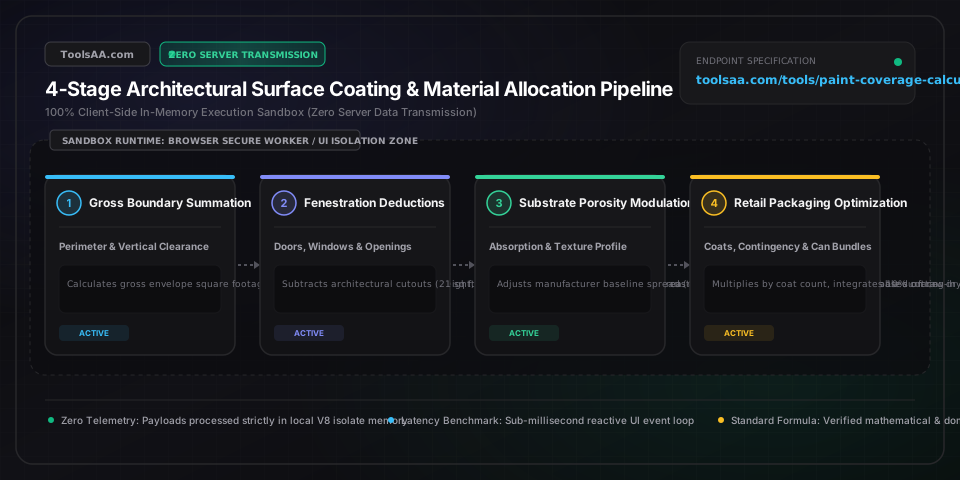
Paint Coverage Calculator & Gallon Estimator Guide — Client-Side In-Memory Architecture & Data Flow

Key Parameters & Controls

Nominal Spread Rate (Coverage Yield)Coverage Yield Benchmark

The manufacturer-rated theoretical surface area covered per volume unit. Standard premium acrylic latex averages 350 to 400 sq ft per US gallon (8.6 to 9.8 m² per liter) at a recommended dry film thickness (DFT) of 1.5 to 2.0 mils. Substrate texture, roller nap thickness (3/8-inch vs 3/4-inch), and application method cause real-world spread rates to vary between 200 and 420 sq ft/gal.

Default: 380 sq ft/gal (9.3 m²/L)
Substrate Porosity MultiplierSurface Absorption Coefficient

Absorption multiplier governing effective paint consumption. Smooth previously painted or sealed drywall has a baseline factor of 1.00. Unprimed fresh drywall joint compound and bare plaster exhibit high capillary draw reducing efficiency to 0.70-0.75 (requiring 30% more material). Heavy textured knockdown or exterior split-face masonry drops efficiency to 0.50-0.60, requiring dedicated high-build primer.

Default: 1.00 (Smooth Primed)
Standard Architectural Cutout AllowancesSubtractive Opening Allowance

Standardized deductions for architectural fenestrations. A standard residential interior door (30x80 to 36x80 inches) subtracts 20 to 21 sq ft (1.86 to 1.95 m²). An average single residential double-hung window subtracts 15 sq ft (1.39 m²). Deducting non-painted openings prevents over-purchasing paint volume by 12% to 22% in typical residential rooms.

Default: Door: 21 sq ft (1.95 m²), Window: 15 sq ft (1.39 m²)
Application Waste & Roller Holdup BufferMaterial Loss Percentage

Safety margin compensating for physical material losses: roller sleeve saturation retention (up to 0.15 gallons held in a high-density nap), paint tray residual film, cutting-in overlap along baseboards, and spray transfer overspray (25-40% loss on airless systems). Standard roller and brush jobs require an 8% to 10% contingency allowance.

Default: 10% Contingency Buffer
Coat Multiplier & Color Contrast GradientDry Film Opacity Layer

Number of continuous barrier coats necessary for complete color obscuration and protective sheen uniformity. Same-color refresh repainting over existing sound film requires 1 coat. Standard color shifts, sheen transitions (flat to satin/semi-gloss), and new drywall require a minimum of 2 coats. Drastic contrast shifts (dark charcoal to pastel white) or low-hiding organic yellow/red pigments demand 1 tinted primer coat plus 2 finish coats.

Default: 2 Complete Coats

Pro Tips & Best Practices

The 5-Gallon Bucket Cost Tipping Point Rule

Commercial paint manufacturers and home centers price a 5-gallon contractor bucket at 15% to 25% less per gallon than single 1-gallon cans. Whenever your calculated requirement exceeds 3.6 gallons, purchasing one 5-gallon bucket is almost always cheaper than buying 4 separate 1-gallon cans ($180 for 5 gallons vs $192 for 4 singles), while providing guaranteed dye-lot color consistency and surplus for future maintenance touchups.

Beware Unprimed Drywall Capillary Suction

Never apply expensive premium topcoat paint directly onto fresh drywall or patched mud. Bare gypsum paper and joint compound exert intense capillary suction that robs paint of its liquid binders, creating irreversible 'flashing' (blotchy patches of uneven sheen) and slashing spread rate from 400 sq ft/gal down to 240 sq ft/gal. Always apply one coat of inexpensive dedicated PVA drywall primer first to seal porosity before calculating topcoat gallons.

Roller Nap Depth Alters Material Spread Rate by 30%

A 3/8-inch nap roller applies paint at approximately 380-400 sq ft per gallon on smooth walls, whereas a 3/4-inch or 1-inch nap roller for textured walls or masonry deposits a much heavier wet film thickness, dropping real-world coverage to 220-260 sq ft per gallon. If rolling heavily textured knockdown walls, adjust your calculation coverage rate downward by at least 25% to prevent running out midway through the second coat.

Always 'Box' Multiple Paint Cans Before Starting

Even with computerized factory color dispensing, slight dye-lot variations of 1% to 3% exist between individual 1-gallon cans. To avoid visible color demarcation lines on a single wall, pour all 1-gallon cans into a clean 5-gallon bucket and stir thoroughly (a practice termed 'boxing' paint). When 1/3 of the boxed paint remains, mix in the next can to guarantee seamless optical uniformity throughout the room.

Common Gotchas & Troubleshooting

⚠️Paint Runs Out Midway Through the Second Wall on Coat 2

Premature exhaustion is almost always caused by applying excessive wet film thickness (WFT > 6 mils) using an overly thirsty thick-nap roller, or applying topcoat over thirsty unprimed substrate without adjusting the spread rate setting. Immediately seal the unpainted boundary along a natural architectural corner (never stop in the middle of a continuous flat wall). Measure remaining unpainted square footage, check container batch numbers to match dye lots, and thin subsequent coats only if specifically permitted by manufacturer specifications (max 4-8 oz water per gallon).

⚠️Severe Sheen Flashing or Shadow Banding Near Cut-In Edges

'Picture framing' occurs when edge cutting-in with a brush dries before the adjacent wall surface is rolled, depositing different texture profiles and film thicknesses. To fix, maintain a continuous 'wet edge' by working in 3-foot wall sections, cutting in immediately followed by rolling within 5 to 10 minutes. For existing dried flashing, apply a single uniform second finish coat over the entire wall plane using a 3/8-inch micro-fiber roller, feathering edges within 1 inch of corners.

⚠️Old Dark Paint Bleeding Through After Two Fresh Coats

Light pastel or vibrant topcoats formulated with low-opacity organic pigments (such as bright yellows, clean reds, and pure whites) lack physical inorganic hiding power over deep navy or charcoal walls. Do not apply a fourth coat of finish enamel. Instead, roll one high-hiding intermediate coat of gray-tinted stain-blocking primer (tinted to Color Hue P4 or P5 gray), which neutralizes color transmission and allows the final finish coat to achieve 100% opacity.

Frequently Asked Questions

How to calculate paint coverage in square feet and gallons?▼

To calculate paint coverage, multiply the perimeter of the room (2 x [Length + Width]) by ceiling height to get gross wall area, add ceiling area (Length x Width) if painting it, then subtract 21 sq ft per door and 15 sq ft per window to find net square footage. Divide net square footage by the paint's spread rate (typically 350 to 400 sq ft per gallon for smooth interior walls), multiply by the number of coats (standard 2 coats), and add a 10% contingency buffer for roller absorption and touchups. The mathematical formula is: Gallons = (Net Square Feet * Coats / Spread Rate) * 1.10.

How many square feet does 1 gallon of paint cover on interior walls?▼

One standard US gallon of quality interior latex paint covers between 350 and 400 square feet (32.5 to 37.2 m²) on smooth previously painted interior walls with one coat. However, coverage drops to 250 to 300 square feet per gallon on textured drywall or plaster, and falls to 175 to 225 square feet on rough unprimed masonry or stucco due to high capillary absorption. For two coats, one gallon provides complete finish coverage for approximately 175 to 200 square feet of wall space.

Do I need 1 coat or 2 coats of paint for interior walls?▼

Two coats are required for virtually all standard residential interior painting jobs to achieve true color saturation, complete opacity, and the manufacturer's specified dry film thickness (typically 3.0 to 4.0 mils total dry film). A single coat is only sufficient when applying identical color and sheen over an existing sound, clean paint film as a cosmetic maintenance refresh. When changing colors, altering sheen levels, or painting repaired drywall, one coat leaves subtle roller shadows and micro-voids that degrade scrubbability.

How much extra paint should you buy for doors, trim, and touch-ups?▼

Buy an additional 10% to 15% beyond calculated net wall requirements to cover roller sleeve holdup (a standard 9-inch roller retains 4 to 8 fluid ounces), tray residue, and future touchups. For separate baseboard, trim, and door casing enamel, estimate approximately 1 quart per 100 linear feet of trim or 2 standard six-panel doors (both sides, 2 coats). Always retain at least one sealed quart of each custom tinted paint formula labeled with the date and room for subsequent seamless scuff repairs.

Is it cheaper to buy a 5 gallon bucket of paint than individual gallons?▼

Yes, buying a 5-gallon contractor bucket is almost always cheaper whenever your project requires 4 or more gallons of paint. A 5-gallon pail typically costs between $160 and $220 compared to $45 to $60 per individual 1-gallon can, generating a 15% to 25% direct savings ($40 to $70 total). Furthermore, using a 5-gallon bucket eliminates dye-lot variations between individual cans and allows faster dipping with an 18-inch production roller grid.

Related Tools & Utilities

All Tools →