Reading Time & Speaking Rate Calculator - Words, Speed & Audio Duration — Reference Guide
Calculate accurate reading time and speech presentation duration based on word count, reading speed (WPM), speech cadence, and complexity scoring. 100% private in-browser text cockpit.
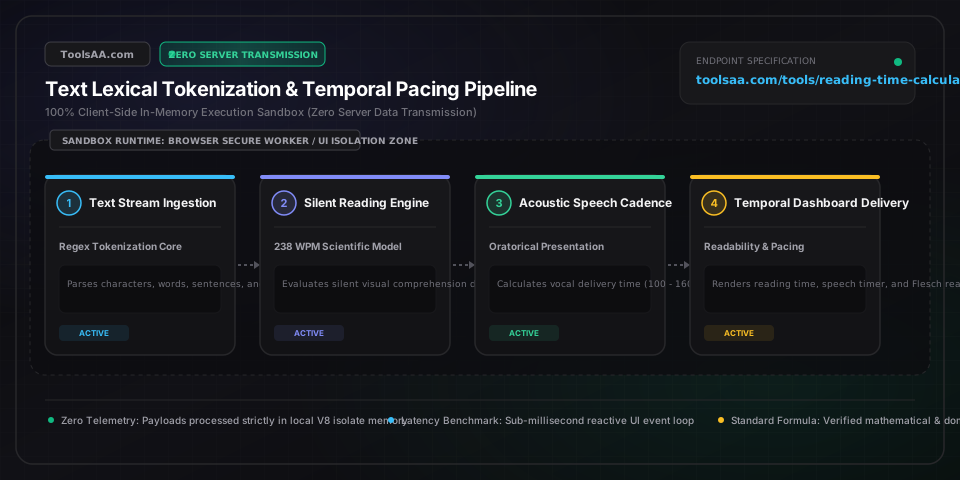
Key Parameters & Controls
Time required for average adult silent reading (238 WPM).
Time required to deliver text out loud at conversational cadence (130 WPM).
Total alphanumeric word tokens parsed in manuscript.
Flesch Reading Ease score; higher numbers indicate easier readability.
Pro Tips & Best Practices
A landmark 2019 meta-analysis (Brysbaert) analyzing 190 studies established that the average adult silent reading rate for English non-fiction is 238 words per minute, lower than the obsolete 300 WPM myth.
While conversational dialogue flows at 140-160 WPM, formal presentations on stage should be delivered between 120 and 130 WPM to give audiences time to absorb slides and vocal emphasis.
If preparing a speech for a strict time limit (e.g. 5 minutes), target a word count around 550 to 600 words to accommodate breathing, rhetorical pauses, and applause.
Common Gotchas & Troubleshooting
⚠️Reading Time Varies Drastically by Content Difficulty
Technical, legal, and medical texts with complex jargon drop human reading velocity to 130-160 WPM. Adjust the WPM slider down for academic publications.
⚠️Word Count Discrepancy Between Microsoft Word and Browser
Hyphenated words (e.g. 'state-of-the-art') and numbers may be counted as single tokens or separate words depending on regex rules. Our engine adheres to Unicode standard word boundaries.
Frequently Asked Questions
How do you calculate reading time from word count?▼
Divide the total word count by your target reading speed in words per minute (WPM). For example, 1,000 words / 238 WPM = 4.2 minutes (4 minutes and 12 seconds).
How many words is a 5-minute speech?▼
At a comfortable, natural presentation pace of 130 words per minute, a 5-minute speech contains approximately 650 words. At an energetic 150 WPM pace, it contains 750 words.
What is the average reading speed for children versus adults?▼
Grade 3 students average ~110 WPM, Middle school students ~170 WPM, High school ~200 WPM, and adults ~238 WPM for silent comprehension.
Is my pasted manuscript stored on any server?▼
No. Text analysis, word tokenization, and reading time derivations run 100% locally in your client web browser memory without network transmission.
Related Tools & Utilities
All Tools →Compare source code, plain text, and configuration files with side-by-side split view, unified diffs, inline character highlights, and whitespace sensitivity controls.
Convert text and code variables between camelCase, PascalCase, snake_case, kebab-case, CONSTANT_CASE, and 15 naming conventions instantly.
High-precision text statistics engine calculating words, characters with/without spaces, syllables, sentences, reading and speaking duration, and lexical keyword density.
Convert titles, unicode strings, and multilingual text into clean, URL-safe SEO slugs with customizable delimiters, lowercase filters, and transliteration rules.
Generate retro ASCII text banners, terminal box headers, and multi-font code comment blocks with customizable font styles, border characters, and copyable text.
Convert binary code (01001000 01101001) to plain ASCII/UTF-8 text and vice versa. Features custom bit grouping, delimiters, and byte encoding.