Daily Water Intake Calculator - Hydration by Weight, Climate & Exercise
Clinical Health & Hydration Physiology

Daily Water Intake Calculator - Hydration by Weight, Climate & Exercise

Calculate your personalized daily hydration requirement based on body mass, climate temperature, exercise duration, and pregnancy/lactation factors. 100% private in-browser health cockpit.

Presets:
Personal Hydration Parameters
kg
45 mins/day
Display Target In:
Real-time NASEM hydration matrix
Daily Hydration
3,025 ml
3.02 Liters / 102 oz
Standard Glasses
12 Cups
250 ml (8.45 oz) per glass
Hourly Pacing
~202 ml/hr
Across 15 waking hours
Sweat & Climate
+563 ml
Sweat compensation delta
3.5L2.5L1.5L0.5L
3.02 L Target

Active Daily Hydration Status76% of 4L Scale

Click glasses below to log today's fluid consumption in browser

Daily Glasses Tracker
0 / 12 Glasses(0%)
Remaining today: 12 glasses (~3000 ml)
Fluid Requirement Components100% Total Volume
Baseline (81%)Workout (19%)
Direct Fluids to Drink (80%)2,420 ml

Target drinking water, herbal teas, infused water, and electrolyte beverages throughout the day.

Dietary Food Moisture (20%)~605 ml

Moisture naturally absorbed from fruits (watermelon, oranges), crisp vegetables, and soups.

Hydration FactorClinical RationaleVolume (ml)Cups (8 oz)
Baseline Weight Need35 ml × 70 kg body weight2450 ml9.8
Exercise Sweat Loss45 mins at moderate intensity+563 ml+2.3
Total Daily Fluid GoalRounded to nearest 25 ml3025 ml12 Cups
Daily Target:3,025 ml|12 Cups
Medical model: NASEM Guidelines (35 ml/kg baseline + dynamic factors)

NASEM Clinical Weight-to-Fluid Matrix & Scenario Comparisons

Standard hydration requirements mapped across body mass brackets from 45 kg (99 lbs) to 115 kg (254 lbs).

Body WeightSedentary Base+30m Moderate WorkoutIn Hot ClimateDaily LitersStandard Cups
45 kg / 99 lbs1575 ml+1950 ml2400 ml2.40 L9.6
50 kg / 110 lbs1750 ml+2125 ml2575 ml2.58 L10.3
55 kg / 121 lbs1925 ml+2300 ml2750 ml2.75 L11.0
60 kg / 132 lbs2100 ml+2475 ml2925 ml2.92 L11.7
65 kg / 143 lbs2275 ml+2650 ml3100 ml3.10 L12.4
70 kg / 154 lbsYour Weight2450 ml+2825 ml3275 ml3.27 L13.1
75 kg / 165 lbs2625 ml+3000 ml3450 ml3.45 L13.8
80 kg / 176 lbs2800 ml+3175 ml3625 ml3.63 L14.5
85 kg / 187 lbs2975 ml+3350 ml3800 ml3.80 L15.2
90 kg / 198 lbs3150 ml+3525 ml3975 ml3.98 L15.9
95 kg / 209 lbs3325 ml+3700 ml4150 ml4.15 L16.6
100 kg / 220 lbs3500 ml+3875 ml4325 ml4.33 L17.3
105 kg / 231 lbs3675 ml+4050 ml4500 ml4.50 L18.0
110 kg / 243 lbs3850 ml+4225 ml4675 ml4.67 L18.7
115 kg / 254 lbs4025 ml+4400 ml4850 ml4.85 L19.4
Authoritative Clinical Safety & Fluid Restriction Disclaimer

This calculator implements generalized NASEM healthy adult fluid guidelines. If you have been clinically diagnosed with Congestive Heart Failure (CHF), Chronic Kidney Disease (CKD/ESRD), Liver Cirrhosis, or Syndrome of Inappropriate Antidiuretic Hormone (SIADH), strictly follow your nephrologist or cardiologist's prescribed fluid restriction orders. Never force fluid beyond your physiological thirst or kidney excretion capacity.

Baseline Fluid Requirement3,025 ml (12 Cups)
Activity & Climate Surplus~202 ml / waking hour
Standard Cups / Day (250ml)100% In-Browser Local
Zero-Knowledge Local Execution

All mathematical computations execute strictly inside your local browser memory. Zero external server uploads.

Sub-Millisecond AST Engine

Instant real-time reactive computation delivers immediate feedback on every keystroke with zero network latency.

Production Standards & Compliance

Strict adherence to official specifications, ensuring enterprise accuracy and zero data leaks.
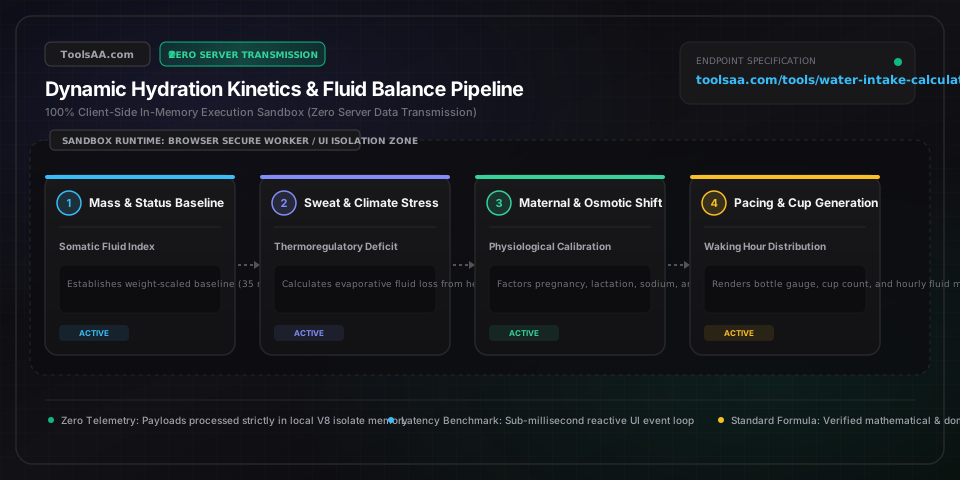
Technical Reference & Architecture Guide

Daily Water Intake Calculator - Hydration by Weight, Climate & Exercise — Reference Guide

Calculate your optimal baseline water intake and hydration pacing based on body weight, daily activity duration, and ambient climate factors.

Daily Water Intake Calculator - Hydration by Weight, Climate & Exercise — Reference Guide — Client-Side In-Memory Architecture & Data Flow

Key Parameters & Controls

Total Daily Water Targetnumber (Liters / Ounces)

Aggregated daily volume of water and hydrating fluids needed.

Default: 3.2 L (108 oz)
Standard Glasses (8 oz / 240 ml)number (cups)

Number of standard drinking glasses to consume across the day.

Default: 13.5 cups
Exercise Fluid Additionnumber (ml)

Additional fluid required specifically to offset sweat loss during workouts.

Default: 750 ml
Hourly Pacing Targetnumber (ml/hour)

Optimal steady intake rate across 15 waking hours.

Default: 210 ml/hr

Pro Tips & Best Practices

Do Not Chug Large Volumes at Once

The human stomach can comfortably empty approximately 800 to 1,000 ml of fluid per hour. Drinking too quickly simply triggers rapid renal excretion without cellular hydration.

Account for Water Content in Whole Foods

Approximately 20% of your daily water intake naturally comes from fruits, vegetables, soups, and cooked grains. The remaining 80% must come from beverages.

Add Electrolytes for Workouts Exceeding 60 Minutes

If training intensely in heat for over an hour, plain water can dilute plasma sodium. Include 300-500 mg sodium to maintain osmotic balance and prevent cramping.

Common Gotchas & Troubleshooting

⚠️Waking Up Frequently at Night to Urinate (Nocturia)

Taper your fluid intake 2 hours before bedtime. Consume 75% of your daily quota before 6:00 PM so your kidneys can process fluids while upright.

⚠️Headaches Despite High Water Intake

Drinking excessive distilled or plain water without electrolytes can lead to mild hyponatremia. Ensure dietary sodium, potassium, and magnesium are balanced.

Frequently Asked Questions

Is the '8 glasses a day' rule accurate?▼

The '8x8 rule' (64 oz or ~1.9 L) is an oversimplified guideline. A 100 kg athlete requires significantly more water than a 50 kg sedentary individual. Personalized calculations based on body mass and activity are far more physiological.

Do coffee and tea count toward my water goal?▼

Yes. Research shows moderate caffeine consumption (under 400 mg/day) does not induce net fluid deficit; caffeinated tea and coffee contribute positively to total daily hydration.

Can drinking too much water be dangerous?▼

Yes. Rapidly consuming excessive plain water beyond renal excretion limits can lead to water intoxication (acute hyponatremia), diluting blood sodium to dangerously low levels.

Is this calculator medical advice for renal conditions?▼

Disclaimer: Individuals with chronic kidney disease (CKD), congestive heart failure (CHF), or hyponatremia must follow fluid restriction guidelines provided directly by their nephrologist or cardiologist.

Related Tools & Utilities

All Tools →