Candy Temperature & Altitude Calculator

Candy Temperature & Altitude Calculator

Professional high-altitude candy temperature calculator. Adjusts all 8 sugar stages (thread, soft ball, firm ball, hard ball, soft crack, hard crack, caramel) based on elevation, local barometric pressure, or boiling water calibration. Features reverse stage detection, recipe water-ratio compensation, and visual thermometer stages.

Presets label

Sec calibration title

Sec calibration desc

Unit feet
Unit ft

Hint altitude

Hint pot material

Sec target title

Sec target desc

Unit deg f cookbook
Unit deg f

Hint sea level temp

45%

Hint ideal humidity

Sec insider title

Sec insider desc

Unit cups
Unit cups short

Hint sugar amount

Lbl adjusted target tempBadge target cook
227.4°F(108.6°C)
Lbl flame cutoff225.9°F

Hint flame cutoff

Lbl elevation offset-10.6°F
Lbl adjusted target range
224.4°F - 229.4°F
Lbl local boil point201.4°F

Title thermometer

Desc thermometer

180°200°220°240°260°280°300°320°340°360°Thread StageSoft Ball StageFirm Ball StageHard Ball StageSoft Crack StageHard Crack StageLight Caramel StageDark Caramel StageLocal Boil (201°F)Sea Level (238°F)Lbl flame cutoff (225.9°F)TARGET: 227.4°F

Title cold water test

Lbl ice bath
Soft Ball Stage85% Sucrose Brix

Forms soft, pliable ball in cold water that flattens between fingertips.

Lbl applicationsFudge, pralines, fondant, Italian meringue, peppermint patties

Title chemistry

Desc chemistry

Lbl extra water3.3 fl oz(6.7 Unit tbsp)
Lbl corn syrup buffer1.0 tbspLbl corn syrup type
Lbl cream of tartar buffer0.13 tspLbl cream of tartar

Title ab compare

Desc ab compare

Col elevationCol boiling pointCol target cookCol flame cutoffCol extra water
Lbl tier sea level212.0°F238.0°F236.5°F0
Lbl tier kitchen (5280 ft)201.4°F227.4°F225.9°F+3.3 fl oz
Lbl tier high mountain195.0°F221.0°F219.5°F+7.2 fl oz
============================================================
CANDY TEMPERATURE & ALTITUDE CALIBRATION REPORT
============================================================
Target Sugar Stage   : Soft Ball Stage (85% Sucrose Brix)
Elevation Reference  : 5280 ft (denver)
Local Water Boiling  : 201.4°F / 94.1°C
Recipe Temp Offset   : -10.6°F / -5.9°C
------------------------------------------------------------
Sea-Level Recipe Temp: 238.0°F / 114.4°C
Adjusted Target Cook : 227.4°F / 108.6°C
Flame Cutoff Temp    : 225.9°F / 107.8°C (Thermal carryover: 1.5°F)
Adjusted Stage Range : 224.4°F - 229.4°F (107.1°C - 110.1°C)
------------------------------------------------------------
HIGH-ALTITUDE ANTI-CRYSTALLIZATION GUARD:
- Extra Starting Liquid : 3.3 fl oz (6.7 tbsp)
- Invert Sugar Shield   : 1.00 tbsp light corn syrup
- Acid Hydrolysis Shield: 0.125 tsp cream of tartar
------------------------------------------------------------
Cold Water Ball Test : Forms soft, pliable ball in cold water that flattens between fingertips.
Best Culinary Uses   : Fudge, pralines, fondant, Italian meringue, peppermint patties
============================================================
Title stage table

Desc stage table

Lbl offset prefix-10.6°F
Th stage nameTh sea level fTh adjusted fTh brixTh cold waterTh uses
Thread Stage230 - 235°F219.4 - 224.4°F80%Syrup drips in fine 2-inch silky threads from spoon into cold water.Simple syrup, glazed fruits, candied citrus peel, fruit preserves
Soft Ball Stage235 - 240°F224.4 - 229.4°F85%Forms soft, pliable ball in cold water that flattens between fingertips.Fudge, pralines, fondant, Italian meringue, peppermint patties
Firm Ball Stage245 - 250°F234.4 - 239.4°F87%Forms round ball that holds shape when removed but yields to finger pressure.Chewy caramels, nougat, gummy bears, marshmallows
Hard Ball Stage250 - 265°F239.4 - 254.4°F92%Forms rigid, firm sphere; holds round shape under pressure with slight give.Divinity, rock candy, butterscotch chews, marshmallows
Soft Crack Stage270 - 290°F259.4 - 279.4°F95%Separates into hard, pliable threads that bend slightly before cracking.English toffee, butterscotch, salt water taffy, chewy brittle
Hard Crack Stage300 - 310°F289.4 - 299.4°F99%Separates into hard, brittle threads that snap cleanly with a crisp crunch.Lollipops, peanut brittle, glazed fruit (tanghulu), hard candy
Light Caramel Stage320 - 335°F309.4 - 324.4°F100%100% water evaporated; sucrose liquefies into pale golden amber syrup.Crème caramel, flan syrup, spun sugar cages, praline base
Dark Caramel Stage335 - 350°F324.4 - 339.4°F100%Deep mahogany liquid; pyrolysis yields rich, complex bittersweet flavors.Dark caramel sauce, caramel glaze, brittle flavoring

Title sensitivity table

Desc sensitivity table

Th elevationTh boil pointTh offset deltaTh soft ballTh firm ballTh hard crack
Sea Level (0 ft / 0 m)212.0°F-0.0°F235 - 240°F245 - 250°F300 - 310°F
Calgary, AB (3,428 ft / 1,045 m)205.1°F-6.9°F228.1 - 233.1°F238.1 - 243.1°F293.1 - 303.1°F
Salt Lake City, UT (4,226 ft / 1,288 m)203.5°F-8.5°F226.5 - 231.5°F236.5 - 241.5°F291.5 - 301.5°F
Denver, CO (5,280 ft / 1,609 m)201.4°F-10.6°F224.4 - 229.4°F234.4 - 239.4°F289.4 - 299.4°F
Lake Tahoe, NV/CA (6,225 ft / 1,897 m)199.5°F-12.5°F222.5 - 227.5°F232.5 - 237.5°F287.5 - 297.5°F
Mexico City, MX (7,350 ft / 2,240 m)197.3°F-14.7°F220.3 - 225.3°F230.3 - 235.3°F285.3 - 295.3°F
Bogotá, Colombia (8,660 ft / 2,640 m)194.7°F-17.3°F217.7 - 222.7°F227.7 - 232.7°F282.7 - 292.7°F
Leadville, CO (10,152 ft / 3,094 m)191.7°F-20.3°F214.7 - 219.7°F224.7 - 229.7°F279.7 - 289.7°F
Primary Metric201.4°F
Lbl elevation offset-10.6°F
Lbl adjusted target temp227.4°F
Efficiency / Capacity85%
Lbl extra water3.3 fl oz
Net OutputVal active
Technical Reference & Architecture Guide

Candy Temperature & Altitude Calculator Guide

Professional high-altitude candy temperature calculator. Adjusts all 8 sugar stages (thread, soft ball, firm ball, hard ball, soft crack, hard crack, caramel) based on elevation, local barometric pressure, or boiling water calibration. Features reverse stage detection, recipe water-ratio compensation, and visual thermometer stages.

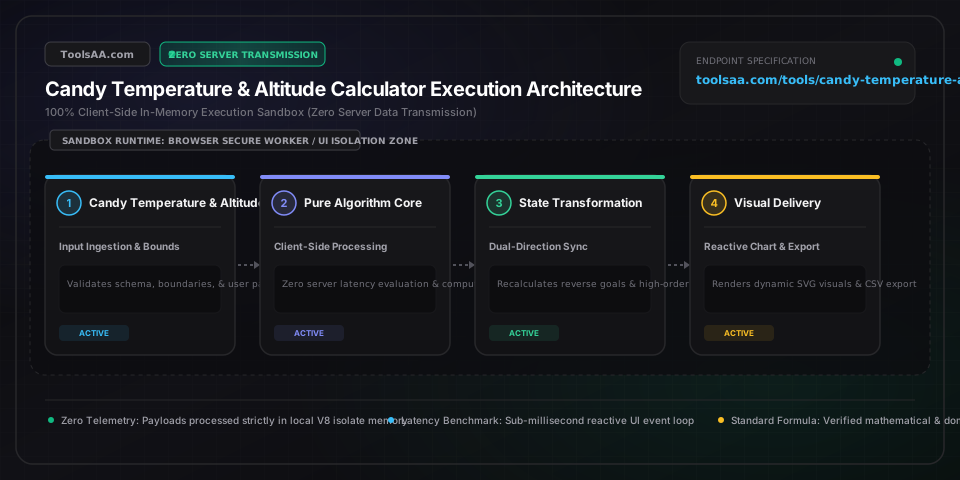
Candy Temperature & Altitude Calculator Guide — Client-Side In-Memory Architecture & Data Flow

Key Parameters & Controls

Input Payloadstring

Primary input configuration or data payload.

Default: Sample Data
Target Format / Modestring

Target conversion dialect or operational schema.

Default: Default
Validation Strictnessboolean

Enforce strict schema or syntax validation during processing.

Default: true

Pro Tips & Best Practices

Zero Server Latency

All processing executes entirely inside browser memory with instant feedback.

Keyboard Shortcuts

Use standard Ctrl+Enter / Cmd+Enter shortcuts to quickly trigger evaluation.

Clean Export

Use the one-click copy button to paste production-ready snippets directly into your IDE.

Common Gotchas & Troubleshooting

⚠️Syntax or Format Parsing Error

Verify input payload against standard specifications and check for missing delimiters.

⚠️Large File Performance

For massive inputs exceeding 10MB, process payloads in smaller batches to ensure browser UI responsiveness.

Frequently Asked Questions

How do you adjust candy temperature for high altitude?▼

To adjust any candy recipe for high altitude, first determine the local boiling point of water (which drops about 1°F for every 500 feet or 2°F per 1,000 feet of elevation). Calculate the difference between sea-level boiling point (212°F / 100°C) and your local boiling point. Then subtract that exact number of degrees from the recipe's recommended cooking temperature. For example, in Denver (5,280 ft), water boils at 201.4°F (10.6°F below 212°F). If your fudge recipe calls for 238°F, cook it to 227.4°F (238°F - 10.6°F).

Why does candy need a lower temperature at high elevations?▼

Candy making is not about heating sugar to a specific thermal state, but rather boiling off water until an exact percentage of sugar concentration (Brix) is reached. Pure water boils at 212°F at sea level, but under lower atmospheric pressure at altitude, water molecules escape into vapor at lower temperatures. Because dissolved sucrose elevates the boiling point of the solution relative to pure water, the syrup reaches the critical sugar concentration (e.g., 85% for soft ball fudge) at a correspondingly lower boiling point. If you cook candy to sea-level temperatures at high altitude, you will boil away too much water, turning tender fudge into hard, crumbly brick.

What is the boiling water test for candy thermometers?▼

The boiling water test is the most accurate way to calibrate your candy thermometer before making a batch. Bring a pot of plain water to a rolling boil, immerse the bulb or probe of your candy thermometer (making sure it doesn't touch the bottom or sides of the metal pot), and read the temperature after 2 minutes. Note the reading: if it reads 202°F, your boiling point is 10°F below sea level (212°F - 202°F = 10°F). Subtract 10°F from whatever temperature your recipe states. This method automatically accounts for your exact altitude, today's weather barometric pressure, and any factory calibration error in your thermometer.

How much extra water should I add to candy recipes at high altitude?▼

At elevations above 2,500 feet, water evaporates much faster than at sea level due to lower atmospheric pressure. Because the liquid boils off so rapidly, the temperature rises before the granular sugar crystals have sufficient time to dissolve completely, which causes grainy, crystallized candy. Confectioners recommend adding 1 to 2 tablespoons (0.5 to 1.0 fl oz or 15 to 30 ml) of extra water for every cup of sugar in the recipe. The extra water will boil off cleanly, but guarantees 100% sucrose dissolution before the syrup reaches critical temperature.

How do corn syrup and cream of tartar prevent candy crystallization?▼

Corn syrup consists of glucose and higher saccharides, which physically block sucrose molecules from aligning into rigid crystal lattices. Cream of tartar (potassium bitartrate) is a mild acid that causes acid hydrolysis (inversion), breaking some sucrose into fructose and glucose (invert sugar). At high altitudes where rapid evaporation accelerates crystallization risks, adding 1 tablespoon of light corn syrup or 1/8 teaspoon of cream of tartar per 2 cups of sugar creates a chemical shield that keeps caramels silky and lollipops glassy.

How does stormy weather or low barometric pressure affect candy making?▼

A passing low-pressure weather system or rainstorm can lower local atmospheric pressure by 0.5 to 1.0 inHg (17 to 34 hPa), which further depresses water's boiling point by 1°F to 2°F on top of your elevation offset. High humidity also slows the cooling and setting of hygroscopic confections like hard crack lollipops and toffee, causing them to absorb ambient moisture from the air and turn sticky. For best results, use the live boiling water calibration on stormy days and avoid making hard candies when relative humidity exceeds 60%.

Related Tools & Utilities

All Tools →