Critical Swim Speed Calculator & CSS Pace Zones

Critical Swim Speed Calculator & CSS Pace Zones

Badge tier

Calculate Critical Swim Speed (CSS), threshold pace per 100m or yard, and 5 customized aerobic training zones with pool turn splits and target race paces.

Lbl quick presets

Card input title

SCM_25
Lbl trial1 heading400Unit meter
Lbl distance (Unit meter)
Lbl duration
Unit min
Unit sec
Lbl quick
Lbl trial2 heading200Unit meter
Lbl distance (Unit meter)
Lbl duration
Unit min
Unit sec
Lbl quick
Lbl turn advantage1.2s Unit per turn

Desc turn advantage

Lbl wetsuit0% (Standard)
Lbl calibrate venue
Lbl goal solver
Lbl target distance (Unit meter)
Lbl target goal time
h
m
s
Lbl css per100m
1:25.0
1.176 m/s
Lbl css per100yd
1:17.7
Badge scy equiv
Lbl awc short
18.8Unit meter
Badge awc sub
Lbl adjusted short
1:25.0
SCM_25

Title zones

Desc zones

CSS: 1:25.0Unit pace100m
Lbl zone aerobicLbl thresholdLbl anaerobic
Z1 (<85%)Z2 (86-92%)Z3 (93-98%)Z4 (99-102%)Z5 (>103%)
Zone1 name
(+11.0s ~ +16.0s)1:36.0 ~ 1:41.0 Unit pace100m
Lbl physiology: Zone1 focus
Lbl feel: Zone1 rpeLbl workout: Zone1 workout
Zone2 name
(+5.0s ~ +10.0s)1:30.0 ~ 1:35.0 Unit pace100m
Lbl physiology: Zone2 focus
Lbl feel: Zone2 rpeLbl workout: Zone2 workout
Zone3 name
(+1.5s ~ +4.5s)1:26.5 ~ 1:29.5 Unit pace100m
Lbl physiology: Zone3 focus
Lbl feel: Zone3 rpeLbl workout: Zone3 workout
Zone4 name
(-1.0s ~ +1.0s)1:24.0 ~ 1:26.0 Unit pace100m
Lbl physiology: Zone4 focus
Lbl feel: Zone4 rpeLbl workout: Zone4 workout
Zone5 name
(-5.5s ~ -2.0s)1:19.5 ~ 1:23.0 Unit pace100m
Lbl physiology: Zone5 focus
Lbl feel: Zone5 rpeLbl workout: Zone5 workout
Disclaimer titleDisclaimer text
Stat protocolLbl two point linear
Stat accuracyLbl mlss accuracy
Stat zero leakLbl zero cloud local

Client-Side Processing

High-performance calculation executed entirely in browser memory.

Zero Server Upload Privacy

All payloads remain strictly local with zero external server communication.

Production Ready Export

Clean, optimized output formats ready for immediate deployment.
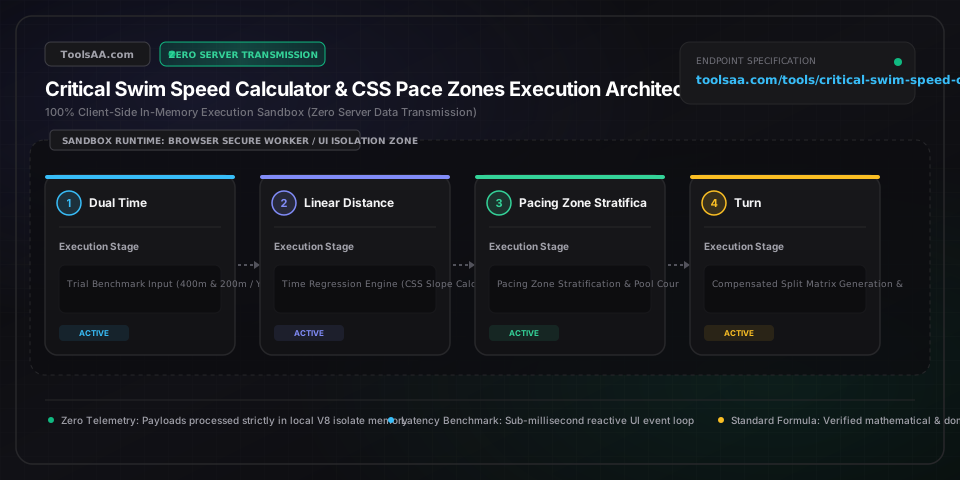
Technical Reference & Architecture Guide

Critical Swim Speed Calculator & CSS Pace Zones Guide

Calculate Critical Swim Speed (CSS), threshold pace per 100m or yard, and 5 customized aerobic training zones with pool turn splits and target race paces.

Critical Swim Speed Calculator & CSS Pace Zones Guide — Client-Side In-Memory Architecture & Data Flow

Key Parameters & Controls

400m / 400yd Endurance Time Trial SplitTime Duration (Minutes & Seconds)

Aerobic capacity benchmark duration from an all-out 400m or 400yd effort following an 800m progressive warm-up. Competitive adult benchmarks span 4:15 to 4:45 (elite club), 5:30 to 6:30 (competitive age-group triathlete), and 7:30 to 9:00 (recreational swimmer). This metric captures maximal aerobic power combined with early-phase stroke durability.

Default: 06:00
200m / 200yd Mid-Distance Time Trial SplitTime Duration (Minutes & Seconds)

Anaerobic/aerobic transition benchmark swum all-out after 12 to 15 minutes of continuous low-intensity active recovery. Standard reference splits range between 2:00 to 2:15 (elite), 2:35 to 3:05 (intermediate age-grouper), and 3:30 to 4:15 (fitness novice). The time delta between the 400m and 200m trials isolates your sustainable lactate inflection threshold.

Default: 02:50
Pool Course Length & Basin GeometryCourse Standard (Meters or Yards)

Official pool dimension standard: 25-meter Short Course Meters (SCM), 25-yard Short Course Yards (SCY, standard across US collegiate swimming), or 50-meter Olympic Long Course Meters (LCM). Turn frequency directly alters metabolic efficiency; swimmers encounter a 1.5 to 2.5 second delta per 100m between short and long course configurations.

Default: 25m (Short Course Meters)
Target Pacing Zone & Lactate TierPhysiological Training Zone (Zone 1 to Zone 5)

Five-tier heart rate and lactate clearance distribution: Zone 1 Recovery (+11s to +18s/100m), Zone 2 Aerobic Base (+5s to +10s/100m), Zone 3 Tempo (+1.5s to +4.5s/100m), Zone 4 CSS Threshold (-1.0s to +1.0s/100m), and Zone 5 VO2 Max (-2.0s to -6.0s/100m). Used to generate structured interval splits and turn pacing tempos.

Default: Zone 4 (CSS Lactate Threshold)

Pro Tips & Best Practices

The First 50m Pacing Trap: Avoiding Glycolytic Flooding

Nearly 85% of swimmers sabotage their CSS calculation by sprinting the opening 50 meters of the 400m test 3 to 5 seconds faster than sustainable threshold pace. This premature burst triggers acute intracellular acidosis and lactate accumulation above 6 mmol/L within the first 90 seconds, deteriorating neuromuscular stroke mechanics and artificially depressing your overall 400m time. Swim the first 100m with a smooth, disciplined 2-beat kick, targeting an even split within 1.0 second of your target average pace.

The 12-to-15 Minute Active Recovery Window

Taking either too little or too much rest between the 400m and 200m trials distorts the 2-point regression slope. Resting under 10 minutes leaves residual metabolic byproducts in the bloodstream, skewing the 200m time artificially slow; resting over 25 minutes drops muscle temperature and neural activation. The sports physiology gold standard is 12 to 15 minutes of active aerobic flushing (such as 400m of continuous easy pull with a buoy and relaxed backstroke) to clear hydrogen ions while maintaining stroke groove.

Converting Accurately Between Yards and Long Course Meters

Never apply a flat 10% mathematical multiplier when translating CSS pace between 25-yard (SCY) and 50-meter (LCM) pools. In a 25-yard course, a swimmer completes 3.3 turns per 100 yards, spending nearly 25% of race distance gliding off walls in an ultra-low drag streamline. In a 50m Olympic pool, only 1 turn occurs per 100m, increasing continuous surface wave drag; your LCM threshold pace will realistically be 6 to 9 seconds slower per 100m than your SCY pace per 100 yards.

Neuromuscular Calibration with an Audio Tempo Trainer

To hardwire your calculated CSS pace into muscle memory, set an audible goggle-mounted metronome (such as a Finis Tempo Trainer in Mode 1) to beep at your target 25m split (CSS per 100 divided by 4). If you arrive at the wall ahead of the beep, you are over-kicking and prematurely draining fast-twitch glycogen; if you lag behind the beep, your stroke length has decayed, indicating that you should take 15 seconds of recovery to reset technical body alignment.

Common Gotchas & Troubleshooting

⚠️Calculated CSS pace is mathematically faster than or identical to your 200m time trial split pace

This error occurs when the 400m time trial suffered severe mid-race deceleration while the 200m trial was swum too conservatively, compressing the time gap (T1 - T2) below the physiological floor. In a valid test, T1 minus T2 should exceed 65 to 70 seconds. If the difference is narrower, the linear slope yields a falsely elevated velocity. Rest for 48 hours, ensure proper carbohydrate fueling, and repeat the protocol using disciplined, even 100m pacing monitored on a poolside pace clock.

⚠️Inability to sustain calculated Zone 4 CSS pace during 100m repeat sets with 10-15 seconds rest

If you fail to hold target CSS splits by repetition 3 or 4 of a 10 x 100m set, you possess an 'anaerobic speed reserve' bias. Swimmers with sprinting backgrounds often execute the 200m trial with heavy anaerobic glycolytic contribution, producing an artificially fast 200m time that pulls the calculated CSS threshold faster than your actual aerobic steady-state. Adjust your active training CSS by adding +2.0 to +3.0 seconds per 100m, or retest using a 400m/800m distance combination to isolate pure aerobic capacity.

⚠️Legs sink and stroke rate drops precipitously after 250 meters during continuous threshold sets

This breakdown is caused by 'kick debt' rather than arm fatigue. Swimmers unconsciously ramp up from an economical 2-beat flutter kick to an exhausting 6-beat kick to offset declining aerobic stamina, rapidly consuming lower-body oxygen and spiking heart rate into Zone 5. Insert a pull buoy for 2 consecutive repetitions to verify if body horizontal alignment stabilizes. If your pace immediately rebounds, consciously dial back kick intensity, press your sternum downward to elevate your hips, and lengthen stroke glide.

Frequently Asked Questions

How do you calculate Critical Swim Speed (CSS)?▼

Critical Swim Speed is calculated using the two-point linear regression formula CSS (m/s) = (D1 - D2) / (T1 - T2), where D1 is 400 meters, D2 is 200 meters, and T1 and T2 are the respective finish times in seconds. To determine your threshold pace per 100 meters, divide 100 by the resulting speed in meters per second (Pace = 100 / CSS). For example, a 400m time of 6:00 (360 seconds) and a 200m time of 2:50 (170 seconds) yields (400 - 200) / (360 - 170) = 200 / 190 = 1.0526 m/s, translating to an exact CSS threshold pace of 1:35 per 100 meters.

What is the difference between a 400m/200m test and a 400m/50m test?▼

The 400m and 200m test is the gold standard for endurance swimmers because the 200m distance requires approximately 65% to 75% aerobic energy expenditure, preventing sprint bias from distorting the threshold slope. In contrast, the 400m and 50m protocol isolates near-pure anaerobic alactic power on the 50m trial (over 80% anaerobic), which artificially steepens the regression line and produces an over-optimistic threshold pace that endurance athletes cannot hold for sets longer than 300 meters.

How much slower is swimming in a 50m long course pool compared to a 25m short course pool?▼

Swimming in a 50-meter Olympic long-course pool is typically 1.5 to 2.5 seconds slower per 100 meters than in a 25-meter short-course pool. In a 25m basin, a swimmer benefits from 3 wall push-offs and streamlined glides per 100m compared to only 1 turn in a 50m basin. Wall push-offs produce instant launch speeds exceeding 2.2 m/s with minimal oxygen consumption, whereas mid-pool swimming faces continuous hydrodynamic frontal drag without mechanical relief.

How often should you retest your Critical Swim Speed?▼

Retest your Critical Swim Speed every 6 to 8 weeks during an active training block or at the start of each new training mesocycle. Developing swimmers and triathletes typically improve by 1 to 3 seconds per 100m over a structured 8-week period; continuing to train with obsolete, slower CSS numbers downgrades critical Zone 4 threshold sets into sub-optimal Zone 3 tempo sessions, stunting mitochondrial and capillary density gains.

How do you use CSS pace zones in structured swim training?▼

CSS pace represents your maximal lactate steady state—the highest speed you can sustain for 1,500m (30 to 45 minutes) without exponential blood lactate accumulation above 4.0 mmol/L. In daily workouts, coaches prescribe 5 functional zones: Zone 1 Recovery (CSS +11s to +18s/100m), Zone 2 Aerobic Base (CSS +5s to +10s/100m), Zone 3 Tempo (CSS +1.5s to +4.5s/100m), Zone 4 Threshold (CSS ±1.0s/100m), and Zone 5 VO2 Max (CSS -2.0s to -6.0s/100m). Sets such as 10 x 100m at CSS with 10 to 15 seconds rest directly raise your lactate inflection velocity.

What is a good Critical Swim Speed pace for triathletes and master swimmers?▼

Disclaimer: This tool is provided strictly for educational and informational purposes only and does not constitute formal financial advice or a binding loan commitment. Please consult a qualified financial advisor before making decisions. A competitive CSS benchmark for amateur age-group triathletes and masters swimmers is between 1:25 and 1:40 per 100 meters, while sub-elite competitors swim between 1:12 and 1:20 per 100m, and international-level distance specialists hold under 1:05 per 100m. Adult-onset swimmers typically start with a CSS between 1:55 and 2:15 per 100m; dedicated threshold interval training combined with head-neutral body balancing commonly trims 8 to 15 seconds per 100m within their first competitive season.

Related Tools & Utilities

All Tools →