🌱Title short

Lawn Fertilizer Spreader Calculator (Rate)

Calculate exact lawn fertilizer spreader settings, pounds per 1,000 sq ft, and bags needed based on N-P-K grade, turf area, and spreader calibration pass rates.

Lbl quick presets

Sec lawn area

5,000 Unit sq ft
Unit sq ft

Hint area

Sec agronomic

0.80 Unit lbs n per1000
0.1 lb (Rate gentle)0.75 lb (Rate optimal)1.5 lb (Rate risk)
Lbl nitrogen n
%
Lbl phosphate p
%
Lbl potash k
%
Unit lbs
$

Sec agronomic sensors

Badge agronomic c f a
30%
Lbl quick solubleLbl controlled releaseLbl organic base

Sec spreader

Kpi app rate
2.50Unit lbs n per1000
Kpi total product
12.5Unit lbs total
Kpi bags needed
1(0.33)
Lbl surplus 25.0 Unit lbs
Kpi total cost
$42.99$8.60 / Unit per1000 sq ft

Dial card title

SCOTTS • ROTARY

Lbl pass rate note
Lbl dial setting2 ¾scotts
Lbl swath width10 ft
Lbl speed compensationOpt pace standard short (100%)

Burn gauge title

Burn gauge subtitle

Agronomically Optimal
Target feeding delivering vigorous chlorophyll density, deep root development, and uniform growth without leaf scorch.

Sim title

Sim criss cross desc

Lbl swath span 10 ft
Sim criss cross title50% + 50% = 100%
Lbl pass1 • Lbl pass2

Criss cross benefit

Sim single pass title100% Single Pass
Lbl single pass run

Single pass warning

Primary Metric4.00 Unit lbs
N
Efficiency / Capacity2 ¾ (SCOTTS)
Net Output1 Lbl bags word (25.0 Unit lbs Lbl reserve)

Client-Side Processing

High-performance calculation executed entirely in browser memory.

Zero Server Upload Privacy

All payloads remain strictly local with zero external server communication.

Production Ready Export

Clean, optimized output formats ready for immediate deployment.

Disclaimer label Disclaimer y m y l
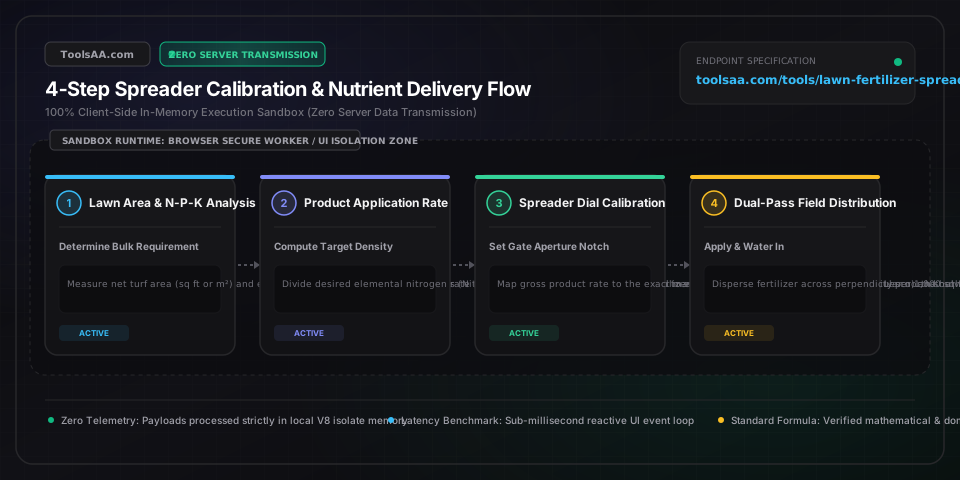
Technical Reference & Architecture Guide

Lawn Fertilizer Spreader Calculator (Rate) Guide

Calculate exact lawn fertilizer spreader settings, pounds per 1,000 sq ft, and bags needed based on N-P-K grade, turf area, and spreader calibration pass rates.

Lawn Fertilizer Spreader Calculator (Rate) Guide — Client-Side In-Memory Architecture & Data Flow

Key Parameters & Controls

Lawn Turf AreaSquare Feet or Square Meters (Area)

Net turfgrass surface area excluding driveways, patios, and planting beds. Standard US suburban residential lots average 5,000 to 10,000 sq ft, while UK and European urban lawns range from 150 to 500 m².

Default: 5,000 sq ft (500 m²)
Target Nitrogen Application RatePounds N per 1,000 sq ft or Grams N per m²

University extension agronomy standard for single-pass nitrogen. Safe cool-season feeding ranges from 0.5 to 0.9 lb N/1,000 sq ft (2.5 to 4.5 g/m²). Fast-release synthetic nitrogen must never exceed 1.0 lb N/1,000 sq ft per application to prevent foliar salt plasmolysis (chemical burn).

Default: 0.75 lb N / 1,000 sq ft
Guaranteed Analysis Nitrogen (N)Percentage by Mass (% w/w)

The first number on the fertilizer grade label representing total nitrogen content. Common synthetic lawn formulations range from 20% to 36% N (e.g. 24-0-11, 32-0-4), whereas natural organic bio-solids range from 5% to 8% N.

Default: 24%
Guaranteed Analysis Phosphate (P₂O₅)Percentage by Mass (% w/w)

The second number indicating available phosphoric acid. Modern environmental laws across 12+ US states (e.g., NY, NJ, MI, MN, FL, WA) prohibit phosphorus application on established turf to prevent aquatic eutrophication, requiring zero-P maintenance fertilizers unless a certified soil test confirms deficiency.

Default: 0%
Guaranteed Analysis Potash (K₂O)Percentage by Mass (% w/w)

The third number denoting soluble potash. Potassium regulates stomatal transpiration, cellular turgor, root system cold hardiness, and summer drought tolerance. Optimal fall winterizer feeds maintain N:K ratios near 2:1 or 1:1.

Default: 11%
Spreader Model Calibration ScaleManufacturer Dial Scale Index

Mechanical gate aperture rating. Scotts rotary spreaders utilize a 2 to 15 logarithmic dial in 1/4 increments; EarthWay EV-N-SPRED utilizes a 1 to 30 linear scale; Lesco commercial broadcast spreaders utilize letter codes (A through Z) or numbers 1 to 30; Spyker utilizes a 1 to 10 micro-stop dial.

Default: Scotts EdgeGuard Dial
Walking Speed Velocity DriftLinear Ground Velocity (mph or km/h)

Standard spreader manufacturer charts assume a brisk, constant operator walking pace of 3.0 mph (4.4 ft/s or 4.8 km/h). Walking at 2.2 mph increases product delivery per square foot by 36%, while brisk walking at 3.8 mph reduces delivery by 21%.

Default: 3.0 mph (Standard Pace)

Pro Tips & Best Practices

The Half-Rate Criss-Cross Protocol

Never apply granular fertilizer at the full calculated dial setting in a single directional pass. Single passes almost universally create unsightly green-and-yellow 'tiger stripes' caused by impeller trajectory segregation and ground speed variations. Instead, set the spreader dial to the half-rate notch and execute two perpendicular passes (north-south followed by east-west) to guarantee 100% uniform turf coverage.

The Walking Speed Flow Paradox

Because broadcast spreader hoppers meter granules via gravity rather than ground-driven wheel pumps, granular discharge per second is nearly constant regardless of your forward walking speed. If you slow down to negotiate tree rings, fence lines, or steep slopes, you inadvertently deposit 30% to 50% more nitrogen per square foot, which is the primary cause of localized edge burn.

Hygroscopic Prill Swelling & Relative Humidity

Synthetic fertilizer prills containing urea or ammonium nitrate are strongly hygroscopic. When ambient relative humidity exceeds 75%, granules absorb atmospheric moisture within 20 minutes, swelling in diameter and increasing surface friction. This reduces gravity flow through the hopper gate by up to 22%, requiring a half-notch increase in dial aperture during humid conditions.

Boundary Turn & Fill Island Safety Rule

Always close the hopper flow gate 5 feet before reaching turf turnarounds, garden beds, or paved sidewalks, and reopen it only after completing the turn and resuming full walking speed. Never load fertilizer into the spreader hopper while parked on grass; even minor spills of high-nitrogen granules create chemical salt plasmolysis dead zones that persist for months.

Common Gotchas & Troubleshooting

⚠️Alternating Light and Dark Stripes on Lawn (Tiger Striping)

Tiger striping indicates inconsistent swath overlap or rotary impeller bias. For rotary broadcast spreaders, ensure each pass overlaps the feathered edge of the previous pass by 30% to 50% (wheel track aligns with previous pass edge spray). For drop spreaders, align the inside tire directly inside the previous pass tire track. Always adopt the half-rate criss-cross technique on subsequent applications.

⚠️Yellow or Straw-Brown Foliage Scorch (Chemical Fertilizer Burn)

Fertilizer burn occurs when localized fast-release nitrogen exceeds 1.0 lb/1,000 sq ft, raising soil osmotic potential and desiccating root tissue. Immediately soak the affected lawn zone with 1 inch of clean water daily for 3 consecutive days to leach excess mineral salts below the 6-inch root zone. Withhold all nitrogen feeding until active green shoot elongation resumes.

⚠️Spreader Hopper Granule Bridging and Blockage

Granules failing to drop through the metering gate indicates moisture clumping or a seized agitator. Empty the hopper, clear the gate aperture with a stiff nylon brush, inspect the cotter pin connecting the agitator wire to the axle, and sift clumpy fertilizer through a 1/4-inch wire mesh screen before refilling. Never leave fertilizer sitting inside the hopper between treatments.

⚠️Fertilizer Bag Lacks Matching Spreader Dial Settings

When your fertilizer bag lists dial notches only for Scotts but you operate an EarthWay, Lesco, or Spyker spreader, do not guess. Calculate your required product rate (e.g. 3.5 lbs/1,000 sq ft) and consult our Spreader Cross-Reference Matrix. To field-verify, measure a 100 sq ft test lane (e.g. 10 ft x 10 ft), load an exact weighed pound of product, sweep and weigh granules applied over that lane, and multiply by 10 to confirm the true field rate per 1,000 sq ft.

Frequently Asked Questions

How do you calculate fertilizer spreader rate?▼

To calculate fertilizer spreader rate, divide your target nitrogen rate per 1,000 sq ft by the decimal nitrogen percentage on the fertilizer bag label (Product Rate = Target N ÷ (N% ÷ 100)). For example, to apply 0.75 lb of nitrogen using a 24-0-11 fertilizer, calculate 0.75 ÷ 0.24 = 3.125 lbs of fertilizer product per 1,000 sq ft. Then multiply this rate by your total lawn area divided by 1,000 to determine total pounds needed.

How much nitrogen does a lawn need per 1000 sq ft?▼

Most established residential lawns require 2.0 to 4.0 pounds of actual nitrogen per 1,000 sq ft annually, distributed across 3 to 4 seasonal feedings of 0.5 to 0.9 lb N per application. Cool-season grasses like Kentucky Bluegrass and Tall Fescue thrive on 0.75 lb N per feeding with heavy late-fall applications, whereas warm-season Bermudagrass requires 0.75 to 1.0 lb N monthly during peak summer heat.

What is the difference between a broadcast spreader and a drop spreader?▼

A broadcast (rotary) spreader throws granules outward in a wide 6 to 12-foot semi-circular pattern via a spinning impeller plate, making it ideal for large, open lawns over 3,000 sq ft. A drop spreader drops granules directly straight down between its wheels in an exact 18 to 24-inch swath, providing surgical edge precision near flower beds, driveways, and waterways but requiring precise wheel-overlap to prevent missed striping.

What happens if you put too much fertilizer on your lawn?▼

Applying more than 1.0 to 1.25 pounds of quick-release nitrogen per 1,000 sq ft causes severe fertilizer burn through soil osmotic shock, pulling water out of grass roots and turning blades brown within 48 to 72 hours. Excessive fertilizer also triggers rapid, weak shoot growth vulnerable to fungal pathogens like Brown Patch and Pythium blight, and causes environmental runoff of toxic nitrates into municipal waterways.

Related Tools & Utilities

All Tools →