Short title

Bench Press One Rep Max Calculator (1RM)

Calculate your bench press one rep max (1RM) instantly using Brzycki, Epley, and Lombardi formulas. Get your percentage chart, plate loading, and RPE goals.

Lbl quick reps

Parameters & Inputs

185 Unit lbs
Unit lbs

Hint weight lifted

5 reps

Hint reps

RPE 9.0 (1 RIR)
Lbl effective reps5 + 1 = 6 reps
180 Unit lbs
Unit lbs

Hint bodyweight

Lbl consensus1 r m
219.7Unit lbs
Primary Metric (6 clinical formulas)
Lbl safe training max
197.7Unit lbs
Efficiency / Capacity (Wendler 5/3/1 protocol)
Lbl bodyweight ratio
1.22×BW
Tier intermediate
0.0x1.25x2.2x+
Lbl strength tierTier intermediate

Client-Side Processing

High-performance calculation executed entirely in browser memory.

Wendler 90% Training Max:197.7 Unit lbs
Tested Rep Exertion:5 reps @ RPE 9.0 (1 RIR)

Estimated Repetition Maximums (Working Loads)

Target Reps% of 1RMPrescribed LoadPlates Each Sleeve
1RM100%220.0 Unit lbs1×45, 1×35, 1×5, 1×2.5
2RM95%207.5 Unit lbs1×45, 1×35
3RM93%205.0 Unit lbs1×45, 1×35
4RM90%197.5 Unit lbs1×45, 1×25, 1×5
5RMCurrent87%190.0 Unit lbs1×45, 1×25, 1×2.5
6RM85%187.5 Unit lbs1×45, 1×25
8RM80%175.0 Unit lbs1×45, 2×10
10RM75%165.0 Unit lbs1×45, 1×10, 1×5
Zero Server Telemetry
Primary Metric219.7 Unit lbs
Efficiency / Capacity197.7 Unit lbs
Net Output1.22× BW
Lbl collar clamps1×45, 1×25

Disclaimer fitness

Technical Reference & Architecture Guide

Bench Press One Rep Max Calculator (1RM) Guide

Calculate your bench press one rep max (1RM) instantly using Brzycki, Epley, and Lombardi formulas. Get your percentage chart, plate loading, and RPE goals.

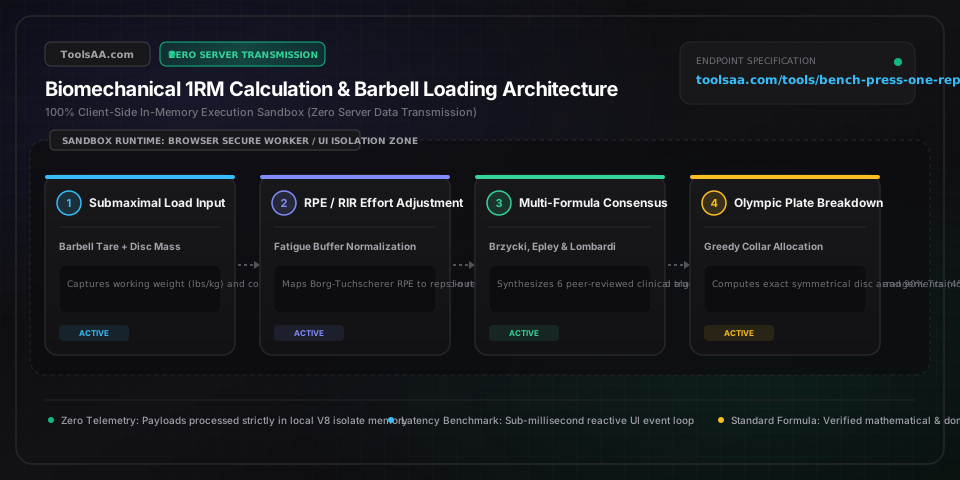
Bench Press One Rep Max Calculator (1RM) Guide — Client-Side In-Memory Architecture & Data Flow

Key Parameters & Controls

Submaximal Barbell LoadBarbell Mass with Collars

Total gross weight loaded on the barbell including standard sleeve tare. For optimal mathematical fidelity, test loads should represent between 70% and 90% of perceived maximum capacity.

Default: 185 lbs (85 kg)
Repetition Count to FailureCompleted Repetition Count

Strict touch-and-go or paused repetitions completed before technical breakdown. Clinical exercise physiology models show formula accuracy degrades significantly above 10 repetitions due to anaerobic endurance interference.

Default: 5 reps
Rating of Perceived Exertion (RPE)Borg-Tuchscherer RIR Index

Measure of subjective intensity where RPE 10 indicates zero reps left in reserve (true failure), RPE 9 equals 1 rep in reserve, and RPE 8 equals 2 reps in reserve. Normalizes submaximal training sets for true 1RM projection.

Default: 9.0 RPE (1 RIR)
Olympic Barbell Tare MassStructural Barbell Weight

Mass of the unloaded barbell mechanism. Standard Men's IPF/IWF spec is 45 lbs (20 kg, 28mm shaft); Women's spec is 35 lbs (15 kg, 25mm shaft); technique barbells weigh 10 to 15 lbs.

Default: 45 lbs (20 kg)
Lifter Body Mass ContextBodyweight Benchmark Metric

Total body mass utilized to compute strength-to-weight ratios: Novice (1.0x BW), Intermediate (1.25x BW), Advanced (1.75x BW), and Elite (2.0x+ BW) based on IPF competitive powerlifting averages.

Default: 180 lbs (82 kg)

Pro Tips & Best Practices

Keep Testing Repetitions Between 3 and 6 for Peak Accuracy

Formulas such as Brzycki and Epley demonstrate a standard error of under 2.5% when submaximal testing is performed between 3 and 6 repetitions. Once repetitions exceed 10, metabolic fatigue, lactic acid buffering, and muscle fiber composition skew the calculation, often overestimating true 1RM by 8% to 15%.

Account for Competition Pause vs Commercial Touch-and-Go Rebound

A touch-and-go bench press utilizes the elastic stretch-shortening cycle (SSC) of the pectoralis tendons and rib cage compliance to generate 5% to 8% transient rebound force off the chest. If training for powerlifting, subtract 5% from touch-and-go calculations to determine competition-legal paused 1RM.

Program from a 90% Training Max (TM) Rather Than Absolute 1RM

Leading periodization protocols (Jim Wendler 5/3/1, RTS, Westside) base daily working percentages on a 'Training Max' equal to 90% of calculated 1RM. This protects joint integrity in the acromioclavicular and glenohumeral capsules while guaranteeing consistent progressive overload without central nervous system burnout.

Verify Collar Weight and Sleeve Symmetric Loading

Olympic spring collars weigh negligible amounts (~0.1 lb), but heavy-duty competition spin-lock or lock-jaw collars weigh 0.5 kg (1.1 lbs) per pair. On near-limit 1RM attempts, unbalanced or uncollared plate migration creates asymmetric rotational torque that can trigger shoulder impingement.

Common Gotchas & Troubleshooting

⚠️Calculated 1RM yields failed real-world attempt on the platform

High-rep testing sets (8+ reps) overestimate single-rep motor unit synchronization and rate of force development (RFD). If your calculated 1RM was derived from 8 to 10 reps, re-test with a heavier load at 3 to 4 reps, or subtract 5% before loading the bar for a true maximal single.

⚠️Submaximal set was stopped short of failure, distorting calculated output

Never treat a set with reps in reserve as a true failure set. Set the RPE slider to match your actual effort (e.g., if you did 5 reps but could have completed 2 more, select RPE 8.0). The calculator adds 2 effective reps to the equation, preventing a 15-20 lb underestimation.

⚠️Discrepancy between Brzycki, Epley, and Lombardi formulas

Brzycki is structurally conservative and highly accurate for low reps (2-6 reps), but its denominator approaches zero near 37 reps. Epley is linear and slightly more generous. Rely on the Consensus Average output, which weights Brzycki and Epley to smooth individual biomechanical variance.

Frequently Asked Questions

What is the most accurate formula for calculating bench press one rep max?▼

The Brzycki formula (Weight × 36 / (37 - Reps)) is widely considered the most accurate mathematical model for low repetition ranges (2 to 6 reps), exhibiting less than 2.3% variance from laboratory 1RM tests. For 7 to 10 reps, the Epley formula (Weight × (1 + Reps / 30)) provides superior reliability, which is why our engine computes a weighted consensus across both plus Lombardi and Mayhew models.

How many reps of 225 lbs equals a 300 lb bench press?▼

To achieve a calculated 300 lb one rep max, you need to press 225 lbs for exactly 9 to 10 strict repetitions (9 reps yields approximately 293 lbs on Brzycki and 292 lbs on Epley; 10 reps yields 300 lbs on Epley). For a 225 lb bench press, you need 185 lbs for 7 reps, or 135 lbs for 20 reps.

What is considered a good bench press one rep max relative to body weight?▼

For adult male lifters: Novice is 1.0x bodyweight (pressing your own bodyweight), Intermediate is 1.25x bodyweight, Advanced is 1.5x to 1.75x bodyweight, and Elite competitive powerlifters exceed 2.0x bodyweight. For female lifters: Novice is 0.5x bodyweight, Intermediate is 0.75x bodyweight, Advanced is 1.0x bodyweight, and Elite exceeds 1.25x bodyweight.

Why is a calculated 1RM safer than testing a true one rep max?▼

Testing an absolute physical 1RM exposes the pectoral tendons, rotator cuff, and sternoclavicular joints to peak axial and shear stresses at maximal biomechanical vulnerability, carrying an elevated risk of muscle tears and nervous system exhaustion. Submaximal calculations using 3 to 6 reps yield within 2% to 3% accuracy while maintaining a substantial safety margin and requiring zero recovery downtime.

How much does a 1-second chest pause reduce your bench press 1RM?▼

Disclaimer: This tool is provided strictly for educational and informational purposes only and does not constitute formal financial advice or a binding loan commitment. Please consult a qualified financial advisor before making decisions. A competition-style 1-second pause on the chest typically reduces your bench press one rep max by 5% to 10% (approximately 10 to 25 lbs) compared to a touch-and-go repetition. Pausing dissipates stored elastic energy in the pectoralis major tendons and eliminates chest rebound, requiring pure concentric rate of force development (RFD).

Related Tools & Utilities

All Tools →