Luggage Weight Converter & Airline Limits

Luggage Weight Converter & Airline Limits

Convert luggage weight instantly between kg, lbs, stone, and oz. Check 50 lb and 23 kg airline baggage limits, overweight fee risk, and packing allowances.

Load Example

Parameters & Inputs

Unit kg
0 kg21.5 kg40 kg
Lbl tweak
Lbl quick limits
3.8 Unit kg (8.4 Unit lbs)
0.5 Unit kg

Hint scale buffer desc

Lbl multi bag modeHint multi bag
Notice iata title

Notice iata body

Stat card1 title21.50 Unit kg47.40 Unit lbs
Stat card2 title17.7 Unit kg18% Lbl case tare
Lbl headroom+1.5 Unit kg+3.3 Unit lbs
Stat card3 titleBadge safeLbl limit prefix 23 Unit kg
0 Unit kg38 Unit kg
21.50 Unit kg47.40 Unit lbs
Badge safe
Lbl selected airlineDelta Air Lines
Lbl standard allowance23 Unit kg (50.7 Unit lbs)
Lbl safe target buffer22.5 Unit kg (-0.5 Unit kg)
Lbl estimated overweight fee$0
Lbl online savingsLbl save prefix 20% Lbl save suffix

Tab converter

Lbl kilograms

21.50 Unit kg

Lbl kg exact
Lbl pounds

47.40 Unit lbs

Lbl lb def
Lbl ounces

758.4 Unit oz

Lbl oz def
Lbl stones pounds

3 Unit stone 5.4 Unit lbs

Lbl st def
Lbl reverse solver1.5 Unit kg (3.3 Unit lbs) Lbl space left

Desc net payload text 19.2 Unit kg (42.3 Unit lbs).

Lbl sweaters~3 Lbl items
Lbl shoes~1 Lbl pairs
Lbl jeans~2 Lbl pairs
Stat card1 title21.50 Unit kg / 47.40 Unit lbs
Stat card2 title17.7 Unit kg (18% Lbl deadweight)
Stat card3 titleSAFE (+1.5 kg margin)
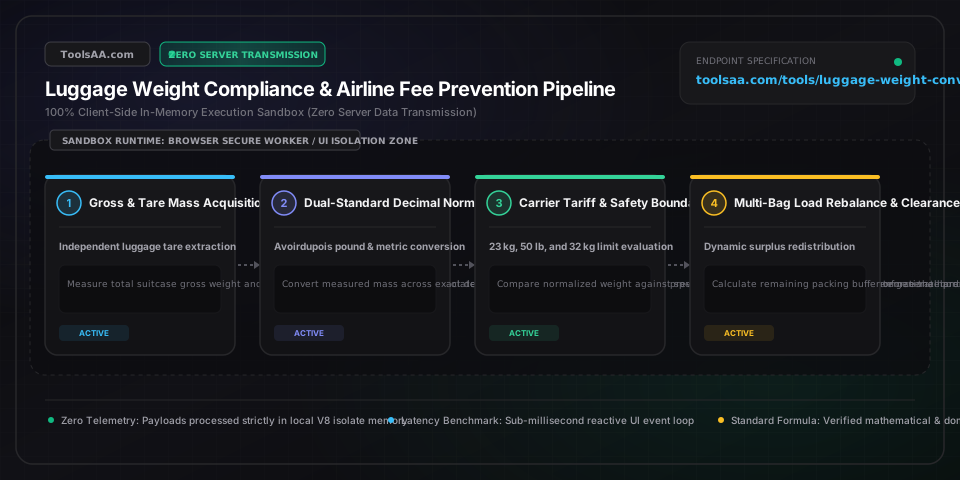
Technical Reference & Architecture Guide

Luggage Weight Converter & Airline Limits Guide

Convert luggage weight instantly between kg, lbs, stone, and oz. Check 50 lb and 23 kg airline baggage limits, overweight fee risk, and packing allowances.

Luggage Weight Converter & Airline Limits Guide — Client-Side In-Memory Architecture & Data Flow

Key Parameters & Controls

Gross Checked Baggage Weight (kg / lbs)Decimal Mass Quantity

Total measured mass of the packed suitcase including luggage casing, wheels, handles, and packed contents. Evaluated directly against statutory airline tariff bands.

Default: 21.8 kg / 48.0 lbs
Suitcase Chassis Tare WeightEmpty Luggage Mass

Unladen mass of the empty luggage container. Standard polycarbonate hardshells average 3.8 to 5.2 kg (8.4 to 11.5 lbs), while lightweight ballistic nylon softshells average 2.2 to 3.4 kg (4.8 to 7.5 lbs), consuming 10% to 23% of total passenger allowance before packing.

Default: 4.1 kg / 9.0 lbs
Standard Economy Allowance ThresholdAirline Tariff Limit

Contractual free or prepaid ticket baggage allowance ceiling. Standard international metric benchmark is 23.00 kg; US domestic imperial benchmark is 50.00 lbs (22.68 kg). Crossing this threshold triggers fixed excess luggage surcharges.

Default: 23.0 kg / 50.0 lbs
IATA Occupational Handler Safety Limit (32 kg / 70 lbs)Aviation Health & Safety Ceiling

International Air Transport Association (IATA) and airport ground crew manual handling health limit. Suitcases exceeding 32 kg (70.55 lbs) cannot be checked as passenger baggage under any circumstance and must be repacked or shipped via commercial air cargo.

Default: 32.0 kg / 70.0 lbs
Domestic Scale Calibration MarginMeasurement Tolerance Percentage

Typical variance observed between uncalibrated domestic spring or piezoelectric bathroom scales and airport NTEP/OIML certified industrial class III strain gauge load-cell check-in scales, averaging +/- 0.3 kg to 0.7 kg (+/- 0.7 to 1.5 lbs).

Default: +/- 2.0%

Pro Tips & Best Practices

Beware the Transatlantic 23 kg vs 50 lb Asymmetry Trap

A standard European or Asian allowance of 23 kg equals 50.706 lbs, whereas a US domestic carrier allowance of 50 lbs equals only 22.680 kg. If you pack a bag in London or Paris to exactly 23.0 kg, it will register as 50.7 lbs at a US check-in desk on your connecting domestic flight, officially putting you 0.7 lbs overweight and triggering up to $150 in domestic overweight penalty fees.

Subtract Luggage Tare Weight Before Calculating Packing Capacity

A large four-wheel hard-shell spinner case often weighs between 4.5 and 5.5 kg (10 to 12 lbs) completely empty. That represents nearly 24% of your total 23 kg economy ticket allowance before a single garment is packed. Always weigh the empty suitcase first to determine true net packing payload.

Automated Self-Service Bag Drops Enforce Zero Leeway

While human check-in agents frequently grant discretionary leeway for bags 0.2 to 0.5 kg (0.5 to 1.1 lbs) over the limit, automated self-service bag drop conveyor belts utilize laser volumetric scanners and certified load cells programmed with zero tolerance. A bag weighing 23.05 kg will be instantly rejected by the robotic gate, forcing manual counter re-queuing.

Wear Your Densest Apparel Through the Airport Gate

A heavy winter wool overcoat, leather jacket, and pair of rugged trekking boots weigh between 2.5 and 4.0 kg (5.5 to 8.8 lbs). Personal worn clothing is never weighed or included in baggage allowance quotas, making it the most effective immediate weight-relief mechanism if your carry-on or checked bag exceeds limits.

Common Gotchas & Troubleshooting

⚠️Handheld Digital Hook Scale Readings Fluctuate Unsteadily

Handheld hanging scales require steady vertical suspension without body sway or wrist tremor. Lift the suitcase using two hands on the hoist handle, keep elbows locked close to your torso, and wait 3 to 4 seconds for the digital display to emit a lock-in chime. Lifting from an angled position introduces lateral vector force errors of up to 5%.

⚠️Suitcase Weighs Significantly Less on Carpet Than on Hard Floor

Weighing luggage or yourself on plush carpeting absorbs downward kinetic load through the carpet pile, causing mechanical and electronic bathroom scale feet to register 1.0 to 2.5 kg (2.2 to 5.5 lbs) lighter than actual mass. Always place the scale on a flat, unyielding hard surface such as ceramic tile, polished hardwood, or concrete.

⚠️Luggage Hangs Over Bathroom Scale Platform Causing Erratic Readouts

When a bulky suitcase hangs off the edges of a compact bathroom scale, parts of the case may touch the floor or cause uneven distribution on the four corner piezoelectric transducers. Use the tare subtraction method: weigh yourself holding the suitcase, weigh yourself without the suitcase, and subtract the two numbers for exact gross luggage mass.

Frequently Asked Questions

Is 23 kg exactly 50 lbs for airline baggage limits?▼

No, 23 kg is equal to 50.706 lbs (50 lbs 11.3 oz), creating a 0.706 lb (320 gram) difference. International carriers based in Europe, Asia, and Latin America mandate a strict 23.0 kg metric ceiling, whereas United States domestic carriers (such as Delta, American, and United) mandate a 50.0 lb (22.68 kg) imperial limit. When traveling between international and US domestic flights on separate tickets, pack to the lower 22.68 kg / 50.0 lb threshold to avoid excess baggage fees.

What is the standard luggage weight limit for international flights?▼

For standard international economy class tickets, the worldwide standard checked bag weight allowance is 23 kg (50 lbs) per bag. Premium economy typically permits 23 kg to 32 kg depending on the airline, while Business and First Class tickets include 32 kg (70 lbs) per checked bag. Carry-on cabin baggage allowances range from 7 kg (15 lbs) on low-cost carriers to 10 kg (22 lbs) on European airlines and unlimited weight (subject to fitting in the overhead bin unaided) on select US carriers like Delta.

Why is 32 kg (70 lbs) the absolute maximum single suitcase weight worldwide?▼

The 32 kg (70.55 lb) cap is a non-negotiable occupational health and safety regulation enforced by the International Air Transport Association (IATA), the UK Health and Safety Executive (HSE), and aviation ground-handling labor agreements globally. Bags weighing over 32 kg pose severe musculoskeletal and spinal injury risks to airport baggage handlers loading aircraft cargo holds. Even if a passenger offers to pay heavy excess weight fees, airlines are legally prohibited from accepting any single passenger bag above 32 kg; it must be split into two bags or consigned to cargo.

How much leeway do airline scales give before charging overweight baggage fees?▼

Traditional manned check-in desks typically allow a discretionary buffer of 0.3 to 0.5 kg (0.7 to 1.1 lbs) for minor scale calibration drift or traveler error. However, automated self-bag-drop stations and ultra-low-cost carriers (e.g. Ryanair, Spirit, Frontier) operate with zero tolerance: an overage of even 0.1 kg (0.2 lbs) triggers an automated fee prompt ranging from $50 to $200. To ensure complete safety, target packing your bag at least 0.5 kg (1.1 lbs) below the official threshold.

Related Tools & Utilities

All Tools →