Short title
Title control deck
$
Lbl hours per week40 Unit hours per week
Lbl weeks per year52 Unit weeks per year
%
%
%
%
US Federal + State + FICA 7.65% Social Security & Medicare
Lbl quick scenarios
Lbl new gross salary
$77,625Lbl per year
$37.32 Lbl per hour
Lbl annual gross raise
+$2,625
+3.50% Lbl nominal growth
Lbl net paycheck delta
+$2,047.50
+$2,048 Lbl net per year
Lbl retirement delta
+$105
4% Lbl match match
Title waterfall

Desc waterfall

+$2,625Svg bar gross-$578Svg bar tax-$2,261Svg bar inflation+$105Svg bar match+$364Svg bar real13.9%Svg dial net yieldSvg gauge titleSvg gauge subtitle
Lbl real wage growth rate+0.49%
Lbl effective hourly raise+$1.26 Lbl per hour
Disclaimer financial
Stat paycheck bump+$2,047.50
Stat real purchasing power+0.49% (Lbl cpi adjusted)
Stat five year cumulative$416,261
Technical Reference & Architecture Guide

Salary Raise Calculator & Pay Increase Guide

Calculate your salary raise, pay increase percentage, and new earnings. Compare gross vs net take-home pay, inflation purchasing power, and reverse raise targets.

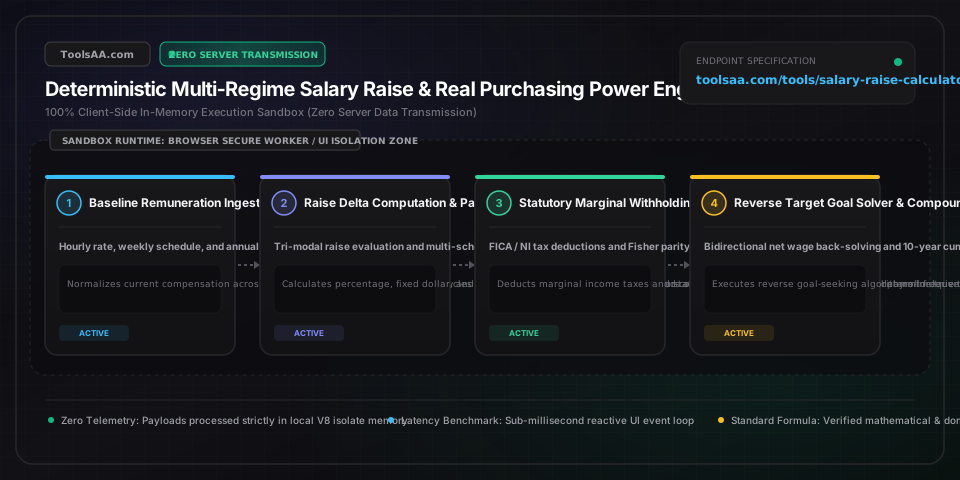
Salary Raise Calculator & Pay Increase Guide — Client-Side In-Memory Architecture & Data Flow

Key Parameters & Controls

current_base_salaryMonetary Currency Amount ($ / £ / € / ¥)

Current baseline contractual pay rate expressed as an annual salary, monthly wage, bi-weekly check, or hourly rate before the raise. Benchmark median annual wages range from $48,000 to $65,000 across OECD economies, with metropolitan professional thresholds commonly spanning $85,000 to $160,000.

Default: $75,000
raise_percentage_or_amountPercentage (%) or Fixed Currency Amount ($)

The magnitude of the pay increase, specified either as a percentage increase (e.g. 3.0% to 5.0% for standard annual merit reviews), a fixed dollar amount (e.g. $5,000/year or $2.50/hour), or a target new salary (e.g. 10% to 20% for competitive promotions or lateral job shifts).

Default: 5.0%
pay_frequencyPayroll Schedule Interval

The statutory distribution interval for paychecks: Hourly (standard 2,080 annual hours), Weekly (52 pay cycles), Bi-Weekly (26 pay cycles, common in North America), Semi-Monthly (24 pay cycles, paid on 15th/end-of-month), or Monthly (12 cycles, standard across UK and EU).

Default: Bi-Weekly (26 pays)
weekly_work_hoursDuration (Hours / Week)

Contractual working hours per week used to normalize hourly wage to annualized compensation (40.0 hours standard in US/Canada; 37.5 hours in UK/Australia; 35.0 to 38.5 hours in EU under statutory working time directives like France's Aubry laws or Germany's ArbZG).

Default: 40.0 hours
annual_inflation_ratePercentage Rate (%)

Prevailing Consumer Price Index (CPI) annual headline inflation rate used to calculate real purchasing power gain via Fisher parity: Real Rate = ((1 + Nominal Raise) / (1 + Inflation Rate) - 1). Central bank target baseline is typically 2.0%.

Default: 3.0%
marginal_tax_withholding_ratePercentage Rate (%)

Combined marginal tax rate applied to incremental wage dollars, combining federal progressive brackets (e.g. 22% or 24% US federal, 40% UK higher rate), state/provincial income taxes (0% to 13.3%), and statutory payroll withholdings (US FICA 7.65%, UK National Insurance, EU Social Security).

Default: 24.0%
target_net_take_home_increaseMonetary Currency Amount ($ / £ / € / ¥)

Target desired net take-home dollar increase per month or pay period entered into the reverse goal solver to determine the gross compensation raise required: Required Gross = Net Target / (1 - Marginal Tax Rate).

Default: $500 / month
Pro Tips & Best Practices

The Marginal Tax Bracket Fallacy (Why a Raise Never Lowers Take-Home Pay)

A persistent financial myth is that receiving a pay raise can push you into a higher tax bracket and leave you with less take-home pay than before. Modern income tax systems in the US, UK, Canada, and Europe are strictly progressive and marginal. Only the specific portion of income that exceeds a tax bracket boundary is taxed at the higher marginal rate; every dollar earned below that threshold remains taxed at the lower historical rates. Getting a raise always increases your absolute net take-home earnings.

The Inflation-Adjusted Real Wage Trap (Nominal vs Real Purchasing Power)

A nominal salary raise of 3% during a year with 4% CPI inflation is mathematically an effective 0.96% real pay cut. To measure whether a compensation adjustment improves your lifestyle, calculate the real wage increase using Fisher's exact equation: Real Rate = ((1 + Nominal Raise) / (1 + Inflation Rate) - 1). If your nominal raise fails to beat headline CPI inflation, your real purchasing power contracts and your household living standard decreases despite receiving a higher nominal paycheck.

The 26 vs 24 Paycheck Discrepancy (Bi-Weekly vs Semi-Monthly Conversion)

Never divide an annual raise by 24 if you are paid bi-weekly. Bi-weekly pay schedules produce exactly 26 paychecks per year (52 weeks / 2), creating two 'three-paycheck months' each calendar year. In contrast, semi-monthly schedules produce exactly 24 paychecks per year (twice per month, typically the 15th and last day). Dividing a $5,200 raise by 24 assumes a $216.67 per-check bump, whereas on a bi-weekly cycle your actual incremental check is $200.00 ($5,200 / 26).

Compounding Career Trajectory (Why Negotiating an Extra 2% Today Matters)

Salary raises compound exponentially over a professional career, functioning like compound interest. Securing a 7% raise instead of an initial 5% offer on an $80,000 base salary creates an initial $1,600 annual difference ($85,600 vs $84,000). Assuming standard 3.5% future annual merit increases over a 15-year career horizon, that single additional 2% negotiated today compounds to over $36,800 in cumulative extra cash earnings and permanently elevates your baseline for future equity grants, 401(k) employer matches, and performance bonuses.

Common Gotchas & Troubleshooting

⚠️Your net take-home paycheck increase is substantially smaller than your gross raise

Your incremental raise dollars are taxed at your highest marginal tax bracket, not your lower effective average tax rate. Furthermore, mandatory statutory payroll deductions (US FICA 7.65% Social Security and Medicare, state disability, and local city taxes) immediately apply to the raise amount. If you also contribute a fixed percentage of salary to an employer 401(k), pension, or HSA plan, those retirement deductions increase proportionally with your gross raise, reducing net cash flow while building long-term wealth.

⚠️Annual salary calculation does not match your employer's exact payroll figure

Payroll discrepancies typically stem from leap year work hours and working day conventions. While standard calculations assume 2,080 annual work hours (40 hours * 52 weeks), actual calendar years contain 260, 261, or 262 paid workdays depending on how weekends align. Many enterprise payroll systems (such as ADP or Workday) calculate hourly pay by dividing annual salary by 2,088 or 2,096 hours in specific calendar years, producing slight differences of a few cents per hour.

⚠️High inflation rate exceeds your annual raise resulting in negative real wage growth

When CPI inflation outpaces your salary increase, prepare an objective, data-backed Cost of Living Adjustment (COLA) business case for your manager. Highlight specific departmental accomplishments, market compensation benchmark reports (e.g. Radford, Mercer, or Levels.fyi for your industry and metro area), and demonstrate how your market replacement cost exceeds your requested compensation adjustment.

⚠️Employer offers non-cash equity or health benefit upgrades instead of a cash base raise

Evaluate total compensation holistically: equity grants (RSUs or stock options) offer upside but lack liquidity and carry market volatility risk; increased employer 401(k) matches, student loan repayment programs, or fully subsidized healthcare premiums represent immediate tax-advantaged financial value. If you need immediate monthly cash flow to cover mortgage or living costs, prioritize base salary or ask for a guaranteed one-time cash retention bonus.

Frequently Asked Questions

How is a salary raise percentage calculated?▼

To calculate a salary raise percentage: subtract your old salary from your new salary to determine the dollar increase, divide that dollar increase by your old salary, and multiply the result by 100. The mathematical formula is: Raise Percentage = ((New Salary - Old Salary) / Old Salary) * 100. For example, if your salary increases from $60,000 to $66,000, your dollar raise is $6,000. Dividing $6,000 by $60,000 gives 0.10, which multiplied by 100 equals a 10% salary raise.

What is an average or good annual salary raise percentage?▼

Historically, average annual corporate merit raises in the United States and developed economies range between 3.0% and 4.0% for cost-of-living and performance maintenance. A raise of 5.0% to 7.0% is considered above average and typically reflects strong individual performance or expanded responsibilities. Internal promotions typically command an 8.0% to 12.0% pay increase, while switching employers laterally in competitive job markets often yields a 15.0% to 20.0% salary increase.

Does getting a pay raise put you in a higher tax bracket and lower your take-home pay?▼

No, getting a pay raise will never lower your total take-home pay. Income tax systems in the United States, United Kingdom, Canada, and Europe use progressive marginal tax brackets. When your raise moves your income into a higher bracket, only the specific dollars above the bracket threshold are taxed at the higher percentage rate. All earnings below that threshold continue to be taxed at the previous, lower bracket rates. You always retain more net money after a raise than before.

How does inflation affect a salary raise?▼

Inflation erodes the purchasing power of money over time. If you receive a 3% salary raise during a year when headline Consumer Price Index (CPI) inflation is 4%, the prices of goods and services have grown faster than your earnings, resulting in an effective real wage decline of approximately 0.96%. To achieve true purchasing power expansion, your nominal salary raise percentage must exceed prevailing inflation. The Fisher real wage growth formula is: Real Growth = ((1 + Nominal Raise) / (1 + Inflation Rate) - 1).

What is the difference between a merit raise and a cost of living adjustment (COLA)?▼

A Cost of Living Adjustment (COLA) is an across-the-board wage adjustment designed to help workers maintain purchasing power parity against rising consumer inflation; it is independent of individual performance and typically indexed to official CPI data. In contrast, a merit raise is an individual pay increase awarded specifically for outstanding job performance, milestone achievements, increased technical proficiency, or expanded leadership responsibilities.

How do you calculate how much of a raise to ask for to achieve a target take-home pay?▼

Disclaimer: This tool is provided for educational and illustrative purposes only and does not constitute formal tax or investment advice. To calculate the gross raise required to achieve a target net take-home increase, use the formula: Required Gross Raise = Target Net Increase / (1 - Marginal Tax Rate). For example, if you need an extra $600 per month ($7,200 annually) in net take-home cash and your combined marginal tax rate (federal, state, and statutory FICA deductions) is 25%, divide $7,200 by 0.75 (1 - 0.25), which equals $9,600 gross annually ($800/month gross).

Related Tools & Utilities

All Tools →