Daily Water Intake Calculator & Hydration
Hydration Physiology & Wellness EngineValidated NASEM, EFSA & ACSM Models

Daily Water Intake Calculator & Hydration

Calculate exact daily water intake based on body weight, exercise, climate, and pregnancy. Get an hourly hydration schedule, bottle tracker, and electrolyte math.

Quick Presets:
1. Biometrics & Life Stage
35 mL/kg
Age30 yrs
Body Weight160 lbs
2. Exercise & Physical Exertion
Active Daily Exercise30 min
3. Environment & Elevation
+0%
Ambient Temperature72 °F
4. Daily Beverages & Salt Offsets
+0 mL
Brewed Coffee:Cups > 2 induce ~160 mL diuretic renal offset each
1
Alcoholic Drinks:Vasopressin inhibition causes +250 mL diuresis per drink
0
High-Sodium Meals:Osmotic pressure draws +200 mL hydration requirement per salty meal
0
5. Waking Schedule & Circadian Taper
16 hrs waking
Total Daily Fluid
100.1fl oz
2.96 L
All sources (Food + Drink)
Beverage Target (80%)
80.1fl oz
10 glasses
Direct drinking fluids
Solid Food (20%)
20fl oz
592 mL
From fruits & meals
Hourly Pace
5.7oz/h
Pre-bed taper safe
Prevents nocturia
Interactive Water Bottle & Progress Meter
2369 mL Direct Drinking
25%50%75%100%
2369 mL Target
Fluid Distribution Breakdown
2961 mL
10glasses
Basal:86%
Sweat:14%
Climate:0%
Offsets:0%
Quickly Log Water Intake:

Circadian Hourly Hydration Pacing

Evenly distributed fluid blocks with a 2-hour pre-bed nocturia buffer to protect deep sleep.

Time WindowTarget FluidPhysiological PhaseLogged
07:00 - 08:008 fl oz(237 mL)Morning Kickstart
08:00 - 09:008 fl oz(237 mL)Morning Kickstart
09:00 - 10:005.8 fl oz(171 mL)Midday Focus
10:00 - 11:005.8 fl oz(171 mL)Midday Focus
11:00 - 12:005.8 fl oz(171 mL)Midday Focus
12:00 - 13:005.8 fl oz(171 mL)Midday Focus
13:00 - 14:005.8 fl oz(171 mL)Midday Focus
14:00 - 15:005.8 fl oz(171 mL)Midday Focus
15:00 - 16:005.8 fl oz(171 mL)Midday Focus
16:00 - 17:005.8 fl oz(171 mL)Midday Focus
17:00 - 18:005.8 fl oz(171 mL)Midday Focus
18:00 - 19:006.4 fl oz(190 mL)Afternoon Activity
19:00 - 20:006.4 fl oz(190 mL)Afternoon Activity
20:00 - 21:006.4 fl oz(190 mL)Afternoon Activity
21:00 - 22:001.2 fl oz(36 mL)Nocturia Sleep Taper
22:00 - 23:001.2 fl oz(36 mL)Nocturia Sleep Taper
Clinical Pacing & Hyponatremia Advisory

Pace your fluid intake evenly across the day. Avoid drinking excessive quantities (>1.0 L / 34 fl oz within a single hour) to prevent acute exercise-associated hyponatremia (water intoxication). Individuals with renal compromise, congestive heart failure, or specific medical fluid restrictions should strictly follow their physician's prescription rather than generic mathematical estimators.

Primary Metric
86% / 14%

Proportion of fluid dedicated to basal metabolic organ perfusion versus active exercise recovery.

Efficiency / Capacity
2.0 Hours

Fluid intake is systematically tapered during the final 2 waking hours to minimize nocturia awakenings.

Net Output
20 fl oz

Estimated moisture naturally absorbed through fruits, vegetables, soups, and daily meal portions.

Client-Side Processing

High-performance calculation executed entirely in browser memory.

Zero Server Upload Privacy

All payloads remain strictly local with zero external server communication.

Production Ready Export

Clean, optimized output formats ready for immediate deployment.
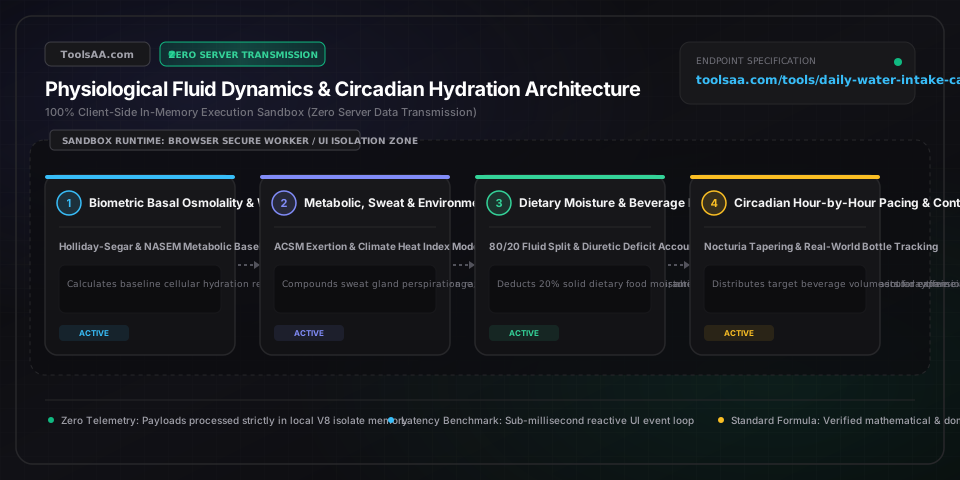
Technical Reference & Architecture Guide

Daily Water Intake Calculator & Hydration Guide

Calculate exact daily water intake based on body weight, exercise, climate, and pregnancy. Get an hourly hydration schedule, bottle tracker, and electrolyte math.

Daily Water Intake Calculator & Hydration Guide — Client-Side In-Memory Architecture & Data Flow

Key Parameters & Controls

Body Mass & Weight (kg / lbs)Anthropometric Mass (Decimal > 0)

Total body weight serving as the foundational metabolic scalar. Standard physiological models assign 30 to 35 mL of baseline water per kilogram of body weight (approx. 0.5 to 0.6 fl oz per pound) to support cellular homeostasis, blood volume, and renal filtration.

Default: 70 kg / 154 lbs
Physical Activity Duration & IntensityMetabolic Exertion (Minutes & Metabolic Tiers)

Daily active exercise duration and exertion tier. Strenuous muscular work elevates core temperature, triggering eccrine sweat glands. ACSM guidelines recommend replenishing 350 to 500 mL (12 to 16 fl oz) per 30 minutes of moderate activity, and up to 850 mL for vigorous endurance exercise.

Default: 30 minutes (Moderate)
Environmental Temperature & Heat IndexThermal Environment (°C / °F & Humidity)

Ambient climatic conditions governing thermoregulation. High ambient heat (>25°C / 77°F) and relative humidity increase perspiration and blunted evaporative cooling, adding 10% to 20% to baseline fluid requirements. Arid dry air increases transepidermal water loss.

Default: 22°C / 72°F (Temperate)
Altitude & Elevation LevelBarometric Elevation (Meters / Feet Above Sea Level)

Elevation above sea level. At altitudes above 2,500 meters (8,200 feet), lower atmospheric pressure and hypoxic air stimulate hyperventilation, doubling respiratory water vapor exhalation and accelerating urinary fluid loss, requiring an additional 500 to 1,000 mL/day.

Default: Sea Level (<1,000 m)
Life Stage & Pregnancy / Lactation StatePhysiological Life Phase (Categorical Enum)

Maternal physiological status. ACOG and NASEM clinical guidelines dictate an additional 300 mL/day (+10 fl oz) during pregnancy to support expanded vascular volume and amniotic fluid, and 700 to 1,000 mL/day (+24 to +34 fl oz) during lactation to supply breast milk synthesis.

Default: Standard (Non-Pregnant)
Dietary Food Moisture Contribution (80/20 Ratio)Nutritional Moisture Fraction (Percentage)

The proportion of total daily water derived from solid foods versus beverages. Standard mixed diets naturally supply approximately 20% of total hydration from fruits, vegetables, soups, and cooked grains, leaving 80% to be satisfied via drinking fluids.

Default: 20% Food / 80% Fluid
Caffeine & Alcohol Diuretic CompensationPharmacological Fluid Offset (Servings / Day)

Daily intake of beverages with diuretic properties. Moderate caffeine (<300 mg) causes minimal net fluid loss, but high doses require 1:1 fluid offsets. Alcohol suppresses posterior pituitary vasopressin (antidiuretic hormone ADH), prompting mandatory 250 mL water replenishment per drink to prevent intracellular dehydration.

Default: 0 servings
Circadian Waking Hours & Pacing WindowTemporal Interval (Clock Hours / Day)

The daily active hydration window between morning awakening and evening sleep. Distributing intake in consistent 150 to 250 mL portions every 60 to 90 minutes optimizes gastrointestinal absorption and renal tubular reabsorption while tapering intake 2 hours before bed minimizes nocturia.

Default: 16 Waking Hours (7:00 AM - 11:00 PM)

Pro Tips & Best Practices

The 80/20 Beverage-to-Food Rule: Why You Never Need to Drink 100% of Your Water Target

A frequent misconception in hydration tracking is assuming your entire daily water recommendation must be consumed through drinking water alone. According to clinical data from the US National Academies (NASEM) and EFSA, roughly 20% of your daily water intake is absorbed from solid food moisture (water-rich fruits like watermelon and strawberries contain 90-92% water; vegetables like cucumbers contain 95%; even cooked rice and chicken provide 60-70% water). For a person with a total biological requirement of 3,000 mL, only 2,400 mL (approx. 80 fl oz) needs to come from direct fluids. This calculator automatically isolates your direct drinking target from total biological requirement.

The Armstrong Urine Color Index vs Thirst Sensation: Why Thirst is a Delayed Metric

Relying strictly on thirst to initiate drinking guarantees chronic mild dehydration. The physiological thirst sensation is mediated by hypothalamic osmoreceptors that only trigger when serum osmolality increases by 1% to 2%—a threshold corresponding to an existing 1.5% to 2.0% body weight fluid deficit, enough to reduce cognitive focus, memory, and physical power output by up to 15%. To evaluate true cellular hydration in real time, reference the validated Armstrong 8-level urine color chart upon morning voiding. Pale straw or light lemonade (Levels 1-3) signals optimal hydration; dark amber or iced-tea shades (Levels 5-8) demand immediate rehydration.

Circadian Hydration Pacing & The 2-Hour Pre-Bed Nocturia Taper: Protecting Sleep Architecture

Chugging large quantities of water late in the evening to meet a daily quota disrupts restorative slow-wave sleep. Glomerular filtration continues overnight, and an overloaded bladder triggers nocturia (waking up to urinate), fragmenting deep sleep cycles and impairing circadian growth hormone release. The optimal clinical protocol fronts 60% of your daily fluid intake during the morning and early afternoon, sips moderate amounts during late afternoon, and halts major fluid consumption 2 hours before bedtime. If nighttime thirst occurs, limit consumption to small 2-3 oz sips.

Electrolytes, Hypotonic Overhydration & Exercise-Associated Hyponatremia (EAH)

More water is not always healthier. In prolonged endurance exercise (>60-90 minutes) or extreme summer heat, drinking massive quantities of plain hypotonic water without replacing lost electrolytes (specifically sodium, lost in sweat at 800 to 1,500 mg per liter) dilutes serum sodium below 135 mEq/L, triggering exercise-associated hyponatremia (EAH). Symptoms include headache, cerebral edema, nausea, and disorientation. When exercising intensely for over an hour or sweating heavily, pair your fluid intake with 200 to 400 mg of sodium and electrolytes per 500 mL of water rather than consuming plain water alone.

Common Gotchas & Troubleshooting

⚠️Experiencing frequent urination and clear urine immediately after increasing water intake

When rapidly escalating daily water consumption, renal tubular down-regulation of aquaporin-2 water channels causes transient polyuria (frequent urination). Do not chug entire 32 oz bottles in single sessions, which exceeds the kidney's maximum excretion rate of 800 to 1,000 mL/hour. Space your intake into steady 150 to 250 mL (5 to 8 oz) servings every 60 to 90 minutes, and ensure adequate dietary electrolytes so water can be retained in intracellular and vascular compartments.

⚠️Stomach sloshing, gastrointestinal cramps, and fullness during workout sessions

During moderate to vigorous exertion, sympathetic nervous activation shunts splanchnic blood flow away from the gut to active skeletal muscles, slowing gastric emptying rates to roughly 600 to 800 mL/hour. Consuming large fluid boluses immediately before or during exercise causes stomach sloshing and nausea. Pre-hydrate with 400 to 500 mL (14 to 17 fl oz) 2 hours before exercise, and restrict intra-workout sips to 100 to 150 mL (3 to 5 fl oz) every 15 to 20 minutes.

⚠️Confusion over whether coffee, tea, and flavored seltzers count toward daily water targets

Scientific studies by Armstrong et al. and Maughan et al. demonstrated that caffeinated beverages up to 300 to 400 mg caffeine (approx. 3 to 4 standard cups of brewed coffee) provide a Beverage Hydration Index (BHI) comparable to plain water without net fluid depletion. However, if your caffeine intake exceeds 400 mg daily or if you consume alcoholic beverages, add 1 glass of plain water per serving to counterbalance mild adenosine receptor antagonism and vasopressin inhibition.

⚠️Severe muscle cramps and fatigue persist despite drinking 4+ liters of water daily

Persistent cramping despite high water intake is a hallmark symptom of intracellular electrolyte depletion rather than dehydration. Heavy sweating expels sodium, chloride, potassium, and magnesium. Consuming plain water further dilutes extracellular solute concentrations, impairing muscle action potentials and neuromuscular transmission. Incorporate an electrolyte supplement or lightly salted beverage (1/4 tsp salt per liter) during heavy sweating days.

Frequently Asked Questions

How do you calculate how much water you should drink a day?▼

To calculate your baseline daily water intake, multiply your body weight in kilograms by 30 to 35 mL (or multiply your weight in pounds by 0.5 to 0.6 fluid ounces). For example, a 160-pound (72.5 kg) individual has a baseline requirement of approximately 80 to 96 fluid ounces (2.2 to 2.5 liters) of water daily. Next, adjust for lifestyle and environmental factors: add 12 to 16 fl oz (350 to 500 mL) for every 30 minutes of moderate exercise, add 10% to 20% in hot or humid weather, and remember that approximately 20% of your total fluid intake naturally comes from solid foods, meaning direct drinking fluid covers the remaining 80%.

Is the 8x8 rule (eight 8-ounce glasses of water a day) scientifically accurate?▼

The popular '8x8 rule'—drinking eight 8-ounce glasses (64 fl oz or approx. 1.9 liters) of water a day—is a convenient rule of thumb but lacks rigorous clinical foundation. It originated from an oversimplified 1945 Food and Nutrition Board recommendation that overlooked water absorbed from food. For petite sedentary individuals, 64 fl oz may be sufficient; however, for larger bodies, active athletes, or hot climates, 64 oz is often inadequate, leaving individuals with a 30% to 50% hydration deficit. Clinical organizations such as the US NASEM recommend total daily fluid intakes of 125 fl oz (3.7 L) for men and 91 fl oz (2.7 L) for women.

How much extra water should you drink during exercise and sweating?▼

The American College of Sports Medicine (ACSM) recommends drinking 16 to 20 fl oz (500 to 600 mL) of water 2 to 3 hours before exercise, 7 to 10 fl oz (200 to 300 mL) every 10 to 20 minutes during exercise, and 16 to 24 fl oz (500 to 750 mL) for every pound of body weight lost through sweat post-workout. For exact precision, weigh yourself nude before and after a 60-minute training session: if you lost 1.5 lbs (0.68 kg) and drank 8 oz of fluid, your sweat rate is 32 fl oz (approx. 1 liter) per hour, which represents your target replenishment pace.

Does coffee, tea, and soda count toward your daily water intake?▼

Yes, caffeinated coffee, tea, and sodas contribute toward your daily hydration quota. Extensive research from the University of Birmingham confirmed that moderate daily coffee consumption (up to 4 cups or 400 mg caffeine) provides hydrating qualities statistically indistinguishable from water. While high doses of caffeine exhibit a mild diuretic effect on naïve consumers, regular coffee drinkers develop tolerance, retaining over 80% to 90% of the ingested fluid volume. However, plain water remains the gold standard because it contains zero added sugars, artificial sweeteners, or acidic dental compounds.

How much water should a pregnant or breastfeeding woman drink daily?▼

According to the American College of Obstetricians and Gynecologists (ACOG) and the Institute of Medicine (IOM), pregnant women need an additional 10 to 12 fl oz (300 mL) of fluid daily, reaching a total recommended intake of 100 fl oz (3.0 L) per day to support expanded maternal blood volume, placental circulation, and amniotic fluid replenishment. Breastfeeding and lactating mothers have significantly higher requirements, needing an additional 24 to 34 fl oz (700 to 1,000 mL) daily—totaling approximately 128 fl oz (3.8 L / 1 gallon) of fluid daily—because human breast milk is composed of approximately 87% water.

What are the health risks of drinking too much water (hyponatremia)?▼

Disclaimer: This tool is provided strictly for educational and informational purposes only and does not constitute formal financial advice or a binding loan commitment. Please consult a qualified financial advisor before making decisions. Drinking excessive water beyond what your kidneys can eliminate—typically exceeding 800 to 1,000 mL (27 to 34 fl oz) per hour on a continuous basis—can lead to water intoxication and hyponatremia. In this condition, excess fluid dilutes the concentration of sodium in the bloodstream below 135 mmol/L, causing osmotic shifts that force water into cellular compartments. Symptoms progress from mild nausea, bloating, and headache to severe cerebral edema, confusion, seizures, and in extreme cases, coma. Hyponatremia is most common among marathon runners and endurance athletes who overconsume hypotonic plain water without electrolyte replacement.

Related Tools & Utilities

All Tools →