Lbl no events
Hint warm audio guide
Decode Morse code from audio files or live microphone in real time. Features automatic carrier frequency detection, adaptive noise filtering, WPM tracking, and live spectrogram.
Lbl no events
Hint warm audio guide
Decode Morse code from audio files or live microphone in real time. Features automatic carrier frequency detection, adaptive noise filtering, WPM tracking, and live spectrogram.
The center acoustic pitch of the continuous-wave (CW) audio tone, standardly calibrated between 500 Hz and 800 Hz (default 700 Hz). The sound engine isolates this specific pitch with a narrow acoustic bandpass filter to eliminate surrounding noise.
The width of the acoustic frequency window admitted into the sound envelope detector. A narrow 50–80 Hz window rejects adjacent radio chatter and room echo, while a wider 150–250 Hz window accommodates vintage transmitters with slight pitch drift.
The sound energy cutoff level used by the dual-level Schmitt trigger to distinguish intentional beeps from quiet background static. Dual-boundary hysteresis (-24 dB on, -28 dB off) prevents micro-bursts of noise from creating false letters.
Pacing speed of telegraphic sound calibrated against the international PARIS standard (50 dot-equivalent units per word). At a conversational 18 WPM, a standard dot (dit) lasts 66.7 milliseconds, and a dash (dah) lasts 200 milliseconds.
Timing multiplier that stretches the silent breathing gaps between characters and words while preserving crisp, high-speed dits and dahs. Essential for learners and training broadcasts practicing rhythmic auditory recognition.
Permissible timing margin when classifying incoming audio pulses into short dits (1 unit) versus long dahs (3 units), compensating for human straight-key rhythmic variations and acoustic room reverberation.
Volume differential between the targeted Morse beep and ambient background static or room murmur. An SNR above 12 dB produces flawless transcription, while 3 to 6 dB represents challenging, near-whisper conditions.
Audio recordings from vintage transmitters, shortwave radios, or hand-cranked field units frequently drift by 20 to 50 Hz over time. Click Auto-Detect Peak Carrier during active sound playback to instantly center the audio bandpass filter directly on the true dominant frequency.
When decoding noisy shortwave recordings, outdoor field captures, or cassette tapes, narrow the filter bandwidth slider to 50–70 Hz. This steep acoustic roll-off cuts out 80% of ambient hiss, air conditioner rumble, and high-pitched squeals without blunting the Morse rhythm.
Single-threshold decoders trigger stuttering false dits whenever crackly audio hovers near the volume cutoff line. If transcriptions show unexpected clusters of 'E' (.) and 'T' (-) letters, widen the detection hysteresis gap so the sound must decisively drop before registering key release.
International Morse code timing is mathematically benchmarked against the standard word 'PARIS', containing exactly 50 elemental time units. Calculate any exact dot duration using the formula: Dit Duration (ms) = 1200 / WPM. At 20 WPM, every dit is exactly 60 ms and every dash is 180 ms.
Educational Morse audio frequently transmits individual letters at a brisk 20 WPM (teaching the ear to recognize sound melodies) while inserting relaxed 10 WPM pauses between words. Enable Farnsworth Mode so prolonged pauses are correctly read as letter spaces rather than broken sentences.
The squelch threshold is set too close to the room static floor, causing random microphone rustle or background hiss to register as micro-beeps. Increase the Squelch Threshold slider by +6 dB to +10 dB, or widen the Schmitt trigger hysteresis spread to ignore gentle floor noise.
The bandpass filter center frequency does not match the pitch of your audio source. Observe the live spectrogram visualizer to identify the bright frequency peak (e.g., 850 Hz instead of the default 700 Hz), then click 'Auto-Tune' or slide Carrier Tone Frequency to match.
The transmission speed (WPM) setting is out of synchronization with the audio pacing, or the recording utilizes Farnsworth pauses. Turn on Automatic WPM Tracking and increase the Farnsworth Spacing Ratio until inter-character audio silences align with space boundaries.
Aggressive audio compression codecs (like low-bitrate MP3s or smartphone noise-cancelling microphone algorithms) smear sharp tone attacks. Disable software noise suppression in your browser microphone settings, or convert compressed audio to an uncompressed 16-bit 44.1 kHz WAV file.
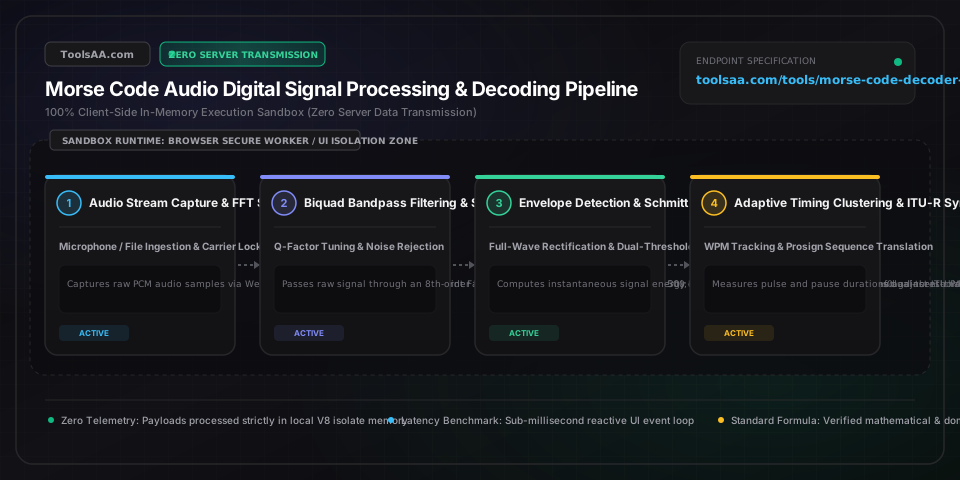
An audio Morse decoder analyzes sound waves through four sequential acoustic stages: First, a narrow bandpass filter isolates the target tone frequency (typically 600–800 Hz) from room echo and background noise. Second, an envelope detector converts raw alternating sound vibrations into a smooth volume energy contour. Third, an adaptive Schmitt trigger applies two-stage hysteresis thresholding to turn energy peaks into clean digital ON and OFF pulses. Finally, pulse lengths are measured against the universal ITU standard ratio (1 unit for a dit, 3 units for a dah, 3 units for letter spaces, and 7 units for word breaks) to transcribe clean plaintext.
The most common audio pitch for continuous-wave (CW) Morse code is 700 Hz, situated within the 600 Hz to 800 Hz range that provides peak human auditory sensitivity with minimal listening fatigue over long sessions. While amateur radio operators universally favor 700 Hz, maritime navigation beacons, aviation NDB markers, and military emergency transmitters can range anywhere from 400 Hz to 1200 Hz. ToolsAA includes a real-time peak carrier detector that sweeps the 300–1500 Hz spectrum to lock onto any incoming pitch automatically.
Morse code speed is calculated using the international 'PARIS' timing standard, where the word 'PARIS' equals exactly 50 elemental dot units (including all internal dits, dahs, and spacing intervals). The fundamental timing formula is: Dit Duration (ms) = 1200 / WPM. For example, at 12 WPM (novice speed), a dot lasts 100 ms and a dash lasts 300 ms; at 20 WPM (standard operator speed), a dot lasts 60 ms and a dash lasts 180 ms. Commercial high-speed telegraphy occasionally employs the 'CODEX' standard (60 units per word, formula: Dit Duration = 1000 / WPM).
Yes, the decoder reliably transcribes degraded audio down to a signal-to-noise ratio (SNR) of +6 dB using acoustic pre-filtering. An 8th-order bandpass filter isolates the carrier tone while stripping 60 Hz electrical hum, room rumble, and broadband tape hiss; an adjustable squelch gate silences dead air; and dual-threshold hysteresis prevents erratic noise oscillations from triggering false dots. For severely degraded recordings, narrowing the filter bandwidth to 50 Hz ensures maximum signal isolation.
Farnsworth timing sends individual Morse characters at a brisk acoustic speed (such as 18 to 25 WPM) but extends the pauses between letters and words to lower the overall pace down to 10 or 12 WPM. Pioneered by Donald R. Farnsworth, this method trains students to perceive each letter as a cohesive musical sound shape rather than counting individual dits and dahs, preventing the common intermediate learning plateau. ToolsAA features an adjustable Farnsworth ratio slider to decode these practice transmissions without merging or dropping words.
Calculate matrix determinants instantly with step-by-step LU decomposition, cofactor expansion, eigenvalues, and invertibility checks for 2x2 up to 8x8 matrices.
Calculate gross profit margin, net margin, and markup instantly. Features 4-way reverse solving, fees and shipping deductions, and pricing sensitivity matrix.
Track intermittent fasting in real time with metabolic stages. Calculate 16:8, 18:6, OMAD eating windows, reverse target solver, and export iCal schedules.
Convert hex to decimal and hexadecimal to dec with signed two's complement, 64-bit BigInt precision, IEEE 754 floats, byte endianness, and step-by-step math.
Calculate your electricity bill, kWh energy usage, and power costs. Estimate appliance consumption with tiered tariffs, fixed charges, and solar savings.
Calculate debt-to-income (DTI) ratio instantly. Compare front-end housing vs back-end total DTI against Fannie Mae, FHA & VA limits with max loan solver.