Title short
Badge cfa standard

Margin Calculator & Profit Markup Tool

Calculate gross profit margin, net margin, and markup instantly. Features 4-way reverse solving, fees and shipping deductions, and pricing sensitivity matrix.

Lbl regime short
Lbl presets
Lbl calc modeBadge four way solver
Title core variablesUS / Global (USD $)
$

Hint cogs

$

Hint revenue

Lbl tax mode
%
Lbl pre tax revenue$68.00
64.7%
%
183.3%
%

Hint markup note

Lbl operating deductionsLbl net margin tier
%
$
$
$
$
Lbl discount simulator10% Lbl off
Lbl discounted price: $61.20Lbl new gross margin: 60.78%
Kpi gross profit
$44.00
Lbl per unit sold
Kpi gross margin
64.71%
Lbl profit share
Kpi markup
183.33%
Lbl cost plus
Kpi net profit
$25.23
Lbl after all fees
Kpi net margin
37.10%
Lbl net share
Kpi multiplier
2.83x
Lbl revenue to cogs
Chart split bar title$68.00 (100%)
35% Chart bar cogs
24% Chart bar ops
37% Chart bar net
Lbl legend cogs:$24.00
Lbl legend fees:$2.27
Lbl legend fulfillment:$16.50
Lbl legend net profit:$25.23
Chart waterfall title

Chart waterfall subtitle

$68.00Col revenue-$24.00Col cogs$44.00Col gross profit-$2.27Col fees-$16.50Col ops cac$25.23Col net profit
Title key insights
Insight margin vs markup

Desc margin vs markup

Insight discount risk

Desc discount risk

Insight unit economics

Desc unit economics

Stat1 value
Stat1 label
Stat1 sub
Stat2 value
Stat2 label
Stat2 sub
Stat3 value
Stat3 label
Stat3 sub

Client-Side Processing

High-performance calculation executed entirely in browser memory.

Zero Server Upload Privacy

All payloads remain strictly local with zero external server communication.

Production Ready Export

Clean, optimized output formats ready for immediate deployment.

Disclaimer text
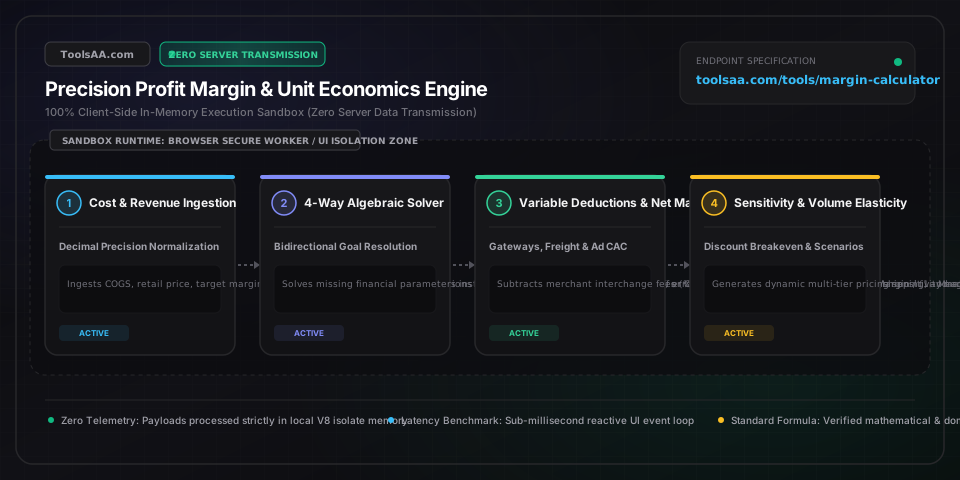
Technical Reference & Architecture Guide

Margin Calculator & Profit Markup Tool Guide

Calculate gross profit margin, net margin, and markup instantly. Features 4-way reverse solving, fees and shipping deductions, and pricing sensitivity matrix.

Margin Calculator & Profit Markup Tool Guide — Client-Side In-Memory Architecture & Data Flow

Key Parameters & Controls

Cost of Goods Sold (COGS)Decimal Currency Amount

The direct expense incurred to acquire, manufacture, or produce a single unit of product. Includes raw materials, direct manufacturing labor, and wholesale purchase price. Excludes indirect overhead such as rent or administrative salaries.

Default: $25.00
Revenue / Selling PriceDecimal Currency Amount

The gross retail or wholesale price charged to the final customer per unit before deductions. In B2C markets, this may be quoted tax-inclusive or tax-exclusive depending on the regional regime.

Default: $50.00
Gross Profit Margin (%)Percentage (0.00% to 99.99%)

The proportion of revenue remaining after subtracting direct product cost (COGS), expressed as a percentage of revenue: ((Revenue - COGS) / Revenue) * 100. Represents the fundamental pricing power and profitability ceiling.

Default: 50.00%
Markup Percentage (%)Percentage (0.00% to 1,000.00%+)

The percentage added to the cost price to determine the final selling price: ((Revenue - COGS) / COGS) * 100. While margin can never reach 100%, markup can scale infinitely (e.g. 100% markup corresponds to 50% margin).

Default: 100.00%
Transaction & Marketplace FeesPercentage + Fixed Currency

Direct payment processing costs (e.g. credit card interchange of 2.9% + $0.30) and third-party marketplace referral commissions (e.g. Amazon 15%, Etsy 6.5%) that reduce gross revenue to net realized receipts.

Default: 2.9% + $0.30
Net Operating Profit & Margin (%)Currency & Percentage

The true bottom-line earnings retained after deducting COGS, payment gateway fees, marketplace commissions, packaging, shipping fulfillment, and per-unit marketing CAC. Net Margin = (Net Profit / Revenue) * 100.

Default: $15.55 (31.10%)

Pro Tips & Best Practices

The Keystone Pricing Rule: Why 100% Markup Equals Exactly 50% Margin

In retail commerce, 'Keystone Pricing' refers to doubling the wholesale acquisition cost to determine the retail MSRP (e.g. buying for $20 and selling for $40). This represents a 100% markup, but exactly a 50% profit margin ($20 profit / $40 revenue). Confusing these two terms is the number one cause of pricing losses: aiming for a 50% margin by adding a 50% markup yields a retail price of only $30, leaving a margin of only 33.3%.

Discount Volume Elasticity: Why a 10% Discount Requires a 33% Volume Surge

Price discounts compress profit margins far faster than revenue. For a product operating at a 40% gross margin, offering a 10% promotional discount reduces the profit margin to 33.3% on price. To earn the exact same dollar profit, your unit sales volume must increase by 33.3% (Delta V = Discount / (Margin - Discount)). If you offer a 20% discount on a 40% margin, you must double unit sales (+100%) simply to break even on profit.

The Hidden Drain of Blended Payment Gateway & Chargeback Reserves

Standard online payment processors quote 2.9% + $0.30 for domestic cards, but cross-border international cards, American Express, and currency conversions frequently elevate the true effective rate to 3.5% - 4.1%. On lower average order values (e.g. $10.00), the fixed $0.30 fee represents an additional 3.0% penalty by itself, resulting in a total fee drag of nearly 6%.

Target Costing: Designing Products Backwards from Retail Market Price

Top manufacturing brands and e-commerce leaders utilize Target Costing rather than Cost-Plus Pricing. Determine the ceiling price customers are willing to pay based on competitor analysis, establish your mandatory target margin (e.g. 65%), and solve for the maximum allowable COGS: Max COGS = Retail Price * (1 - Margin). If manufacturing quotes exceed this ceiling, re-engineer product specs before entering production.

Common Gotchas & Troubleshooting

⚠️Target Margin of 100% or greater triggers calculation error or infinite price

By mathematical formula, Margin = (Price - Cost) / Price. Achieving a 100% margin requires Cost of Goods to be exactly zero, while a margin greater than 100% requires a negative cost. To price physical products or services with positive COGS, the target margin must remain strictly below 100% (typically 10% to 85%). If you intend to double or triple your cost, use the Markup input instead.

⚠️Gross profit is positive but net operating margin results in a loss

A product with a seemingly healthy 40% gross profit margin will generate negative cash flow if per-unit variable deductions exceed the gross spread. Verify the sum of payment processing fees (2.9% + $0.30), marketplace commissions (8-15%), outbound pick-and-pack fulfillment ($4-$8), and blended advertising CAC ($10-$25). Increase retail price, bundle units to raise AOV, or negotiate bulk supplier discounts.

⚠️Floating-point penny rounding discrepancies across large invoicing batches

Standard computing systems and electronic spreadsheets using IEEE 754 binary floating-point representation can create subtle fractional cent drift (for example, multiplying $19.99 by 3 displaying as $59.970000000000006). This tool utilizes exact decimal mathematics with strict half-up commercial rounding to two decimal places, fully reconciling with GAAP accounting conventions, bank ledgers, and enterprise invoicing standards.

Frequently Asked Questions

What is the difference between profit margin and markup?▼

Profit margin and markup are two ways of measuring the relationship between cost and selling price, but they use different denominators. Profit margin is profit divided by selling price (Profit / Revenue), showing how much of every dollar earned is kept as profit. Markup is profit divided by cost (Profit / COGS), showing how much the price was raised above the original cost. For example, if you buy an item for $50 and sell it for $100, your profit is $50: your markup is 100% ($50 / $50), but your profit margin is 50% ($50 / $100).

How do you calculate gross profit margin?▼

To calculate gross profit margin: first, find gross profit by subtracting Cost of Goods Sold (COGS) from total revenue (Gross Profit = Revenue - COGS). Next, divide gross profit by total revenue. Finally, multiply by 100 to convert to a percentage: Margin = ((Revenue - COGS) / Revenue) * 100. For instance, selling a product for $80 that cost $48 to produce yields $32 in gross profit, resulting in a gross margin of 40% ($32 / $80 * 100).

What is the formula to convert markup to margin?▼

To convert markup percentage into profit margin: Margin = Markup / (1 + Markup). When using percentages, the formula is: Margin % = (Markup % / (100 + Markup %)) * 100. For example, a 50% markup converts to: 50 / (100 + 50) = 50 / 150 = 33.33% margin. Conversely, to convert margin into markup: Markup % = (Margin % / (100 - Margin %)) * 100.

What is a good profit margin for a business?▼

A 'good' profit margin varies substantially by industry and business model. According to NYU Stern corporate benchmark data, retail grocery stores operate on slim net margins of 1% to 3%, general retail and e-commerce typically target 20% to 45% gross margins with 5% to 10% net margins, restaurants average 3% to 6% net profit, while enterprise software (SaaS) and digital products regularly achieve 75% to 85% gross margins and 20% to 30% net operating margins.

How do discounts affect profit margin and required sales volume?▼

Discounts disproportionately erode profit margins because fixed product costs (COGS) remain constant while revenue decreases. The required sales volume increase to maintain identical gross profit dollars is calculated as: Volume Surge % = (Discount % / (Gross Margin % - Discount %)) * 100. For example, on a 30% margin product, a 10% discount leaves only a 20% margin spread, requiring a 50% increase in unit sales volume (10 / (30 - 10) = 50%) just to make the same total profit.

How do you calculate selling price from cost and desired margin?▼

Disclaimer: This tool is provided strictly for educational and informational purposes only and does not constitute formal financial advice or a binding loan commitment. Please consult a qualified financial advisor before making decisions. To find the selling price needed to achieve a target gross profit margin: Selling Price = COGS / (1 - (Target Margin % / 100)). For example, if your product cost is $60 and your business requires a 40% profit margin: Selling Price = $60 / (1 - 0.40) = $60 / 0.60 = $100. Do not multiply cost by 1.40 (which is a 40% markup and yields $84, resulting in only a 28.57% margin).

Related Tools & Utilities

All Tools →