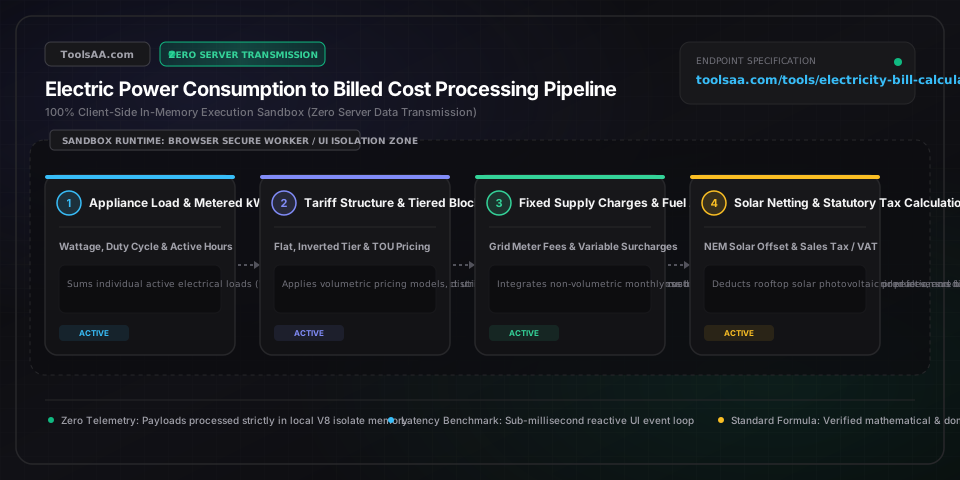
Calculate your electricity bill, kWh energy usage, and power costs. Estimate appliance consumption with tiered tariffs, fixed charges, and solar savings.
The rate at which an electrical appliance consumes active energy per unit of time, rated in Watts (W) or Kilowatts (1 kW = 1,000 W). Nameplate ratings reflect maximum full-load draw; continuous operational draw is governed by compressor cycling and thermal duty cycles.
Total active running duration of the electrical load per 24-hour cycle. Thermostatically controlled equipment (air conditioners, heat pumps, refrigerators) cycles on and off, operating at an effective duty cycle of 30% to 65% of elapsed clock time.
Cumulative electrical energy consumed across a utility billing cycle, measured in kilowatt-hours (kWh). One kWh equals one thousand watts consumed continuously for one hour. The US Energy Information Administration (EIA) benchmarks median residential usage at 890 kWh/month.
Volumetric energy supply charge billed by the electric utility per kilowatt-hour. Residential rates in North America range from $0.10/kWh (hydro-heavy regions) to over $0.35/kWh (California, Northeast US), while European household tariffs average €0.25 to €0.38/kWh.
Mandatory non-volumetric monthly standing charge billed by the utility for grid infrastructure connection, meter maintenance, and customer billing services, assessed regardless of whether any electricity is consumed.
Volumetric consumption thresholds where the marginal price per kWh escalates. Utilities establish a baseline Tier 1 allowance (typically 300-600 kWh/month) at subsidized rates, while excess consumption in Tier 2 and Tier 3 carries steep surcharges to incentivize conservation.
Credit rate credited to grid-tied rooftop solar owners for surplus solar energy exported back to the utility distribution grid under Net Energy Metering (NEM 1.0/2.0 full retail rate vs NEM 3.0 avoided-cost wholesale export rate).
Household electronics, smart appliances, television displays, and audio amplifiers consume 50 to 120 Watts of continuous standby power even when turned 'off'. Over a 30-day billing cycle, this continuous vampire draw totals 36 to 86 kWh—adding $6.00 to $20.00 to monthly utility bills with zero functional utility. Placing home entertainment centers and desktop computing setups on smart master-controlled power strips eliminates standby phantom draw completely.
Under Time-of-Use rate structures, electricity consumed during on-peak windows (typically 4:00 PM to 9:00 PM on weekdays) carries a tariff 2x to 3.5x higher than off-peak or super-off-peak night hours. Scheduling high-draw appliances—such as electric clothes dryers (3,000W), dishwashers (1,800W), and Level 2 electric vehicle chargers (7,700W)—to run after 9:00 PM or overnight reduces monthly flexible load expenditure by 40% to 65%.
Inverted block tiered tariffs bill baseline electricity affordably (e.g., $0.13/kWh for the first 500 kWh), but penalize heavy usage (e.g., $0.23/kWh over 1,000 kWh). Running an older 10 SEER central air conditioner during hot summer months consumes an extra 600 to 900 kWh, pushing your entire household load into Tier 2 and Tier 3. Every additional degree below 76°F (24.4°C) on your thermostat increases cooling power consumption by 3% to 5% at the highest marginal rate tier.
The headline 'generation rate' published by electric utilities represents only 45% to 60% of your actual bottom-line cost per kilowatt-hour. Utility invoices unbundle charges into Generation, Transmission, Local Distribution, Fuel Cost Adjustment (FCA) riders, and System Reliability Surcharges. Always calculate your effective rate by dividing total net billed dollars (excluding fixed meter fees) by total metered kWh.
Discrepancies between calculated appliance totals and utility bills typically stem from uncounted thermal baseloads: central HVAC auxiliary resistive strip heating (which draws 5,000 to 10,000 Watts when heat pumps defrost), continuous water heater standby jacket losses, duct leakage (averaging 20% to 30% thermal loss in unconditioned attics), and unbundled utility fixed meter fees or local franchise taxes.
Appliance manufacturer specification plates list maximum instantaneous peak draw under extreme mechanical stress, not steady-state consumption. For example, a refrigerator compressor rated at 400W only runs at a 30% to 40% duty cycle, yielding an effective continuous draw of only 120W to 160W. For cycling appliances, calculate energy using: (Nameplate Watts × Duty Cycle % × Operating Hours) / 1,000.
Charging a standard EV for 1,200 miles per month requires approximately 360 to 420 kWh. On flat or tiered tariffs, this additional volume stacks directly on top of existing household consumption, forcing the EV load into the most punitive Tier 2 or Tier 3 block ($0.25-$0.35/kWh). Enroll in your utility's dedicated EV Time-of-Use (EV-TOU) tariff and configure vehicle scheduled charging to engage strictly during super-off-peak overnight windows (12:00 AM to 6:00 AM).
Even when grid-tied rooftop solar panels generate 100% of your gross annual kilowatt-hours, electric utilities mandate minimum monthly customer delivery charges ($10.00 to $15.00/month) and statutory Non-Bypassable Charges (NBCs) for public purpose programs on every delivered kilowatt-hour. Under Net Billing (NEM 3.0), daytime exported energy is credited at low wholesale avoided-cost rates rather than full retail value, requiring home battery storage to achieve zero net billing.
To calculate your electricity bill from kWh, multiply your total kilowatt-hours consumed by your utility's rate per kWh, then add fixed monthly service charges and local taxes: Total Bill = (Total kWh × Energy Rate per kWh) + Fixed Meter Charge + Taxes. For example, consuming 900 kWh at $0.16 per kWh with a $12.00 monthly service charge and 6% sales tax results in (900 × $0.16) + $12.00 = $156.00 subtotal, plus $9.36 tax, totaling $165.36.
Running a 1,000-watt appliance for 1 hour consumes exactly 1.0 kilowatt-hour (kWh) of electricity. At the US national average residential electricity tariff of $0.165 per kWh, operating a 1,000W appliance costs $0.165 per hour. In European regions with an average tariff of €0.32/kWh, that same 1,000W device costs €0.32 per hour of continuous operation.
According to the US Energy Information Administration (EIA), the average residential electricity bill in the United States is approximately $140 to $150 per month. The average American household consumes approximately 890 kWh per month at a national average rate of 16.5 cents per kWh, with regional averages ranging from $90/month in Utah and Idaho to over $220/month in Connecticut and Hawaii.
Heating and air conditioning (HVAC) accounts for approximately 46% to 50% of an average home's total electricity consumption. Water heating represents the second-largest electrical load at 14% to 18%, followed by major appliances (refrigerators, washers, and dryers) at 13%, home entertainment and computing electronics at 8%, and interior/exterior lighting at 7% to 9%.
A flat rate tariff bills every kilowatt-hour consumed at the exact same fixed price (e.g., $0.16/kWh) regardless of total monthly volume. A tiered inverted block tariff splits consumption into volume tiers: baseline Tier 1 (e.g., 0-500 kWh) is charged at a lower rate ($0.13/kWh), while Tier 2 (501-1,000 kWh) and Tier 3 (>1,000 kWh) carry escalating rates ($0.19 and $0.26/kWh) to encourage energy conservation.
Disclaimer: This tool is provided strictly for educational and informational purposes only and does not constitute formal financial advice or a binding loan commitment. Please consult a qualified financial advisor before making decisions. Time-of-Use (TOU) pricing varies the cost per kilowatt-hour based on the time of day and season when electricity is consumed. Peak hours (typically 4:00 PM to 9:00 PM on summer weekdays) carry the highest rates when grid demand is stressed, while off-peak hours (morning, midday, and late evening) and super-off-peak hours (overnight) offer substantially discounted electricity tariffs.
Calculate debt-to-income (DTI) ratio instantly. Compare front-end housing vs back-end total DTI against Fannie Mae, FHA & VA limits with max loan solver.
Convert cooking measurements between cups, grams, tablespoons, ounces, and milliliters. Scale recipe yields with ingredient density tables and oven temperatures.
Calculate CD interest, APY earnings, and maturity payout for certificates of deposit. Compare compounding frequencies, early withdrawal penalties, and tax drag.
Convert binary to decimal with our binary to decimal converter and calculator. Supports signed two's complement, fractional bits, and step-by-step math.
Convert HEX to RGBA color codes with opacity and alpha transparency instantly. Supports 3, 6, and 8-digit hex codes, batch conversion, and ready-to-use CSS output.
Commission calculator to calculate sales payouts, tiered rates, agent splits, and broker fees. Project total earnings or solve reverse sales targets to hit quota.