CD Calculator & Certificate of Deposit APY
Badge cfa standard•Lbl tier m

CD Calculator & Certificate of Deposit APY

Calculate CD interest, APY earnings, and maturity payout for certificates of deposit. Compare compounding frequencies, early withdrawal penalties, and tax drag.

Lbl banking jurisdiction
Lbl quick scenarios
Lbl calculation directionMode forward short
FDIC Insurance ($250k Cap)
$
Lbl quick adjust
Lbl fully insured$10,000.00 / $250,000.00
Lbl market rates
12 Lbl months (1.0 Lbl years)
Lbl early penalty rule90 Lbl days interest
Lbl tax and inflation
IRS Form 1099-INT Ordinary Income24Unit percent
Lbl expected inflation3.0Unit percent
Lbl final maturity
$10,500.00
+$500.00 Lbl gross interest
Lbl total interest earned
$500.00
5.00% Lbl effective apy short
Lbl net after tax
$380.00
-$120.00 (24Unit percent Lbl tax drag)
Lbl effective apy
5.00%
Lbl apr prefix 4.88%
Lbl real purchasing power
0.78%
Lbl beating inflation
Lbl daily earnings
$1.37
Lbl tilde$41.67 Unit per month

Chart title

Chart desc

Legend maturityLegend tax net
Lbl initial principal $10,000
Lbl rule of7214.4 Lbl years
Lbl monthly comp gainLbl tilde$41.67
Lbl total tax drag sum-$120.00
Lbl net final payout$10,380.00
Cfa insight title

Cfa insight body

Lbl audit clipboard
Disclaimer title

Disclaimer text

Primary Metric
Stat100 insured

FDIC Insurance ($250k Cap) (United States (FDIC / IRS))

Efficiency / Capacity
1.0500Unit multiplier x

Stat comp multi desc

Net Output
0.78%

Stat real spread desc

Client-Side Processing

High-performance calculation executed entirely in browser memory.

Zero Server Upload Privacy

All payloads remain strictly local with zero external server communication.

Production Ready Export

Clean, optimized output formats ready for immediate deployment.
Technical Reference & Architecture Guide

CD Calculator & Certificate of Deposit APY Guide

Calculate CD interest, APY earnings, and maturity payout for certificates of deposit. Compare compounding frequencies, early withdrawal penalties, and tax drag.

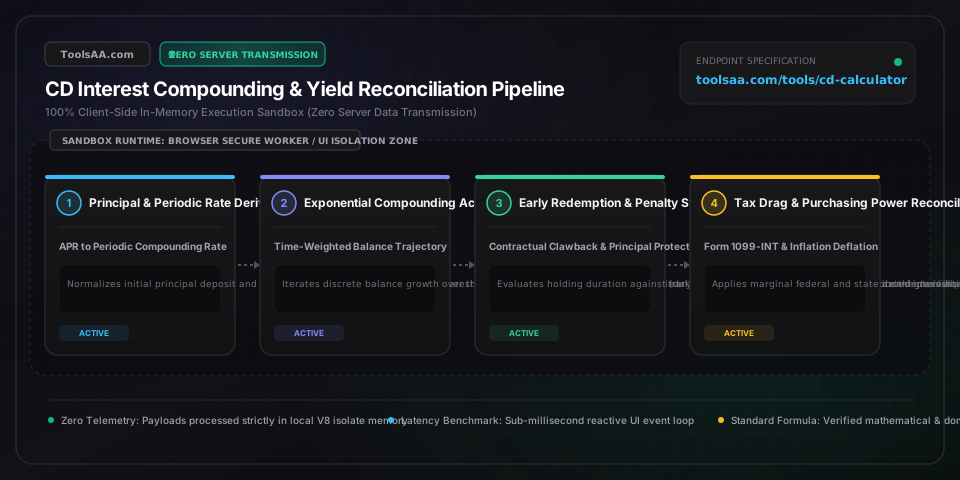
CD Calculator & Certificate of Deposit APY Guide — Client-Side In-Memory Architecture & Data Flow

Key Parameters & Controls

Principal Deposit (P)Currency (USD / GBP / EUR)

Initial lump-sum monetary capital deposited into the Certificate of Deposit. Governed by statutory deposit insurance limits ($250,000 per depositor per insured institution under FDIC in the United States, £85,000 under FSCS in the UK, and €100,000 under EU Deposit Guarantee Schemes).

Default: $10,000
Annual Percentage Yield (APY)Percentage (%)

Standardized annualized yield reflecting the true rate of return earned on principal taking into account compound interest over 365 days. Mandated by the Federal Reserve Truth in Savings Act (Regulation DD) to enable objective comparisons across varying compounding frequencies.

Default: 5.00%
Contractual Term Length (t)Duration (Months / Years)

Fixed contractual maturity horizon during which the deposited capital remains committed to the bank, commonly structured in standard intervals of 3, 6, 12, 18, 24, 36, or 60 months.

Default: 12 Months
Compounding Frequency (n)Interval (Daily / Monthly / Annually)

Rate at which accumulated interest is credited back to the principal balance to earn subsequent interest. Options include Daily 365-day basis, Commercial Bank 360-day basis (Rule of 360), Monthly (n=12), Quarterly (n=4), Semi-Annually (n=2), and Annually (n=1).

Default: Daily (365 days)
Early Withdrawal Penalty (EWP)Contractual Interest Clawback

Contractual penalty assessed under Federal Reserve Regulation D and financial institution account agreements upon premature liquidation. Standard conventions forfeit 90 days of interest for terms under 1 year, 180 to 270 days for terms of 1 to 3 years, and up to 365 days for 5-year terms.

Default: 90 Days Interest
Marginal Income Tax RatePercentage (%)

Combined marginal federal and state income tax rate applied to accrued interest under IRS Form 1099-INT constructive receipt rules, where interest is taxed as ordinary income rather than preferential long-term capital gains.

Default: 24.00%
Headline Inflation Benchmark (CPI-U)Percentage (%)

Expected annualized inflation rate measured by the Consumer Price Index for All Urban Consumers, utilized to discount nominal interest yield into real economic purchasing power return.

Default: 3.00%

Pro Tips & Best Practices

The 360-Day Commercial Bank Compounding Discrepancy

Certain commercial banks utilize an 'ordinary interest' 360-day calendar year convention (Rule of 360) rather than an exact 365-day year. While dividing annual interest by 360 marginally increases the daily periodic rate (by 365/360 or ~1.0139%), verify whether quoted APYs strictly conform to Regulation DD 365-day annualization to avoid unexpected payout discrepancies.

The Grace Period Auto-Rollover Default Rate Trap

Certificates of deposit routinely feature a strict 7-to-10 calendar day grace period following maturity. If renewal instructions are not registered, financial institutions automatically roll both principal and accrued interest into a new CD of matching term at prevailing 'board rates', which are historically 150 to 300 basis points lower than promotional new-money rates.

Principal Invasion via Early Withdrawal Penalty Clauses

If a certificate is liquidated early before accumulating sufficient interest to cover the stipulated penalty (e.g. liquidating a 5-year CD with a 180-day penalty after only 60 days of holding), financial institutions are contractually authorized to deduct the unearned penalty balance directly from your original principal deposit, resulting in negative capital returns.

IRS Form 1099-INT Annual Constructive Receipt Liability

Interest earned on multi-year certificates is reported to the IRS annually on Form 1099-INT and taxed in the calendar year credited under constructive receipt doctrine, even if your deposit agreement locks funds until final maturity and you cannot access the accrued cash without incurring penalty charges.

The CD Laddering Yield-Curve Arbitrage Strategy

Dividing lump-sum capital across five staggered maturities (1, 2, 3, 4, and 5 years) and rolling each maturing 1-year tranche into a new 5-year certificate allows savers to capture high long-duration yields while ensuring 20% of total capital unlocks every 12 months penalty-free for liquidity or rate reinvestment.

Common Gotchas & Troubleshooting

⚠️Maturity balance is higher than nominal interest rate multiplied by years.

Certificates of deposit compound interest periodically (daily or monthly), creating an Annual Percentage Yield (APY) that exceeds nominal interest (APR). For example, a 5.00% APR compounded daily yields an APY of 5.127%. The calculator reflects compounding growth; verify whether your institution quotes nominal APR or effective APY.

⚠️Net redemption cash upon early withdrawal is less than the original principal.

You encountered a principal invasion penalty. If a contract requires a 180-day interest penalty and the CD is liquidated after only 60 days of holding, the bank deducts the remaining 120 days of interest directly from your initial principal. Review contract penalty schedules or consider no-penalty CD alternatives before breaking.

⚠️Annual IRS Form 1099-INT taxable amount does not match cash distributions.

Multi-year CDs accrue taxable interest every calendar year under IRS constructive receipt rules regardless of whether interest is distributed to a checking account or automatically compounded inside the CD. Tax liabilities must be paid annually from external cash flow rather than deferred until final CD maturity.

⚠️Negative real purchasing power return despite high promotional headline rate.

Nominal yields are diminished by tax drag and consumer inflation. If an account earns 4.50% APY in a 24% tax bracket with 3.50% CPI inflation, the net post-tax return is 3.42% (4.50% * 0.76), yielding a net real purchasing power contraction of -0.08%. Use the tax and inflation discount tabs to quantify real purchasing power.

Frequently Asked Questions

How is CD interest calculated with compounding?▼

CD compound interest is calculated using the formula A = P * (1 + r / n)^(n * t), where A is the maturity balance, P is the principal deposit, r is the nominal annual interest rate (in decimal), n is the compounding frequency per year (365 for daily, 12 for monthly), and t is the investment term in years. The effective Annual Percentage Yield is APY = (1 + r / n)^n - 1. For example, a $10,000 principal at 5.00% nominal APR compounded daily yields $10,512.67 after 1 year, delivering an effective APY of 5.127%.

What is the penalty for withdrawing a CD before maturity?▼

Early withdrawal penalties typically forfeit between 60 and 365 days of simple interest based on the contract length and issuing bank terms. Standard banking benchmarks mandate 90 days of interest for terms up to 12 months, 180 days for terms of 1 to 3 years, and 270 to 365 days for 4 to 5-year terms. If the CD is liquidated before earning sufficient interest, the deficit is deducted directly from your principal deposit.

What is the difference between CD interest rate and APY?▼

The interest rate (APR) is the contractual nominal interest paid annually without accounting for compounding. Annual Percentage Yield (APY) reflects the true annual return earned when interest compounds upon itself throughout the year. Because compounding reinvests accrued interest into the principal base, APY is always higher than or equal to nominal APR for frequencies greater than once per year (e.g. 5.00% APR compounded daily produces 5.127% APY).

Are CD earnings taxed each year or only upon maturity?▼

CD interest earnings are taxed annually in the tax year credited, in accordance with IRS constructive receipt doctrine. Financial institutions issue IRS Form 1099-INT for all accounts earning $10 or more in interest annually. Even for multi-year certificates where funds remain locked until maturity, interest accrued and credited during that calendar year must be reported as ordinary income on federal and state returns.

How does a CD ladder maximize returns and liquidity?▼

Disclaimer: This tool is provided strictly for educational and informational purposes only and does not constitute formal financial advice or a binding loan commitment. Please consult a qualified financial advisor before making decisions. A CD ladder divides total investment capital into equal tranches across certificates with staggered maturity horizons (such as 1, 2, 3, 4, and 5 years). Each year, the shortest certificate matures, delivering penalty-free liquidity. If funds are not needed, the maturing tranche is rolled into a new 5-year CD at current rates. This strategy locks in higher long-term yields across the yield curve while ensuring regular annual cash liquidity.

Related Tools & Utilities

All Tools →