Simple Interest & Loan Payoff Calculator

Simple Interest & Loan Payoff Calculator

Calculate simple interest, total loan payoff, and maturity value with exact day counts. Solve for principal, rate, or term plus compare compound interest drag.

100% Client-Side Privacy
Lbl scenario details
Parameters & Inputs
$
Lbl slider principal:$28,000.00
6.50%
%
Lbl slider rate:6.50%
Lbl quick rates
Lbl slider term:5 Yrs
Lbl per diem:
$4.99Lbl per diem unit
Kpi interest$9,100.006.50% Lbl interest rate
Kpi maturity$37,100.00Lbl formula balance
Lbl monthly payment$618.3360 Unit months
Lbl compound differential+$1,618.89+17.8% Lbl compound model
Kpi maturity$37,100.0024.5% Kpi interest
Lbl principal: 75%
Kpi interest: 25%
Lbl statutory proof
Lbl simple model: Lbl formula simple
$28,000.00 × 0.0650 × 5.0000 Yrs = $9,100.00
Lbl formula balance: $28,000.00 + $9,100.00 = $37,100.00
Lbl purchasing power
$32,790.99
-$4,309.01 (2.5% Lbl inflation rate)
Lbl after tax yield
5.07%
22% Lbl tax bracket: $2,002.00

Disclaimer text
Primary Metric$9,100.00
Efficiency / Capacity$4.99 Lbl per diem unit
Net Output$37,100.00
Technical Reference & Architecture Guide

Simple Interest & Loan Payoff Calculator Guide

Calculate simple interest, total loan payoff, and maturity value with exact day counts. Solve for principal, rate, or term plus compare compound interest drag.

Simple Interest & Loan Payoff Calculator Guide — Client-Side In-Memory Architecture & Data Flow

Key Parameters & Controls

Principal Capital (P)Contractual Currency Balance

The base unadjusted amount of capital borrowed, invested, or financed before the application of finance charges. Under the Truth in Lending Act (Regulation Z), this constitutes the initial Amount Financed.

Default: 10,000.00
Nominal Annual Percentage Rate (r)Annual Percentage Rate (APR)

The contractual annual simple interest rate agreed upon by lender and debtor, expressed as a yearly percentage. Distinct from Effective Annual Yield (APY) because it assumes zero intermediate reinvestment or compounding.

Default: 5.00%
Duration Horizon (t)Temporal Maturity Interval

The elapsed lifespan of the credit facility converted into an annualized decimal fraction based on selected day-count conventions (Years, Months / 12, or Days / 365 or 360).

Default: 3.0 Years
Day-Count Convention BasisInstitutional Accrual Standard

The mathematical divisor used to allocate daily interest. Exact/365 allocates across 365 calendar days; Ordinary 30/360 (Banker's Rule) assumes twelve 30-day months, increasing daily interest charges by approximately 1.39%.

Default: Actual/365
Expected Annual Inflation (i)CPI Discount Metric

Annualized percentage depreciation of currency purchasing power, used to compute the Fisher equation real return: (1 + nominal) / (1 + inflation) - 1.

Default: 2.50%

Pro Tips & Best Practices

The Banker's Rule 360-Day Divisor Premium

Commercial loans and short-term business debt frequently utilize the 30/360 or Actual/360 Banker's Day-Count Convention. Because 360 is smaller than 365, the daily interest quotient (r / 360) is exactly 1.3889% larger than (r / 365). On a $500,000 credit line at 9.0% over 180 days, using Actual/360 costs $22,500.00 versus $22,191.78 under Actual/365, silently extracting an extra $308.22 in unearned interest.

Simple Interest Auto Loans vs Precomputed Interest

Verify whether your vehicle contract is a true daily Simple Interest Loan or a Precomputed Loan (Rule of 78s or Sum-of-Digits). True simple interest accrues daily on remaining principal, meaning paying $100 extra each month directly reduces future interest charges. Precomputed loans lock in the total lifetime finance charge upfront, penalizing borrowers who attempt early loan settlement.

The 1-Year Compounding Parity Tipping Point

For maturities under 12 months, simple interest and compounding interest yield nearly indistinguishable results (e.g. 5% simple on $10,000 for 6 months yields $250.00, while monthly compound yields $252.62). However, past year 3, the compounding curve accelerates exponentially: over 10 years, compound interest exceeds simple interest by over 29.4%, making simple interest agreements structurally advantageous for borrowers and detrimental for long-term investors.

Inflation Drag & Negative Real Yield Threshold

Fixed simple interest investments (such as non-compounding promissory notes or short-term notes) carry significant purchasing power risk. If a 3-year note pays 4.0% simple interest while inflation averages 3.5%, the nominal return is $1,200 on $10,000, but real inflation-adjusted terminal value is only $10,101.69 in year-0 purchasing power, cutting actual wealth growth by over 91.5%.

Common Gotchas & Troubleshooting

⚠️Contractual Interest Exceeds Expected Formula Output by Exactly 1.39%

Check your institutional loan note for the day-count basis. Lenders using the 30/360 Ordinary Interest (Banker's Rule) divide the annual rate by 360 instead of 365, producing 365 / 360 = 1.013889 times more daily interest. Switch the Day-Count toggle in this calculator to 30/360 to reconcile bank figures down to the exact cent.

⚠️Mismatched Time Unit Scaling Producing Massive 12x or 365x Calculation Errors

Ensure your term unit selector matches the entered number. Entering 36 under 'Years' rather than 'Months' evaluates a 36-year debt obligation rather than 3 years. Use the dedicated Unit Selector to let the calculator automatically normalize months (t / 12) or days (t / 365) to fractional years.

⚠️Reverse Solver Yielding NaN or Infinite Results When Calculating Principal or Rate

Mathematical isolation of P = I / (r * t) requires non-zero denominators. If Rate or Term is set to 0.00, the algebraic solution collapses to a division by zero. The calculator automatically clamps minimum active parameters to 0.01 to safeguard against numerical instability.

⚠️Leap Year Daily Interest Discrepancy on High-Balance Corporate Debt

In leap years containing February 29 (366 days), retail loans under Actual/Actual divide interest by 366. For a $1,000,000 note at 7%, daily interest drops from $191.78 to $191.26 per diem. Toggle the Day-Count selector to Actual/366 to ensure audited accounting compliance.

Frequently Asked Questions

How do you calculate simple interest using the formula?▼

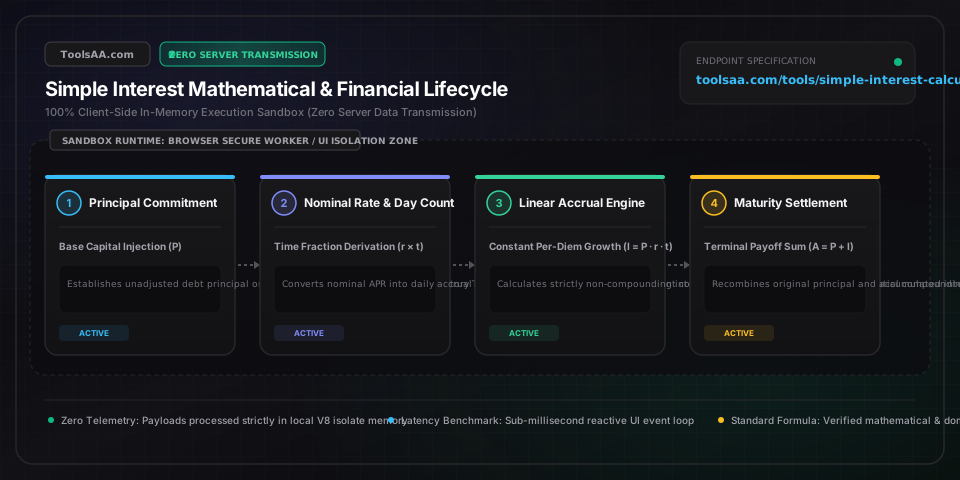
Simple interest is calculated using the formula I = P × r × t, where I is total accrued interest, P is principal balance, r is nominal annual interest rate as a decimal (e.g., 5.5% = 0.055), and t is time duration in years. For example, a $10,000 loan at 6% simple interest for 3 years yields I = $10,000 × 0.06 × 3 = $1,800. The total repayment amount at maturity equals principal plus interest: A = P + I = $11,800.

What is the difference between simple interest and compound interest?▼

Simple interest accrues exclusively on the original principal balance throughout the loan lifecycle, whereas compound interest calculates interest on both the initial principal and previously accumulated interest. On a $10,000 balance at 6% over 10 years, simple interest generates exactly $6,000 in interest ($16,000 total). In contrast, monthly compound interest generates $8,193.97 in interest ($18,193.97 total), creating a $2,193.97 compounding penalty for borrowers.

How does the Banker's Rule 360-day year affect my loan interest?▼

The Banker's Rule (Ordinary Interest) calculates daily interest as r / 360 rather than r / 365 while multiplying by actual calendar days elapsed. Because 360 is smaller than 365, the daily interest rate is 1.3889% higher. On a $100,000 commercial loan at 10% for 90 days, the Banker's Rule charges $2,500.00, whereas the Exact 365-day convention charges $2,465.75, costing the borrower an extra $34.25 in finance charges.

Can you pay off a simple interest loan early to save money?▼

Disclaimer: This tool is provided strictly for educational and informational purposes only and does not constitute formal financial advice or a binding loan commitment. Please consult a qualified financial advisor before making decisions. Yes, on a true simple interest loan, interest accrues on a daily basis (per diem) on the remaining unpaid principal balance. Making extra principal payments or paying off the balance early directly reduces the outstanding principal that daily interest is multiplied against, eliminating all future interest charges that would have otherwise accrued.

Related Tools & Utilities

All Tools →