Hourly to Salary Calculator

Hourly to Salary Calculator & Wage Converter

CFA-Certified Multi-Period Engine

Free hourly to salary calculator to convert hourly wage to annual salary, monthly pay, bi-weekly check, and overtime. Includes PTO, 1099 contractor, and bonus.

Presets:
$/ hr
Quick:
Daily Hours: 8.0h
PTO & Statutory Holidays
Overtime & Premium Enhancements
Classification & Parity
Gross Annual$52,000.00Nominal: $52,000.00
Real Hourly$27.08/hr+8.3% yield boost
Monthly Pay$4,333.3312 checks/yr
Bi-Weekly Pay$2,000.0026 checks/yr
Est. Take-Home$40,560.00After Deductions

Compensation Anatomy & Pay Flow Dynamics

Real-time multi-dimensional cash flow decomposition model.

Real Hourly$27.08/ hr
Base Pay
Physical Work Hours / Yr1,920.0 hrs
Employer Paid PTO & Holiday Value$4,000.00
Weekly Gross Inflow$1,000.00
Inflation-Adjusted Purchasing Power$39,546.00
CFA Business Intelligence Advisory & Compounding Basis

Nominal compensation assumes an unadjusted 2,080 annual hours (40 hours × 52 weeks). Actual gross income accounts for non-working unpaid periods, shift differentials, and non-exempt overtime multipliers under statutory labor standards. In bi-weekly schedules (26 checks), two months per year contain a third "bonus" paycheck, creating a positive seasonal liquidity buffer.

Annual Statutory Base2080 hours / yr
Overtime Premium Share0.0%
Employer Payroll Match7.65% statutory

Professional Financial Modeling Disclosure: This calculator is provided for comparative compensation analysis and educational guidance only. Actual take-home pay varies based on federal, state, and provincial marginal tax brackets, local municipal assessments, post-tax deductions, and specific payroll withholdings (e.g. Form W-4 / P45 / Tax File Declarations). Consult a licensed CPA, CFA, or payroll attorney prior to contractual wage execution.

Technical Reference & Architecture Guide

Hourly to Salary Calculator & Wage Converter Guide

Free hourly to salary calculator to convert hourly wage to annual salary, monthly pay, bi-weekly check, and overtime. Includes PTO, 1099 contractor, and bonus.

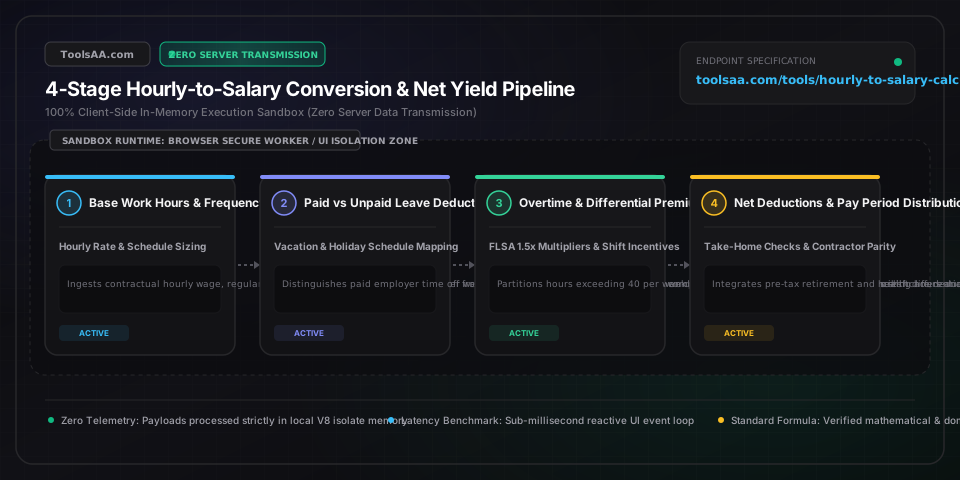
Hourly to Salary Calculator & Wage Converter Guide — Client-Side In-Memory Architecture & Data Flow

Key Parameters & Controls

Base Hourly Wage / Pay RateMonetary Currency Amount [Non-Negative]

The gross monetary compensation earned per standard working hour before taxes, retirement allocations, or voluntary deductions. Serves as the primary multiplication base across all frequency conversions.

Default: $25.00 / hour
Weekly Work Hours & Daily ScheduleDecimal Number [1.0 to 168.0 Hours/Week]

The contractual number of regular hours scheduled per week and days worked per week. The standard US and international benchmark is 40.0 hours per week across 5 working days (8.0 hours/day).

Default: 40.0 hours / week (5 days)
Paid Time Off (PTO) & Holiday AllowancesTime Intervals [Weeks & Statutory Days]

Distinguishes employer-compensated leave from unpaid absences. In full-time salaried and standard W-2 employment, paid vacation weeks and paid holidays do not reduce annual cash earnings; unpaid leave days are subtracted from total working hours.

Default: 2.0 weeks paid vacation, 10 paid holidays
Overtime Hours & Statutory MultiplierHours Quantity & Multiplier Factor [1.0x to 3.0x]

Hours worked exceeding the statutory standard (typically 40 hours/week under US FLSA). Overtime hours are compensated at premium statutory rates, conventionally 1.5x (time-and-a-half) or 2.0x (double-time for holidays/weekends).

Default: 0.0 overtime hours (1.5x multiplier)
Shift Differential & Annual Performance BonusHourly Premium & Fixed Annual Cash Amount

Additional monetary incentives including flat hourly uplifts for second/third shifts or hazard duty ($/hr), and non-guaranteed annual cash bonuses, profit sharing, or contractual sales commissions.

Default: $0.00 shift differential, $0.00 annual bonus
Employment Classification (W-2 vs 1099 Contractor)Categorical Selection [W-2 Employee | 1099 Contractor]

Governs employer payroll tax allocation. W-2 employers pay 7.65% in matching FICA taxes (6.2% Social Security + 1.45% Medicare); 1099 independent contractors pay the full 15.3% self-employment tax and fund their own benefits and unpaid downtime.

Default: W-2 Employee (Employer pays 7.65% FICA match)

Pro Tips & Best Practices

The 2,080 Annual Hours Benchmark and Leap Year Paycheck Cycles

The standard corporate formula for annual salary calculation assumes 2,080 working hours per year (40 hours/week * 52 weeks). However, a standard calendar year contains 365 days (52 weeks + 1 extra day), and a leap year contains 366 days (52 weeks + 2 extra days). Because of this calendar drift, bi-weekly salaried employees paid every two weeks (26 paychecks in standard years) will encounter a '27-paycheck year' approximately once every 11 years. Hourly workers are paid for actual hours clocked, whereas salaried workers with fixed annual agreements may experience slightly diluted bi-weekly paycheck amounts depending on payroll accounting policies.

FLSA Regular Rate of Pay Rules vs Base Hourly Distortions

Under United States Fair Labor Standards Act (FLSA) regulations, overtime cannot be calculated simply by multiplying your base hourly rate by 1.5 if you receive non-discretionary bonuses or shift differentials. The law mandates that non-discretionary bonuses (e.g. attendance, safety, or production bonuses) and shift premiums must be added into your total regular earnings before dividing by total hours worked to establish the true 'regular rate of pay'. Overtime premiums must then be calculated on this elevated regular rate, resulting in higher overtime payouts than base-rate arithmetic suggests.

The True Contractor Markup: Converting 1099 Rates to W-2 Equivalents

When evaluating whether to transition from a W-2 employee position to a 1099 independent contractor role, never accept a 1-to-1 hourly rate match. A 1099 contractor must pay an additional 7.65% in employer-equivalent FICA self-employment taxes, absorb 100% of health insurance premiums ($400-$800/month), self-fund retirement without employer 401(k) matches, and absorb 15-25 days of unpaid holidays and sick leave. As an industrial rule of thumb, an independent contractor must charge 30% to 50% above the equivalent W-2 hourly rate to achieve identical net take-home compensation.

Bi-Weekly (26x) vs Semi-Monthly (24x) Paycheck Discrepancy

Employees frequently confuse bi-weekly pay schedules with semi-monthly pay schedules, leading to budgeting errors. Semi-monthly payroll occurs exactly twice per month (typically the 15th and last day of the month), producing exactly 24 paychecks per year: Gross Paycheck = Annual Salary / 24. Bi-weekly payroll occurs every other Friday, producing 26 paychecks per year: Gross Paycheck = Annual Salary / 26. A $60,000 annual salary yields $2,500.00 gross per semi-monthly paycheck, but only $2,307.69 gross per bi-weekly paycheck, even though both accumulate to the exact same $60,000 annual total.

Common Gotchas & Troubleshooting

⚠️Annual salary calculation discrepancy: Multiplying hourly rate by 2,000 hours vs 2,080 hours produces a $2,000+ difference

The quick rule of thumb used by hiring managers multiplies hourly wage by 2,000 (e.g., $30/hr * 2,000 = $60,000) by subtracting 2 weeks (80 hours) of unpaid vacation. The formal industrial payroll standard uses 2,080 hours (40 hrs/wk * 52 weeks = 2,080 hrs; $30/hr * 2,080 = $62,400) because full-time corporate salaries include paid vacation and holidays. If your position includes paid time off, always calculate using 2,080 hours; if your contract has unpaid time off, deduct actual unpaid hours from 2,080.

⚠️Bi-weekly paycheck does not equal monthly salary divided by two

Months do not have exactly four weeks. A month averages 4.333 weeks (52 weeks / 12 months = 4.333 weeks = 173.33 working hours). A bi-weekly paycheck covers exactly 2 weeks (80 hours). Dividing monthly salary by 2 assumes an 86.67-hour pay period, which corresponds to semi-monthly pay (24 checks/year), not bi-weekly pay (26 checks/year). In two months of every calendar year, bi-weekly workers receive a third 'magic' paycheck.

⚠️Contractor take-home pay is significantly lower than anticipated despite a higher nominal billing rate

Verify billable utilization and self-employment tax settings. Independent contractors rarely bill 100% of a 40-hour work week to clients; administrative tasks, invoicing, marketing, and client acquisition typically consume 15% to 25% of working hours (yielding 75-85% billable utilization). Furthermore, the 15.3% self-employment tax (Schedule SE) applies to 92.35% of net business profit, alongside direct out-of-pocket health insurance premiums.

⚠️Overtime pay is missing or miscalculated on weeks that include a paid statutory holiday

Under FLSA rules, statutory overtime applies only to hours physically worked in excess of 40 in a designated workweek. Paid holiday hours, paid sick leave, or paid vacation days do not count as hours worked toward the 40-hour overtime threshold. For example, if an employee works 36 physical hours and receives 8 holiday hours (totaling 44 paid hours), the employer is generally not legally required to pay 1.5x overtime for the 4 hours exceeding 40, unless specified by an employment contract or collective bargaining agreement.

Frequently Asked Questions

How do I convert an hourly wage to an annual salary?▼

To convert an hourly wage to an annual salary for a standard full-time role, multiply your hourly rate by the number of hours worked per week, then multiply that result by 52 weeks in a year: Annual Salary = Hourly Wage * Hours per Week * 52. For example, if you earn $25.00 per hour working a standard 40-hour work week, your annual salary is $25.00 * 40 * 52 = $52,000 per year. If your job includes paid vacation and paid holidays, these are included within the 52 weeks. If you take unpaid time off, subtract the unpaid weeks from 52 before multiplying.

How many working hours are in a year for salary calculation?▼

A standard full-time work year consists of 2,080 working hours. This benchmark is derived by multiplying 40 hours per week by 52 weeks per year (40 * 52 = 2,080). Over a typical calendar year of 260 working days (52 weeks * 5 days/week), 260 days multiplied by 8 hours per day equals exactly 2,080 hours. Depending on the exact day of the week the calendar year begins and whether it is a leap year, an actual calendar year may contain 261 or 262 working days (2,088 to 2,096 hours), but corporate payroll systems standardise on 2,080 hours.

What is $25 an hour as an annual salary?▼

At $25.00 per hour working a standard full-time schedule of 40 hours per week, your gross earnings are: $1,000.00 per week, $2,000.00 bi-weekly (every two weeks), $2,166.67 semi-monthly (twice a month), $4,333.33 per month, and $52,000.00 per year. If you work 30 hours per week, $25 an hour yields $39,000 annually. If you work 45 hours per week with 5 hours of overtime paid at 1.5x ($37.50/hr), your annual earnings increase to $61,750 per year.

How does paid time off (PTO) affect my effective hourly rate?▼

Paid time off (PTO) increases your effective hourly wage for actual hours physically worked while keeping your total annual gross compensation constant. For example, if you earn a $62,400 annual salary ($30.00/hr nominal over 2,080 hours) and receive 4 weeks of paid vacation plus 10 paid holidays (totaling 30 days or 240 paid hours off), you only physically work 1,840 hours (2,080 - 240). Dividing your $62,400 salary by 1,840 actual hours worked reveals an effective true hourly wage of $33.91 per hour—a 13% increase in your realized hourly value.

How do you calculate annual salary with overtime hours?▼

To calculate total annual salary with overtime, separate your weekly schedule into standard regular hours (up to 40) and overtime hours (hours exceeding 40). Multiply regular hours by your base hourly rate, multiply overtime hours by your overtime rate (usually 1.5 times your base rate), sum the two amounts to find your weekly gross pay, and multiply by the number of working weeks in a year (typically 52). For example, earning $30/hr and working 48 hours per week: Regular Pay = 40 hrs * $30 = $1,200/wk; Overtime Pay = 8 hrs * ($30 * 1.5) = $360/wk; Total Weekly Pay = $1,560/wk; Annual Salary = $1,560 * 52 = $81,120 per year.

What hourly rate should a 1099 contractor charge to match a W-2 salary?▼

Disclaimer: This tool is provided strictly for educational and informational purposes only and does not constitute formal financial advice or a binding loan commitment. Please consult a qualified financial advisor before making decisions. To match a W-2 salary as a 1099 contractor, you should charge an hourly rate that is 30% to 50% higher than the equivalent W-2 employee rate. For example, if a W-2 role pays $50.00/hr ($104,000/yr), a 1099 contractor should charge between $65.00/hr and $75.00/hr. This premium accounts for three mandatory factors: (1) Self-Employment FICA Tax: The contractor must pay the employer's 7.65% share of Social Security and Medicare; (2) Unpaid Leave & Holidays: Contractors do not receive paid vacation or statutory holidays, losing 3 to 5 weeks of paid compensation; and (3) Self-Funded Benefits: The contractor must purchase private health insurance, disability coverage, and fund their own retirement savings.
Related Tools & Utilities

All Tools →