Tool short name

VAT Calculator (Add or Remove Tax)

Instant VAT calculator to add or remove value added tax. Calculate gross, net price, and tax breakdown across UK, EU, and global standard or reduced VAT rates.

Lbl active regime tagUK (£)
Lbl quick pill heading

Title control deck

UK • GBP

United Kingdom (HMRC)

£
20%

Hint reverse charge

0%
0%

Hint merchant fee

Status client math engine
Kpi net subtotal
£ 1,500.00
Kpi net desc
Kpi vat tax due
£ 300.00
20%Kpi nominal tax bracket
Kpi gross total
£ 1,800.00
Kpi gross desc
Lbl proportional share83.3% Lbl net share / 16.7% Lbl vat share
Legend net subtotal £ 1,500.00
Legend vat due £ 300.00

Title math verification

1. Step net base turnover: £1,500.00
2. Step vat formula forward: £1,500.00 × (20 / 100) = £300.00
3. Step gross settlement: £1,500.00 + £300.00 = £1,800.00
Status audit reconciled
Stat1 title
Stat1 value
Stat1 desc
Stat2 title
Stat2 value
Stat2 desc
Stat3 title
Stat3 value
Stat3 desc

Disclaimer text

Client-Side Processing

High-performance calculation executed entirely in browser memory.

Zero Server Upload Privacy

All payloads remain strictly local with zero external server communication.

Production Ready Export

Clean, optimized output formats ready for immediate deployment.
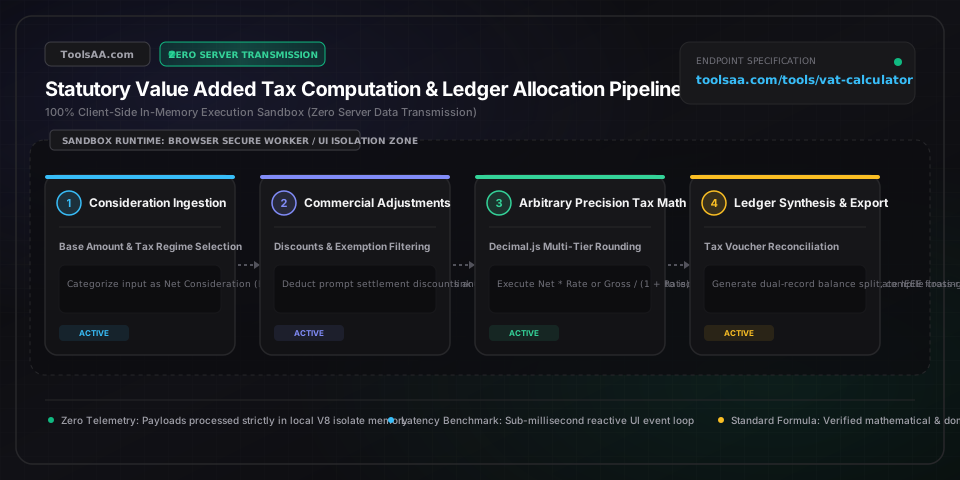
Technical Reference & Architecture Guide

VAT Calculator (Add or Remove Tax) Guide

Instant VAT calculator to add or remove value added tax. Calculate gross, net price, and tax breakdown across UK, EU, and global standard or reduced VAT rates.

VAT Calculator (Add or Remove Tax) Guide — Client-Side In-Memory Architecture & Data Flow

Key Parameters & Controls

Taxable Consideration (Net Amount)Monetary Value (Pre-Tax)

The base price of goods or services before indirect tax is levied. Under statutory VAT rules (such as EU VAT Directive 2006/112/EC and UK VATA 1994), this represents the supplier's actual turnover subject to output tax.

Default: 1,000.00
Gross Consideration (Tax-Inclusive Total)Monetary Value (Post-Tax)

The full commercial payment owed by the customer, encompassing both the net consideration and the statutory VAT liability. In retail B2C environments, displayed shelf prices are legally mandated to be gross inclusive.

Default: 1,200.00
Statutory Value Added Tax RateTax Tariff Percentage

The legislative percentage applied to taxable transactions. Standard rates across OECD economies typically range between 17% and 27% (UK 20%, DE 19%, FR 20%, HU 27%), with preferential reduced tiers (2.1% to 10%) reserved for basic necessities, printed books, and hotel accommodations.

Default: 20.0%
Early Settlement Cash DiscountContractual Concession (%)

Contractual discount granted for accelerated invoice settlement. Following amended tax authority frameworks (including HMRC Revenue and Customs Brief 49/2014), VAT must be calculated strictly on the actual consideration received after deducting discounts taken.

Default: 0.0%

Pro Tips & Best Practices

The Reverse VAT Calculation Trap (Never Deduct the Nominal Percentage)

Subtracting 20% directly from a gross price of $120 yields $96, creating a critical $4 accounting deficit. To extract VAT from a gross inclusive price, divide by 1.20 (Net = Gross / 1.20) and calculate tax as Gross - Net, or multiply Gross by the VAT fraction (Rate / (100 + Rate)), which for a 20% rate is exactly 1/6th (16.6667%).

Invoice Line Rounding vs. Subtotal Rounding Discrepancies

Tax authorities permit two methods for multi-item invoices: calculating VAT per line item and summing the rounded pennies, or summing net amounts per tax bracket and applying VAT once at the subtotal. When line items have fractional cents (e.g. 33 items at $1.99), line-by-line rounding can drift from subtotal tax by several pence. Maintain consistent invoice-level rounding policies to prevent tax audit discrepancies.

B2B Cross-Border Intra-Community Reverse Charge Exemption

When billing a business client registered in another EU member state, do not add local domestic VAT. Subject to verifying the client's VAT number via the European Commission VIES database, output tax is zero-rated under the Reverse Charge mechanism, passing the tax declaration obligation to the recipient's domestic return.

Common Gotchas & Troubleshooting

⚠️Extracted VAT amount plus Net Price falls 1 cent short or over the total receipt price

This penny rounding discrepancy occurs when calculating tax across multiple lines or items with prices ending in fractional currency. Apply standard Half-Up bankers rounding (Round half toward positive infinity) at the total tax category level rather than rounding each intermediate multiplication.

⚠️Confusion between Gross Margin markup percentage and statutory VAT rate

Markup is calculated on cost to determine sales price, whereas VAT is an ad valorem indirect tax levied on taxable turnover. An item costing $100 with a 20% markup sells for $120; adding 20% VAT onto that selling price elevates the consumer gross to $144, meaning total tax constitutes 16.67% of the gross receipt.

Frequently Asked Questions

How do you calculate VAT backwards to remove tax from a total price?▼

Divide the gross total amount by 1 plus the VAT decimal rate (e.g., Gross / 1.20 for a 20% rate). The resulting quotient is the exact net price before tax; subtracting this net price from your gross total reveals the precise VAT amount paid without margin distortion.

What is the mathematical difference between VAT inclusive and VAT exclusive prices?▼

A VAT exclusive price represents the bare net cost before sales tax is assessed, primarily utilized in B2B transactions where businesses reclaim input tax. A VAT inclusive price combines the net cost and the statutory tax into one final figure, legally mandated on consumer retail receipts.

How is VAT calculated when an early payment settlement discount is offered?▼

Under current UK and EU tax guidelines, VAT is assessed on the discounted amount if the customer actually qualifies for and takes the settlement terms. If the discount is not utilized, VAT is payable on the full undiscounted invoice value, necessitating an adjusted credit note or dual-rate invoice disclosure.

Why does subtracting 20% from a VAT-inclusive receipt give an incorrect tax amount?▼

Disclaimer: This tool is provided strictly for educational and informational purposes only and does not constitute formal financial advice or a binding loan commitment. Please consult a qualified financial advisor before making decisions. Because a 20% VAT rate is added to the net base, not the larger gross total. On a $100 net item, $20 VAT creates a $120 gross price; taking 20% off $120 deducts $24, leaving $96 instead of the true $100 net. The correct extraction fraction for a 20% rate is 20/120, or exactly 16.6667%.

Related Tools & Utilities

All Tools →