Salary Calculator (Gross to Net Pay)

Salary Calculator (Gross to Net Pay)

Calculate take home pay and salary from gross to net across hourly and annual rates with federal and state tax brackets, FICA, and 401(k) deductions.

Lbl presets
Lbl calculation mode
$120,000.00
$
Lbl state rate:
Lbl local tax rate:
Lbl pre tax deductions
Lbl k401:8%
Lbl h s a:
Lbl health insurance:
Lbl dental vision:
Lbl post tax deductions
Lbl roth k401:
Lbl post tax other:
Kpi net pay$74,259.76$74,259.76 Lbl per year
Kpi effective rate24.3%Lbl marginal rate: 27.8%
Kpi total tax$29,200.24$29,200.24 Lbl per year
Kpi gross pay$120,000.00$120,000.00 Lbl per year
Lbl donut title
Kpi net pay62%
Lbl take home share$74,259.76
Lbl tax share$29,200.24
Lbl benefits share$16,540.00
Lbl waterfall title
Lbl per year
Kpi gross pay$120,000.00
Lbl pre tax benefits-$16,540.00
Lbl federal tax-$14,602.20
Th fica-$8,649.09
Lbl state tax-$5,948.95
Post-Tax Deductions & Roth-$0.00
Kpi net pay$74,259.76
27.8%
Th bracket rate: 27.8%24.3% Kpi effective rate vs 27.8% statutory marginal ceiling.
FICA: 7.65%State: 5.8%
Th frequencyLbl per paycheckLbl annualizedTh pct of gross
Kpi gross pay$120,000.00$120,000.00100.0%
Lbl pre tax benefits-$6,940.00-$6,940.005.8%
Lbl retirement deferral-$9,600.00-$9,600.008.0%
Lbl federal tax-$14,602.20-$14,602.2012.2%
Lbl state tax-$5,948.95-$5,948.955.0%
Th fica-$8,649.09-$8,649.097.2%
Kpi net pay$74,259.76$74,259.7661.9%
Lbl disclosureDisclaimer text
Kpi net pay$74,259.76
Kpi effective rate24.33%
Kpi total tax$29,200.24
Kpi gross pay$120,000.00
Technical Reference & Architecture Guide

Salary Calculator (Gross to Net Pay) Guide

Calculate take home pay and salary from gross to net across hourly and annual rates with federal and state tax brackets, FICA, and 401(k) deductions.

Salary Calculator (Gross to Net Pay) Guide — Client-Side In-Memory Architecture & Data Flow

Key Parameters & Controls

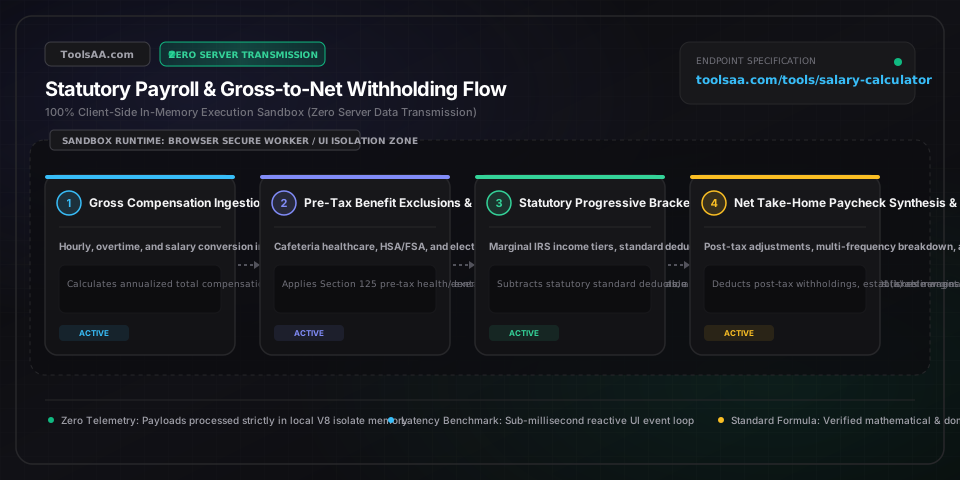
gross_compensation_amountContractual Gross Earnings ($ / £ / € / CAD)

Stipulated pre-tax contractual earnings before statutory tax withholdings and elective payroll reductions. Benchmark salaries range between national median personal earnings ($48,000 to $62,000 in the US) and professional metropolitan benchmarks ($100,000 to $180,000).

Default: 75,000
pay_frequency_cadencePayroll Cadence Schedule

Disbursement frequency determining per-paycheck tax apportionment: Bi-weekly (26 pay periods per calendar year, common in healthcare and corporate enterprises) versus Semi-monthly (24 pay periods, common in tech and professional firms).

Default: bi-weekly
statutory_filing_statusIRS Tax Filing Classification

Official legal tax classification governing standard deduction allowances ($15,000 Single / $30,000 Married Filing Jointly) and progressive bracket thresholds. Dictates the marginal tax rate applied to each layer of taxable income.

Default: Single
pretax_retirement_deferralElective Deferral (% or Dollar Amount)

Traditional 401(k) or 403(b) elective deferrals up to the statutory annual IRS ceiling ($23,500 for regular employees; additional $7,500 catch-up for age 50+). Lowers federal and state Adjusted Gross Income but remains subject to FICA payroll taxes.

Default: 6%
section_125_health_deductionsPre-Tax Cafeteria Contribution ($)

Qualified Section 125 cafeteria plan contributions including employer group health insurance premiums, Health Savings Accounts (HSA, statutory limit $4,300 single / $8,550 family), and Flexible Spending Accounts (FSA, limit $3,300), exempt from federal income, state income, and FICA taxes.

Default: $200 / month
state_income_tax_scheduleJurisdictional Statutory Rate (%)

State-level statutory income tax rate ranging from 0.0% in non-income-tax states (Texas, Florida, Washington, Nevada, Tennessee, Wyoming, South Dakota, Alaska) to progressive schedules peaking at 13.3% (California) and 10.9% (New York).

Default: 5.0%
Pro Tips & Best Practices

Section 125 Pre-Tax Deductions vs 401(k) FICA Tax Exemption Asymmetry

Traditional 401(k) contributions reduce your federal and state taxable income on IRS Form W-2 Box 1, but they DO NOT reduce Social Security or Medicare taxes on Box 3 and Box 5. In contrast, Section 125 cafeteria health insurance premiums and HSA contributions are triple-tax-advantaged: they bypass federal income tax, state income tax, AND the 7.65% FICA tax, delivering an immediate extra 7.65% cash-flow savings.

The 26 vs 24 Paycheck Budgeting Illusion for Bi-Weekly Earners

Bi-weekly employees receive 26 paychecks annually (every two weeks), whereas semi-monthly employees receive 24 paychecks (twice per month). In bi-weekly schedules, two calendar months each year contain three paychecks instead of two ('magic paycheck months'). Budgeting your fixed monthly expenses based on two paychecks lets you treat the two extra paychecks as 100% surplus for debt payoff or emergency savings.

Social Security Wage Base Cap Cliff ($176,100) Autumn Pay Raise

The 6.2% FICA Social Security tax only applies to wages up to the statutory annual wage base ($176,100). Once cumulative year-to-date gross earnings cross this threshold—typically between August and November for high earners—the 6.2% withholding stops completely until January 1st, generating an automatic 6.2% bump in net take-home pay for the remainder of the year.

Supplemental Wage Flat 22% Withholding Trap on Annual Bonuses

Employers typically withhold federal income tax on discretionary bonuses, equity vests, and commissions at a statutory flat supplemental rate of 22% (or 37% on amounts over $1 million). If your regular marginal income tax bracket is 24%, 32%, or 35%, this flat rate under-withholds taxes throughout the year, potentially triggering an unexpected tax liability or underpayment penalty when filing Form 1040.

Common Gotchas & Troubleshooting

⚠️January Paycheck Take-Home Pay is Lower than December's Paycheck

If your annual salary exceeds the Social Security wage cap ($176,100), Social Security tax (6.2%) ceased being withheld in late autumn of the previous year. On January 1st, the statutory wage counter resets to zero, causing the 6.2% withholding to resume immediately, lowering your net check by up to $900+ per month compared to December.

⚠️Lump-Sum Bonus Heavily Withheld at 35%+ Instead of Statutory 22%

If your employer combines your bonus with regular pay in a single paycheck using the aggregate payroll method rather than the separate flat 22% supplemental method, payroll software annualizes that single large check as if you earn that amount every pay period, pushing you artificially into the highest 37% tax bracket. The over-withheld excess is fully refunded when you file your annual tax return.

⚠️Annual Salary Divided by 24 Does Not Match My Bi-Weekly Paycheck

Dividing annual gross salary by 24 calculates semi-monthly pay (24 checks per year). Bi-weekly payroll divides annual gross by 26 pay periods (52 weeks / 2). Each bi-weekly paycheck is approximately 7.69% smaller than a semi-monthly paycheck, but you receive two additional paychecks over the course of the full calendar year.

⚠️Traditional 401(k) Lowers Federal Tax but Did Not Reduce FICA Taxes

Under Internal Revenue Code Section 3121(v)(1)(A), elective deferrals to 401(k) and 403(b) retirement plans are explicitly defined as wages subject to employment taxes. While these deferrals reduce Box 1 Federal Taxable Wages, they remain subject to Social Security (6.2%) and Medicare (1.45%) on Boxes 3 and 5 of Form W-2.

Frequently Asked Questions

How to calculate take home pay from hourly wage?▼

To calculate take home pay from an hourly wage, first determine weekly gross earnings by multiplying hourly rate by hours worked (e.g. $30/hr × 40 hrs = $1,200). Subtract mandatory FICA payroll taxes (7.65% = $91.80), estimated federal income withholding based on IRS Form W-4 tables, applicable state/local taxes, and any pre-tax health or retirement deductions. Net pay typically equals 72% to 82% of gross hourly earnings depending on your state and tax bracket.

What is the difference between gross pay and net pay?▼

Gross pay is the total compensation an employer pays you before any deductions, including regular wages, overtime, commissions, and bonuses. Net pay—commonly called take-home pay—is the actual net dollar amount deposited into your bank account after subtracting statutory taxes (Federal, State, Local, Social Security, Medicare) and voluntary deductions (401k, health insurance, HSA).

Why does my bonus get taxed higher than my regular salary paycheck?▼

Bonuses are not taxed at a higher rate at tax time, but they are often withheld differently. The IRS classifies bonuses as supplemental wages, which employers either withhold at a mandatory flat 22% rate or combine with regular wages using the aggregate method, which temporarily treats you as a high earner for that pay period. Any discrepancy between withholding and your actual marginal tax bracket reconciles on your annual tax return.

How many pay periods are in a year for biweekly vs semimonthly payroll?▼

Bi-weekly payroll occurs every two weeks and has exactly 26 pay periods in a standard year (occasionally 27 in calendar leap years with 53 Thursdays/Fridays). Semi-monthly payroll occurs twice per month (typically on the 15th and last day of the month) and always has exactly 24 pay periods. Consequently, a bi-weekly check is smaller than a semi-monthly check for the same annual salary.

How much gross salary do I need to make $5,000 a month after taxes?▼

To net $5,000 monthly ($60,000 take-home per year) as a single filer claiming the standard deduction, you need an estimated gross salary of $76,000 to $84,000 annually ($6,333 to $7,000 gross per month), depending on your state of residence. In zero-income-tax states like Texas or Florida, roughly $76,500 gross is required, whereas in higher-tax states like California or New York, approximately $83,000 to $85,000 gross is required.

How does a traditional 401(k) contribution affect take-home pay?▼

Disclaimer: This tool is provided strictly for educational and informational purposes only and does not constitute formal financial advice or a binding loan commitment. Please consult a qualified financial advisor before making decisions. Contributing to a Traditional 401(k) reduces your net take-home pay by significantly less than the dollar amount invested due to upfront income tax savings. For example, contributing $500 monthly while in a combined 22% federal and 5% state tax bracket lowers take-home pay by only $365 ($500 minus $135 tax savings), effectively routing $135 of deferred tax money straight into your retirement portfolio.

Related Tools & Utilities

All Tools →