Hint lifted weight
Hint reps
Hint rpe
Medical disclaimer
Back Squat • Opt formula ensemble
Calculate your one rep max (1RM) instantly using validated Brzycki, Epley, and Lander formulas. Features RPE adjustment, plate loading, and rep max percentages.
Hint lifted weight
Hint reps
Hint rpe
Medical disclaimer
Back Squat • Opt formula ensemble
Calculate your one rep max (1RM) instantly using validated Brzycki, Epley, and Lander formulas. Features RPE adjustment, plate loading, and rep max percentages.
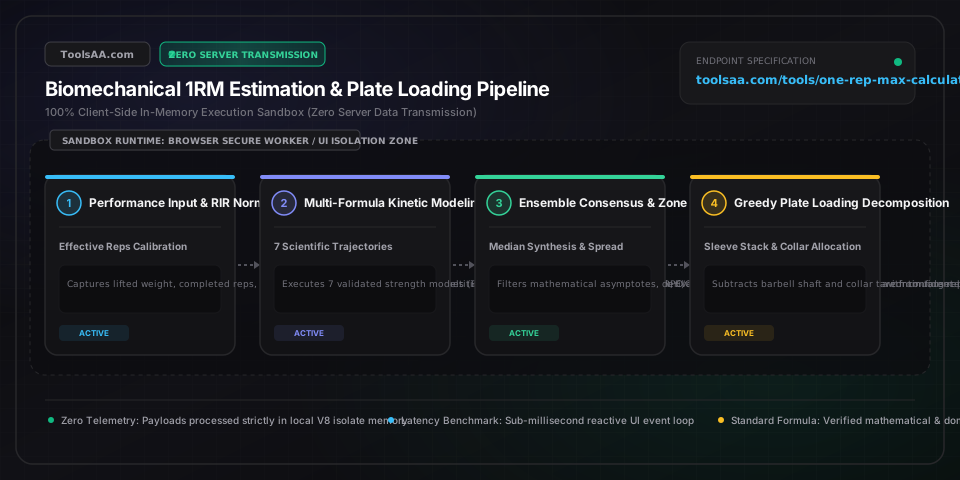
Total resistance lifted through the complete anatomical range of motion, inclusive of barbell shaft, collars, and plate weight. Accurate measurement requires factoring bar tare rather than counting plate weight alone; omitting the empty barbell tare (typically 20 kg / 44 lbs or 15 kg / 33 lbs) skews submaximal prediction curves and underestimates true neuromuscular peak force by up to 20%.
Number of continuous, technically sound repetitions executed before technical breakdown or muscular exhaustion. In sports science, neuromuscular predictive accuracy is highest between 1 and 5 repetitions (error margin ±1.5% to ±2.5%), remains robust up to 10 repetitions, and degrades beyond 10 reps as anaerobic glycolysis and systemic cardiorespiratory fatigue overtake pure neural motor unit recruitment.
Standardized measure of proximity to failure, where RPE 10 signifies 0 reps in reserve (RIR), RPE 9 signifies 1 RIR, and RPE 8 signifies 2 RIR. Adjusts effective repetitions to prevent 1RM underestimation when sets are not taken to complete exhaustion, allowing safe strength tracking without risking injury on all-out failure sets.
Mathematical model used to extrapolate maximal strength. Brzycki is linear and conservative for 1 to 10 reps; Epley is standard in powerlifting; Lander is quadratic; Lombardi uses power curves; Ensemble Consensus calculates the median across all 7 validated models to filter out individual formula bias.
Weight of the barbell shaft and fastening collars. Standard Men's Olympic barbells weigh 20 kg (44.09 lbs, nominal 45 lbs); Women's Olympic bars weigh 15 kg (33.07 lbs, nominal 35 lbs); competition collars add 2.5 kg (5.5 lbs) per pair, and basic spring clips add 0.5 kg (1.1 lbs) total.
Prescribed percentage of 1RM utilized in autoregulated strength programming: 90% to 100% for peak neuromuscular recruitment and competitive singles, 80% to 85% for 5-rep strength and myofibrillar hypertrophy, 70% to 75% for volume accumulation, and 50% to 60% for speed work, dynamic effort, and warmups.
All empirical 1RM formulas (Brzycki, Epley, Lander) assume neuromuscular recruitment is the sole limiting factor. Beyond 10 repetitions, cellular lactate accumulation, local muscular endurance, and cardiovascular capacity distort the curve. A 3-to-5 rep test yields a 1RM prediction error within ±2.5%, whereas a 15-rep test often exhibits an error spread exceeding ±10%.
Testing to absolute failure (RPE 10) significantly increases soft-tissue injury risk and requires multi-day central nervous system (CNS) recovery. By recording a set at RPE 8.5 (1-2 reps in reserve), you can calculate your true 1RM without compromising the remainder of your training week or risking breakdown in spinal posture.
Different muscle groups exhibit distinct rep-to-percentage relationships. Squats and bench presses typically adhere closely to the Epley and Brzycki curves. In contrast, deadlifts fatigue the central nervous system rapidly, meaning lifters often struggle to hit predicted 1RM based on high-rep sets. Conversely, high-slow-twitch lifters might complete 12 reps at 80% 1RM where standard formulas predict only 8.
Always load the heaviest denomination plates (25 kg / 45 lb) closest to the barbell sleeve shoulder inside the collar. Placing heavy plates on the inside minimizes the rotational moment of inertia, reduces bar whip under high acceleration, and protects sleeve bushings from unnecessary torque during heavy rack walkouts.
Instead of guessing daily weights, use the Reverse Target Solver to derive training loads from your current target 1RM. For example, if programmed for 5x5 at 75% 1RM, calculate the exact plate configuration rather than rounding arbitrarily, ensuring progressive overload increments are metrically validated.
The Brzycki equation [weight * 36 / (37 - reps)] is asymptotically hyperbolic and has a vertical asymptote at 37 reps. Above 10 reps, the denominator shrinks rapidly, inflating estimated 1RM. Switch to the Lombardi (exponential) or Wathan models for sets exceeding 10 reps, or select 'Ensemble Consensus' to filter out asymptotic mathematical spikes.
Submaximal rep calculators assume identical bar speed and technical proficiency throughout the set. A true 1RM single requires maximum psychological arousal, peak motor unit synchronization, and zero hesitation under peak loads. If your real 1RM lags submaximal predictions, incorporate paused reps and heavy singles (90-95% 1RM @ RPE 8-9) to develop single-rep neural efficiency.
The requested load cannot be evenly divided with your available plate inventory (e.g. attempting to load 103 kg with only 2.5 kg plates). Enable 'Fractional / Micro-Plates' (0.5 kg or 1.25 lb) in settings, or allow the engine to round to the nearest achievable 2.5 kg or 5 lb increment based on your minimum collar/plate combination.
A standard 20 kg barbell is exactly 44.092 lbs, but commercial gyms in North America use 45 lb barbells (20.41 kg). When converting units, our engine utilizes arbitrary-precision arithmetic via decimal.js to preserve exact sleeve tare weights. Ensure you select the physical barbell profile (Olympic 20kg vs US 45lb) matching your gym equipment.
To calculate your one rep max (1RM), multiply the lifted weight by the repetition factor using a validated formula. The most popular method, the Epley formula, uses the equation: 1RM = Weight × (1 + Reps / 30). For example, lifting 200 lbs for 5 reps yields: 200 × (1 + 5/30) = 200 × 1.1667 = 233.3 lbs. For maximum accuracy, keep repetitions between 2 and 6 reps and ensure full range of motion.
The accuracy of Brzycki versus Epley depends on your repetition range. For lower repetitions (1 to 6 reps), the Brzycki formula [Weight × 36 / (37 - Reps)] is widely regarded by strength coaches as slightly more accurate and conservative. For moderate repetitions (6 to 10 reps), the Epley formula performs consistently well across powerlifting populations. For sets above 10 reps, both formulas tend to overestimate 1RM, making the Lombardi or Wathan power-curve formulas preferable. ToolsAA computes an Ensemble Median across 7 models to cancel individual formula bias.
A standard one rep max benchmark is evaluated relative to your body weight across established strength tiers: Beginner (1.0× body weight for squat, 0.75× for bench press, 1.25× for deadlift), Intermediate (1.5× squat, 1.0×–1.25× bench, 1.75×–2.0× deadlift), Advanced (2.0× squat, 1.5× bench, 2.5× deadlift), and Elite (2.5×+ squat, 2.0×+ bench, 3.0×+ deadlift). Clinical exercise physiologists emphasize evaluating strength normalized to lean mass and biological sex rather than comparing gross barbell poundages alone.
Rate of Perceived Exertion (RPE) is a 1-to-10 subjective scale developed for strength training by Mike Tuchscherer based on Reps in Reserve (RIR). An RPE of 10 means zero reps remained in reserve (complete failure); RPE 9 means exactly 1 rep was left in the tank; RPE 8 means 2 reps remained. Standard 1RM formulas assume you performed reps to failure (RPE 10). If you complete 5 reps at RPE 8, your effective repetition capacity was actually 7 reps. Integrating RPE prevents underestimating your 1RM on submaximal training sets.
Working weight percentages are calculated by multiplying your true or estimated 1RM by the target percentage decimal: Working Load = 1RM × (Target % / 100). Common strength training percentages include: 90% (heavy triples for neuromuscular strength), 80-85% (5-rep working sets for strength and hypertrophy), 70-75% (8-12 rep hypertrophy volume), and 60-65% (speed and dynamic effort work). Our tool generates a complete 50% to 100% percentage matrix with exact plate-loading breakdowns for each bracket.
Disclaimer: This tool is provided strictly for educational and informational purposes only and does not constitute formal financial advice or a binding loan commitment. Please consult a qualified financial advisor before making decisions. Testing a true 1-rep maximum places extreme mechanical stress on ligaments, tendons, and the axial skeleton, significantly increasing the probability of acute muscle tears, joint strain, or form breakdown. Furthermore, a maximal 1RM attempt generates heavy central nervous system (CNS) fatigue requiring up to 7-10 days of recovery before normal training volume can resume. A submaximal 1RM calculator provides an accurate estimate (within 2-3% when tested at 3-5 reps) with negligible recovery debt and minimal injury risk.
Calculate daily protein, carbs, and fat with our macro calculator. Set personalized BMR, TDEE, calorie deficit or surplus, and macro ratios for any fitness goal.
Calculate historical and future inflation, purchasing power decay, cumulative CPI rates, and cost-of-living adjustments with instant client-side precision.
Convert Excel to JSON instantly in your browser. Parse XLSX, XLS, and CSV files into clean JSON objects, nested trees, or column arrays with zero server upload.
Calculate credit card payoff timelines, interest savings, and debt payoff strategies. Compare fixed payments vs payoff goal dates with amortization schedule.
Calculate your optimal emergency fund target and survival runway across essential and discretionary expenses, life shock scenarios, and multi-tier liquidity vaults (Cash, HYSA, Government Bonds). Features bi-directional what-if reverse calculations and dynamic reserve allocation visualizers.
Calculate your true minimum viable and target hourly freelance rates based on desired net income, unbillable admin overhead, local self-employment taxes, and equipment expenses. Features bi-directional what-if reverse calculations and dynamic income waterfall charts.