Auto Refinance Calculator (Car Loan)

Auto Refinance Calculator (Car Loan)

Calculate your monthly payment savings, total interest reduction, and break-even point with our auto refinance calculator. Compare new rates, terms, and fees.

Quick chips label

Parameters & Inputs

Lbl fee treatment

Title, Doc & Lien Release Fees
Lbl existing debt card$744.24/Lbl mo
$28,000.00
%
Lbl mo
$29,500.00
Lbl new refinance card$656.30/Lbl mo
5.90%
48 Lbl months
Lbl fee treatmentLbl pay out of pocket
+$0.00/Lbl mo
Lbl target budget solver card
Lbl target budget$650.00/Lbl mo
Lbl target apr result5.41% APR
Kpi net savings
$4,026.22
Lbl interest cut
Kpi monthly diff
-$87.94/Lbl mo
Lbl proposed
Kpi break even
2.2 Lbl months
Lbl upfront fees
Kpi ltv ratio
94.9%
Lbl caution zone

Chart title

Lbl fee treatment

Legend old balance
Legend new balance
$0.00$7,350.00$14,700.00$22,050.00$29,400.000m12m24m36m48m

Status recommended

Lbl interest cut: $4,026.22.

Lbl term extension warning title

Lbl speedup summary

Kpi monthly diff$87.94/Lbl mo
Lbl interest cut$4,026.22
Kpi break even2.2 Lbl months

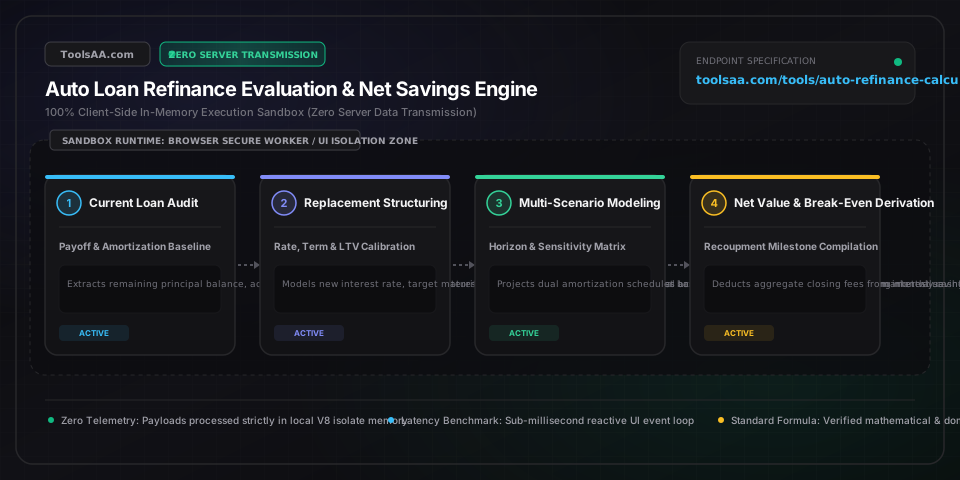
Client-Side Processing

High-performance calculation executed entirely in browser memory.

Zero Server Upload Privacy

All payloads remain strictly local with zero external server communication.

Production Ready Export

Clean, optimized output formats ready for immediate deployment.

Disclaimer title

Disclaimer text

Technical Reference & Architecture Guide

Auto Refinance Calculator (Car Loan) Guide

Calculate your monthly payment savings, total interest reduction, and break-even point with our auto refinance calculator. Compare new rates, terms, and fees.

Auto Refinance Calculator (Car Loan) Guide — Client-Side In-Memory Architecture & Data Flow

Key Parameters & Controls

existingBalanceMonetary Currency Figure ($)

Outstanding principal balance remaining on the current vehicle loan agreement, excluding unearned future finance charges. Sourced from an official 10-day payoff statement rather than a billing statement to account for daily per diem interest accrual.

Default: $25,000
existingAprAnnual Percentage Rate (APR %)

Contracted nominal annual percentage rate on the current installment note, converted to a daily periodic rate (APR / 365) under simple interest amortization rules mandated by Regulation Z of the Truth in Lending Act.

Default: 10.50%
remainingTermDuration in Months

Exact number of scheduled monthly billing cycles remaining until the existing automobile note matures and reaches full principal amortization.

Default: 48 Months
vehicleMarketValueFair Market Valuation ($)

Current wholesale or retail market value established via industry benchmarks (NADA Guide or Kelley Blue Book clean trade-in), used to determine the Loan-to-Value (LTV) ratio against standard 100% to 125% prime risk thresholds.

Default: $27,000
newAprRefinanced Annual Percentage Rate (APR %)

Proposed annual interest rate offered by the replacement financial institution or credit union, typically requiring a 150 to 300 basis point reduction to generate compelling net present value savings after transaction friction.

Default: 5.75%
newTermNew Amortization Duration (Months)

Total repayment duration for the refinanced facility (standard tiers: 36, 48, 60, or 72 months), which directly governs monthly cash flow versus cumulative lifetime interest expense.

Default: 48 Months
upfrontFeesClosing and Administrative Costs ($)

Total administrative closing friction, aggregating state Department of Motor Vehicles certificate of title transfers ($15–$150), county lien perfection filings ($10–$50), and administrative lender doc fees ($0–$200).

Default: $175
rollFeesIntoLoanBinary Financing Election

Financing mode selecting between settling closing costs in cash out-of-pocket at signing or capitalizing expenses directly into the refinanced principal balance, which causes closing fees to accrue compound interest.

Default: Cash (Out of Pocket)
cashOutAmountDiscretionary Capital Withdrawal ($)

Additional loan proceeds borrowed against positive vehicle equity up to lender LTV caps (typically 100%–120%), disbursed as non-taxable cash proceeds while expanding the debt balance.

Default: $0 (Rate and Term Only)
extraMonthlyPaymentDiscretionary Principal Addition ($/mo)

Recurring monthly cash contributed exclusively toward reducing principal balance, eliminating forward daily interest accumulation and accelerating the loan payoff schedule.

Default: $0 / Month
Pro Tips & Best Practices

The Term Extension Trap and Total Finance Charge Distortion

A frequent pitfall in auto loan refinancing is focusing exclusively on reducing the monthly installment. Extending a loan with 36 remaining months into a new 60-month agreement will lower monthly cash outflow, but can substantially increase cumulative interest paid over the life of the vehicle. For example, refinancing a $20,000 balance at 8% APR from 36 remaining months to 60 months at 6% APR reduces monthly payments from $627 to $387 (saving $240 monthly), yet increases total interest paid from $2,561 to $3,199—costing an extra $638 overall. To genuinely save money, match or shorten the remaining term when locking in a lower APR.

Prepayment Penalties and the Rule of 78s Calculation Trap

Before committing to refinance, verify whether your existing loan utilizes simple daily interest or a precomputed interest structure governed by the Rule of 78s (sum of the digits method). While the federal Truth in Lending Act and modern lending laws prohibit the Rule of 78s on auto loans exceeding 61 months, some subprime and short-term dealership contracts still front-load finance charges. If your existing contract contains a precomputed interest clause or early termination penalty, paying off the loan early will yield far less interest rebate than anticipated, eroding the net profit of refinancing.

LTV Thresholds, Negative Equity, and Gap Insurance Policies

Most prime auto lenders cap their maximum Loan-to-Value (LTV) ratio at 100% to 125% of the vehicle wholesale book value (e.g. NADA or Kelley Blue Book). If your vehicle has depreciated faster than your amortization schedule—leaving you upside-down or underwater—lenders may reject your application unless you make a cash principal contribution to lower the balance. Furthermore, refinancing terminates your existing vehicle service contracts and Guaranteed Asset Protection (GAP) insurance. Always request a pro-rata GAP premium refund from your original lender and evaluate purchasing a replacement GAP policy if your new loan LTV exceeds 90%.

Break-Even Horizon and Upfront Fee Capitalization

Auto refinancing entails administrative closing expenses, including state title transfer fees ($15-$150), lien recording charges ($10-$50), and potential lender processing fees ($100-$300). When lenders offer no-out-of-pocket refinancing, they capitalize these expenses into the new principal balance, causing you to pay interest on fees over time. Always divide total upfront fees by your monthly cash savings to pinpoint your exact break-even month. If you plan to trade in or sell the car before reaching that break-even threshold, refinancing will generate a net financial loss.

Common Gotchas & Troubleshooting

⚠️Lender Rejection Due to Negative Equity (LTV Exceeds Prime Ceilings)

When a vehicle's outstanding balance exceeds 120% to 125% of its wholesale benchmark value, automated underwriting models trigger immediate collateral exceptions. To cure this deficiency, execute a targeted principal paydown to bridge the equity gap below 100% LTV, secure an approved co-signer with established tier-one credit, or redirect the refinance package to regional credit unions that accommodate up to 130% LTV for high-credit borrowers.

⚠️Payoff Quote Discrepancy Against Current Monthly Statement Balance

Billing statements report the ledger principal as of the closing date, omitting unbilled per diem interest accrued between statement issuance and actual wire settlement. Because auto notes accrue interest continuously based on the daily periodic rate (Balance * APR / 365), you must request a formal 10-day or 15-day payoff statement from the current servicer to capture accrued interest and statutory lien discharge fees precisely.

⚠️Fee Capitalization Diluting Monthly Cash Savings and Prolonging Break-Even

Rolling closing administrative charges ($200 to $500) into the replacement note inflates the funded principal balance, creating a perpetual compound interest drag that expands the break-even schedule. To retain maximum net present value and ensure immediate amortization acceleration, elect out-of-pocket cash settlement for title re-registration and state filing expenses during loan signing.

⚠️Dealer Finance Reserve Clawback and Early Payoff Restrictions

Some retail installment sales contracts arranged through dealership captive finance arms include stipulations where refinancing within the initial 90 to 180 days triggers administrative payoff surcharges or clawbacks on dealer finance reserves. Audit Section 3 ('Prepayment Disclosures') of your retail contract; if a mandatory exit fee or precomputed charge applies, include it as an upfront closing fee to confirm positive net savings.

Frequently Asked Questions

How do you calculate monthly savings and break-even on an auto refinance?▼

Monthly payment savings equal the existing installment minus the replacement installment calculated via standard amortization: PMT = P * [r(1+r)^n] / [(1+r)^n - 1], where r is the monthly periodic rate (APR / 12) and n is total months. The break-even timeline is calculated by dividing total transaction fees by the net monthly savings (Break-Even Months = Closing Fees / Monthly Savings). For example, $200 in closing fees divided by a $50 monthly payment reduction yields a break-even horizon of exactly 4.0 months.

When is it worth refinancing a car loan?▼

Refinancing an auto loan is financially advantageous when market rates drop by at least 1.5% to 2.0% (150 to 200 basis points) or your credit score increases by 35+ points to unlock higher borrower tiers. It is also compelling when transitioning away from inflated dealership markup contracts to credit union wholesale rates, provided the vehicle has at least 18 to 24 months of remaining scheduled payments to amortize administrative closing expenses.

How much does refinancing a car hurt your credit score?▼

Auto refinancing causes an immediate, temporary reduction of approximately 3 to 8 points on FICO and VantageScore credit models due to the hard credit inquiry. However, credit scoring algorithms apply a rate-shopping deduping window (14 days under legacy FICO, up to 45 days under modern FICO 8/9/10 and VantageScore 4.0), consolidating all auto loan inquiries during that interval into a single scoring event. Scores typically rebound within 60 to 90 days of on-time installments.

Can you refinance an auto loan if you owe more than the car is worth?▼

Yes, but options are restricted because mainstream lenders enforce strict Loan-to-Value (LTV) limits between 100% and 125% of the vehicle's wholesale trade-in valuation. If your negative equity exceeds these risk thresholds, refinancing requires injecting upfront cash to buy down the principal balance to 100% LTV, rolling the deficit into specialized credit union programs offering up to 130% LTV, or attaching a qualified co-borrower to mitigate credit risk.

What fees and closing costs are involved in refinancing a car?▼

Auto refinancing closing expenses range from $50 to $400 depending on jurisdiction, significantly lower than residential mortgage closing fees. Primary expenses comprise state DMV certificate of title re-issuance fees ($15 to $150), county or state electronic lien titling documentation fees ($10 to $50), and occasional lender document processing fees ($0 to $200, though credit unions frequently waive administrative charges).

What is the difference between rate-and-term vs cash-out auto refinancing?▼

Disclaimer: This tool is provided strictly for educational and informational purposes only and does not constitute formal financial advice or a binding loan commitment. Please consult a qualified financial advisor before making decisions. A rate-and-term auto refinance strictly restructures the interest rate (APR) and maturity timeline of an existing balance without extracting equity, whereas a cash-out auto refinance leverages positive vehicle equity to originate a larger loan balance up to 100%–120% LTV and distribute the excess as non-taxable cash proceeds. Cash-out funds are frequently utilized to consolidate high-interest credit card revolving debt (18%–28% APR) into lower vehicle-secured installment rates (6%–9% APR). However, under IRS Section 163(h), interest on personal auto debt is non-tax-deductible, and encumbering depreciating motor collateral increases underwater default exposure if vehicle valuation declines.

Related Tools & Utilities

All Tools →