Debt to Income & DTI Ratio Calculator

Debt to Income & DTI Ratio Calculator

Calculate debt-to-income (DTI) ratio instantly. Compare front-end housing vs back-end total DTI against Fannie Mae, FHA & VA limits with max loan solver.

Lbl quick scenarios

Card title income housing

Card subtitle income housing

$7,500 / Unit per month
$

Hint gross income

$2,400 / Unit per month
$

Hint housing piti

Card title debts

Card subtitle debts

$1,050 / Unit per month
$
$
$

Hint student loans

$

Card title reverse parameters

Card subtitle reverse parameters

Lbl target dti cap43%
28% (Tier prime)36% (Tier standard)43% (Tier qm cap)50% (Tier aus)
Front-End DTI
32.0%
Benchmark label ≤ 28%
Back-End DTI
46.0%
Benchmark label ≤ 36%
Kpi max purchase price
$344,880
@43% Kpi target cap
Kpi underwriting status
AUS Conditional Approval
Statutory ceiling
Lbl total dti ratio46.0%
Lbl front prefix32.0%
AUS Conditional Approval
Legend front end
Legend back end

Spectrum header

≤ 28% Band primeBadge excellent

Desc band prime

29% - 36% Band standardBadge standard

Desc band standard

37% - 43% Band qm limitBadge qm cap

Desc band qm

44% - 50% Band aus highBadge conditional

Desc band aus

Ab headingAb no payoffs yet
Lbl engine ready
Stat non housing debt share14.0%
Stat residual income$4,050 / Unit per month
Stat housing absorption32.0%

Client-Side Processing

High-performance calculation executed entirely in browser memory.

Zero Server Upload Privacy

All payloads remain strictly local with zero external server communication.

Production Ready Export

Clean, optimized output formats ready for immediate deployment.
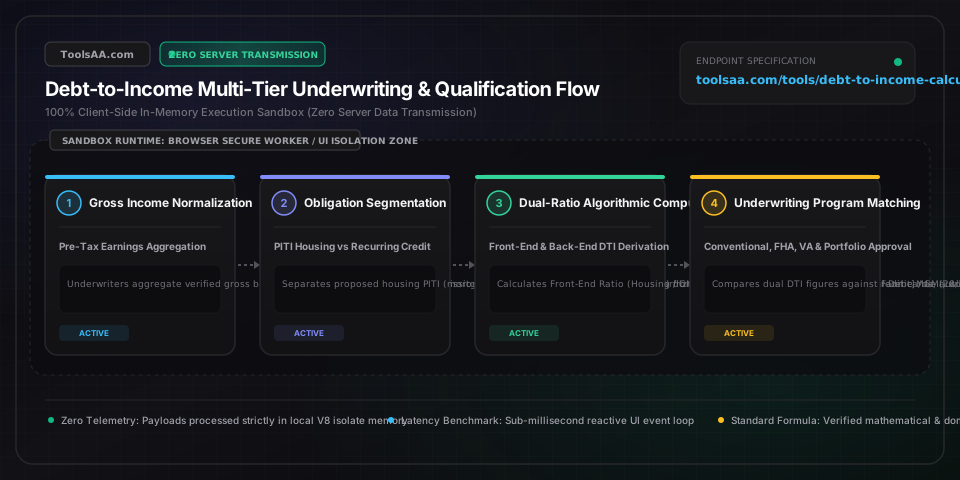
Technical Reference & Architecture Guide

Debt to Income & DTI Ratio Calculator Guide

Calculate debt-to-income (DTI) ratio instantly. Compare front-end housing vs back-end total DTI against Fannie Mae, FHA & VA limits with max loan solver.

Debt to Income & DTI Ratio Calculator Guide — Client-Side In-Memory Architecture & Data Flow

Key Parameters & Controls

Gross Monthly Income (GMI)Gross Monthly Pre-Tax Earnings ($)

Total verifiable pre-tax monthly income including base salary, regular wages, documented two-year average overtime, commissions, and Schedule C net business income before income tax deductions.

Default: $8,500.00
Proposed Housing Expense (PITI)Total Housing Outlay ($)

Comprehensive monthly mortgage obligation consisting of Principal, Interest, real estate Property Taxes, Homeowners Hazard Insurance, Private Mortgage Insurance (PMI/MIP), and mandatory HOA dues.

Default: $2,350.00
Revolving Credit Card PaymentsMonthly Minimum Obligations ($)

Total minimum statutory monthly payments reported on credit bureau statements for all open revolving accounts, credit cards, and lines of credit regardless of total outstanding balances.

Default: $150.00
Auto & Installment LoansFixed Monthly Installments ($)

Contractual monthly payments for auto loans, vehicle leases, motorcycle financing, and personal installment debts with more than 10 monthly payments remaining under Fannie Mae guidelines.

Default: $450.00
Student Loan Underwriting PaymentMonthly Verified / Calculated Liability ($)

Monthly verified amortizing payment or statutory calculation (0.5% of total balance for FHA loans, or 1% if documented Income-Driven Repayment (IDR) statement shows $0 on certain conventional guidelines).

Default: $250.00
Other Legal & Contingent LiabilitiesCourt-Ordered & Contingent Payments ($)

Court-mandated child support, spousal maintenance, legal alimony payments, tax payment installment agreements, and debts co-signed for others lacking 12 months of third-party payment proof.

Default: $0.00

Pro Tips & Best Practices

The 10-Month Installment Exclusion Rule

Under Fannie Mae Selling Guide B3-6-05, installment debts (such as auto loans or personal loans) with 10 or fewer remaining payments can be completely excluded from DTI calculations, provided the remaining payments do not significantly impact the borrower's post-closing liquidity. Revolving credit cards and leases can never be excluded regardless of remaining term.

Student Loan Income-Driven Repayment ($0 Letter) Underwriting Divergence

Fannie Mae accepts a documented $0 monthly payment for borrowers on federal Income-Driven Repayment (IDR) plans if verified by loan servicer documentation. However, FHA guidelines strictly require underwriters to calculate 0.5% of the total outstanding student loan balance as the monthly debt liability if the credit report displays $0, which can instantly disqualify an otherwise borderline borrower.

Co-Signed Debt Contingent Liability Defense

If you co-signed a car loan, student loan, or mortgage for a relative or business partner, mortgage underwriters will omit that payment from your DTI if you provide 12 consecutive months of bank statements or canceled checks proving that the primary obligor made all 12 payments on time from their own bank account.

401(k) Loan Repayments Never Count Against DTI

Because borrowing against your 401(k) or employer-sponsored retirement account is backed by your own vested assets and failure to repay results in income tax and early withdrawal penalties rather than a legal default reported to credit bureaus, Fannie Mae and FHA guidelines explicitly prohibit lenders from including 401(k) loan repayments in DTI ratios.

Common Gotchas & Troubleshooting

⚠️Back-End DTI exceeds 43% Qualified Mortgage ceiling causing conventional loan pre-approval hurdles

Submit the loan file through Fannie Mae Desktop Underwriter (DU) or Freddie Mac Loan Product Advisor (LPA). Automated Underwriting Systems (AUS) routinely grant Approve/Eligible findings up to 45% or even 50% back-end DTI when balanced with strong compensating factors, such as 6+ months of verified PITI cash reserves, a FICO score >= 740, or a down payment of 20% or higher.

⚠️Declining self-employment or 1099 commission income skewing monthly income divisor

Mortgage underwriters average two full tax years of Schedule C or Form 1120-S income. If Year 2 net income declined by more than 5% compared to Year 1, underwriters will not average the two years; they will strictly utilize the lower Year 2 income, significantly inflating your calculated DTI ratio. Review your write-offs with your CPA before filing prior-year tax returns.

Frequently Asked Questions

How do you calculate debt-to-income ratio?▼

To calculate your debt-to-income (DTI) ratio, divide your total monthly debt payments by your gross monthly pre-tax income, then multiply by 100. For example, if your gross monthly income is $8,000, your proposed housing payment (PITI) is $2,000, and your monthly recurring debts (auto loan, credit cards, student loans) total $800, your Front-End DTI is 25.0% ($2,000 / $8,000) and your Back-End DTI is 35.0% ($2,800 / $8,000).

What is a good debt-to-income ratio to buy a house?▼

A back-end DTI of 36% or lower is widely considered the gold standard for prime conventional mortgages, offering the lowest interest rates and easiest automated underwriting approvals. A DTI between 37% and 43% is acceptable under standard Consumer Financial Protection Bureau (CFPB) Qualified Mortgage rules. For FHA loans, automated underwriting can approve DTIs up to 46.9% front-end and 56.9% back-end with solid credit and cash reserves.

What is the difference between front-end and back-end DTI?▼

Front-end DTI (also called the housing ratio) measures only your proposed housing expense (principal, interest, property taxes, hazard insurance, and HOA fees) divided by gross monthly income. Back-end DTI measures your proposed housing expense PLUS all recurring consumer debt obligations (credit card minimums, car loans, student loans, child support) divided by gross monthly income. Lenders weigh back-end DTI most heavily during loan approval.

Do utility bills, cell phone plans, and groceries count toward DTI?▼

Disclaimer: This tool is provided strictly for educational and informational purposes only and does not constitute formal financial advice or a binding loan commitment. Please consult a qualified financial advisor before making decisions. No. Living expenses such as electricity, water, gas, broadband internet, cellular phone plans, car insurance premiums, medical co-pays, and grocery costs are not legally enforceable credit debts and are not reported on consumer credit bureau files. Mortgage underwriters only include recurring debts tied to contractual credit agreements (loans, lines of credit) and court-mandated obligations (alimony, child support).

Related Tools & Utilities

All Tools →