Intermittent Fasting Timer & Tracker

Intermittent Fasting Timer & Tracker

Badge live bio

Track intermittent fasting in real time with metabolic stages. Calculate 16:8, 18:6, OMAD eating windows, reverse target solver, and export iCal schedules.

Lbl quick presets
Lbl calculation direction
Lbl time format
Lbl fluid metric

Card title protocol

16:8 Lbl ratio
Lbl fasting hours
16 Lbl hours short
Lbl eating hours
8 Lbl hours short
Lbl quick set

Card title metabolic modifiers

Badge precision kinetics

Card title circadian

50% Lbl asleep

8 Unit hours Msg sleep fasting benefit

Card title hydration

1250 / 3000 Unit ml
Lbl glass counter
Lbl electrolytes title

Hint electrolytes

Card title journal

Lbl auto saved
Kpi elapsed14:16:5089% Lbl target met
Kpi remaining01:43:09Lbl until break fast
Kpi fast ends at05:00 AMNov 3, 05:00 AM
Kpi eating closes01:00 PM8Unit h Lbl nourish window
Lbl elapsed chrono14:16:50
89.3%
01:43:09 Lbl remaining short
Ketosis & Cellular Autophagy ActivationBadge active state

Active Autophagy & High Fat Oxidation

Stat card1 labelKetosis & Cellular Autophagy Activation13.8Unit h - 18.5Unit h Lbl milestone short
Stat card2 label8Unit h Lbl fasted in sleep50% Lbl effortless fast
Stat card3 label1250 / 3000 Unit mlNa • Mg

Client-Side Processing

High-performance calculation executed entirely in browser memory.

Zero Server Upload Privacy

All payloads remain strictly local with zero external server communication.

Production Ready Export

Clean, optimized output formats ready for immediate deployment.

Technical Reference & Architecture Guide

Intermittent Fasting Timer & Tracker Guide

Track intermittent fasting in real time with metabolic stages. Calculate 16:8, 18:6, OMAD eating windows, reverse target solver, and export iCal schedules.

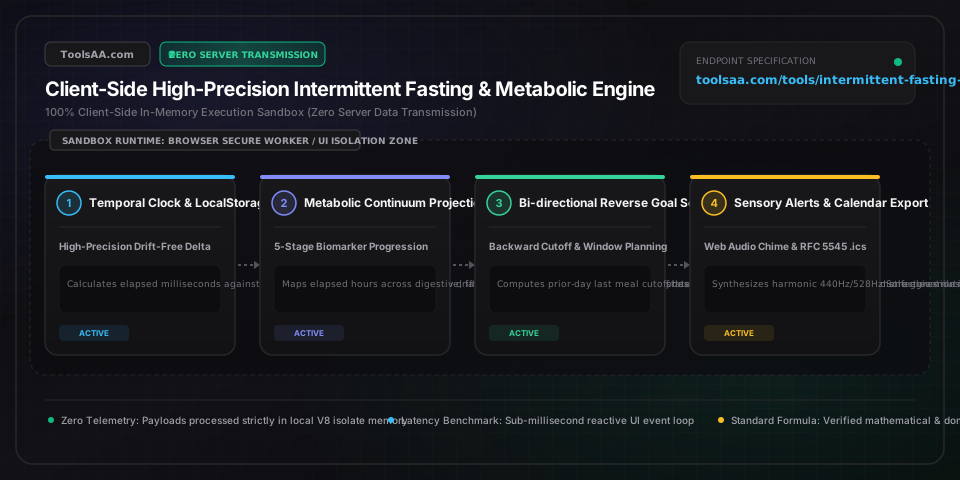
Intermittent Fasting Timer & Tracker Guide — Client-Side In-Memory Architecture & Data Flow

Key Parameters & Controls

Fasting Protocol Ratio (fastingProtocolRatio)Daily Time Allocation (Fasting Hours : Eating Window Hours)

Defines the daily division of 24 hours between complete caloric rest (fasting) and healthy nutrient intake (eating). Proven circadian protocols range from 14:10 (gentle circadian balance) and 16:8 (the clinical standard for metabolic flexibility) to 18:6 (accelerated fat oxidation) and 20:4 / 23:1 (OMAD or One Meal A Day). Fasting periods beyond 16 hours prompt the liver to deplete glycogen stores and initiate cellular autophagy.

Default: 16:8 Protocol (16 Hours Fasting / 8 Hours Eating)
Metabolic Phase Thresholds (metabolicPhaseThresholds)Postprandial Biological Milestones (Elapsed Hours Since Last Meal)

Maps your body's cellular and hormonal transitions after your final bite: Phase 1 Fed State (0–4h: glucose and insulin rise, food is absorbed); Phase 2 Early Transition (4–12h: blood glucose normalizes, insulin drops, liver begins releasing stored energy); Phase 3 Fat Burning & Ketosis Induction (12–18h: liver glycogen drops by ~80%, mobilizing stored fatty acids); Phase 4 Ketosis & Cellular Autophagy (18–24h: liver produces ketones, cells recycle worn-out components via autophagy); Phase 5 Deep Autophagy & Growth Hormone Surge (24–48h+: human growth hormone peaks up to 500% to preserve lean muscle while cellular clean-up peaks).

Default: Phase 1: 0–4h | Phase 2: 4–12h | Phase 3: 12–18h | Phase 4: 18–24h | Phase 5: 24h+
Temporal Elapsed Precision (temporalElapsedPrecision)Continuous Background Clock Synchronization

Calculates precise elapsed fasting duration by anchoring directly to your device's persistent real-time clock. Unlike simple visual timers that freeze when your screen turns off or battery-saver mode activates, this continuous clock synchronization guarantees uninterrupted tracking across phone lock screens, laptop lid closes, and browser refreshes.

Default: Real-Time Device Clock Synchronization (Zero Drift)
Reverse Goal Meal Cutoff (reverseMealCutoff)Backward Schedule Calculator (Target Meal Time Minus Fasting Duration)

Solves backwards to tell you the exact time you must stop eating tonight so you can comfortably break your fast at a chosen family dinner, business lunch, or weekend social event tomorrow. Factoring in a recommended 30-minute digestive wind-down before bedtime ensures insulin levels drop naturally before you go to sleep.

Default: Target Social Meal Time Minus Fasting Duration
Circadian Melatonin Window (circadianMelatoninWindow)Nocturnal Fasting Buffer (Hours Between Last Bite and Sleep)

Calculates the protective buffer between your last meal of the day and your planned bedtime. Clinical sleep studies show that eating within 2 to 3 hours of sleep delays natural melatonin release, raises nighttime resting heart rate by 8–12 BPM, and suppresses deep restorative slow-wave sleep. Maintaining a 3 to 4-hour pre-bed fasting window significantly improves sleep architecture and next-day energy.

Default: 3.0 Hours Prior to Target Bedtime
Electrolyte & Osmotic Hydration Baseline (osmoticHydrationBaseline)Daily Fluid & Mineral Target (Milliliters / Ounces + Milligrams)

Quantifies daily fluid and essential mineral requirements during fasting. As insulin falls, the kidneys naturally release stored water and sodium (the natriuresis of fasting). Drinking 30 to 35 ml of fluid per kg of body weight (typically 2,500 to 3,500 ml or 85–120 fl oz) paired with essential electrolytes (sodium, potassium, and magnesium) prevents common fasting side effects such as lightheadedness, headaches, and afternoon fatigue.

Default: 3,000 ml (100 fl oz) Water + Essential Electrolytes
Pro Tips & Best Practices

Front-Load Hydration and Mineral Salt Upon Waking to Prevent Fasting Headaches

The morning headache or faintness often felt around hours 12 to 16 is almost universally caused by mild electrolyte loss rather than low blood sugar. When insulin drops during overnight fasting, the kidneys rapidly excrete sodium and water. Dissolving 1/4 teaspoon (about 1,200 mg) of unrefined mineral salt into a warm 16-ounce glass of water first thing in the morning stabilizes blood volume and stops morning dizziness in its tracks.

Protect Sleep Quality by Closing Your Eating Window 3 Hours Before Bed

Digesting food requires active metabolic work that raises your core body temperature and elevates nocturnal resting heart rate by 8 to 12 beats per minute. Aligning your daily eating window so that dinner concludes at least 3 hours before you go to sleep allows core temperature to drop naturally, dramatically increasing deep restorative slow-wave sleep and nighttime growth hormone release.

Break Extended Fasts in Two Gentle Steps with Bone Broth or Healthy Fats

After 18 to 24 hours of fasting, your stomach temporarily scales down digestive enzyme production. Breaking a fast with heavy carbohydrates or a massive meal often causes sudden bloating, cramps, and an exhausting insulin crash. Instead, adopt a two-phase refeed: sip warm bone broth or eat half an avocado first, wait 30 minutes for digestive enzymes to reactivate, and then enjoy your wholesome, protein-rich meal.

Use Reverse Meal Scheduling to Keep Family Dinners and Social Plans Effortless

The leading reason people abandon fasting schedules is social friction with friends and family. Instead of skipping celebratory dinners or feeling isolated, calculate backwards: if tomorrow's family dinner is at 7:30 PM and you follow a 16:8 protocol, simply finish eating tonight by 11:30 PM (or 9:30 PM for an 18:6 fast). Reverse scheduling delivers 100% metabolic consistency without sacrificing your social life.

Schedule Resistance Training in the Final Two Hours of Your Fast

Working out during hours 14 to 16 of your fast takes advantage of elevated growth hormone and adrenaline levels, which prioritize stubborn body fat for energy. Following your workout with a balanced meal containing 30 to 40 grams of lean protein channels nutrients directly toward muscle repair and recovery when your muscle cells are at peak insulin sensitivity.

Common Gotchas & Troubleshooting

⚠️The browser tab was closed, device restarted, or phone screen went to sleep during a fast

Your fasting timer did not lose a single second. Our tracker anchors directly to your device's internal clock rather than an active webpage animation. Whenever you reopen the page or unlock your phone, the tracker instantly synchronizes with the exact current time, seamlessly resuming your elapsed time, remaining duration, and active metabolic stage.

⚠️Sudden intense hunger pangs and stomach rumbling between hours 12 and 14

Hunger is not a steadily growing emergency; it comes in brief waves orchestrated by the digestive hormone ghrelin, which peaks at your habitual meal times. Ghrelin waves naturally crest and vanish within 20 to 30 minutes even if you don't eat. When a wave strikes, drink a tall glass of sparkling mineral water or warm herbal tea, step away for a quick 5-minute walk, and allow the wave to subside naturally.

⚠️Feeling lightheaded, shaky, or experiencing brain fog during the fasting window

This is almost always a classic sign of sudden sodium and water release caused by falling insulin levels, which temporarily reduces blood volume. Drink 10 to 12 ounces of water mixed with a pinch of natural sea salt or an unsweetened electrolyte blend providing sodium, potassium, and magnesium. If dizziness persists after 20 minutes, safely break your fast with a nourishing light snack.

⚠️Fasting milestone audio chime or reminder alert did not sound

Modern mobile and desktop browsers automatically silence sounds and alerts until you have interacted with the webpage and granted explicit notification permissions. Tap the audio speaker icon on the timer or click 'Start Fast' to enable browser audio, and make sure sound and notifications are allowed for ToolsAA in your browser's site permissions bar.

⚠️Experiencing a weight loss plateau after several consistent weeks of 16:8 fasting

While intermittent fasting optimizes hormonal balance and insulin sensitivity, weekly energy balance still determines overall body composition. If compensatory snacking during the 8-hour window leads to a caloric surplus, fat loss will level off. Focus on whole foods with at least 1.6 grams of protein per kilogram of target body weight, or try gently cycling your routine by doing two 18:6 days or one 20:4 day each week to reignite metabolic adaptations.

Frequently Asked Questions

How does a 16:8 intermittent fasting schedule work?▼

A 16:8 intermittent fasting schedule divides the 24-hour day into 16 consecutive hours of caloric fasting and an 8-hour daytime eating window (such as fasting from 8:00 PM until 12:00 PM noon the next day, and eating between 12:00 PM and 8:00 PM). During the 16-hour fasting period, you consume non-caloric fluids such as water, black coffee, and unsweetened herbal tea. This routine naturally lowers average insulin levels, encourages fat oxidation, and seamlessly integrates with standard work and school schedules.

What are the 5 biological stages of fasting and when does autophagy start?▼

The five biological fasting stages are: (1) Fed State (0–4 hours), during which food is digested and absorbed; (2) Early Fasting (4–12 hours), where blood glucose normalizes and insulin drops; (3) Fat Burning (12–18 hours), where liver glycogen depletes by roughly 80% and the body mobilizes fat stores; (4) Ketosis and Autophagy (18–24 hours), where the cellular recycling process known as autophagy accelerates and ketone production rises; and (5) Deep Autophagy and Growth Hormone Surge (24–48+ hours), where cellular repair peaks and human growth hormone increases up to 500% to preserve lean muscle tissue. Clinically noticeable autophagy begins around hours 16 to 18 and reaches peak activity between hours 24 and 48.

Can I drink water, black coffee, or tea during intermittent fasting without breaking my fast?▼

Yes, you can freely drink plain water, sparkling mineral water, unsweetened black coffee, and unflavored green or herbal tea without breaking your fast. These non-caloric fluids do not trigger an insulin response or pause fat burning; in fact, natural polyphenols in green tea and black coffee may actually support cellular autophagy. However, adding milk, cream, sugar, honey, collagen powders, or branched-chain amino acids (BCAAs) stimulates insulin and mTOR pathways, which immediately ends your fasted state.

How do I calculate when to start fasting if I have a planned social dinner tomorrow?▼

To calculate your exact dinner cutoff, subtract your target fasting hours directly from tomorrow's dinner time. For example, if your dinner begins tomorrow at 7:30 PM and you practice a 16:8 fasting schedule, subtract 16 hours to arrive at a 3:30 AM cutoff—or if you prefer a realistic evening cutoff, count back from a 1:00 PM lunch tomorrow to finish dinner tonight by 9:00 PM. Using this reverse target calculation ensures you hit your complete fasting goal right as you sit down for your social meal without missing out on life events.

What is the difference between 16:8, 18:6, and OMAD fasting results?▼

The core difference between 16:8, 18:6, and OMAD (23:1) lies in the depth of cellular autophagy, daily caloric restriction, and ketone production. A 16:8 schedule is the easiest to maintain long term, offering sustained insulin sensitivity and steady fat burning; an 18:6 protocol deepens fat oxidation and introduces earlier autophagy; OMAD (One Meal A Day) condenses eating into a single 1-hour window, providing profound cellular clean-up, maximum growth hormone release, and a natural caloric deficit. Most health professionals recommend mastering 16:8 for at least 3 to 4 weeks before progressing to 18:6 or OMAD.

How to set up an intermittent fasting schedule if I work night shifts?▼

To succeed with intermittent fasting on night shifts, anchor your eating window to your personal wake and sleep cycle rather than day or night. If you work from 11:00 PM to 7:00 AM and sleep during the day from 8:30 AM to 4:30 PM, your ideal 16:8 fasting window spans your sleep and early waking hours (for example, fasting from 10:00 PM to 2:00 PM), with an 8-hour eating window between 2:00 PM and 10:00 PM before your shift starts. Avoid eating heavy meals between 2:00 AM and 5:00 AM, because your body's circadian insulin sensitivity is naturally at its lowest during biological midnight.

Related Tools & Utilities

All Tools →