Short title

Period Tracker Calculator & Ovulation

Badge zero tracking

Calculate your next period, ovulation day, and fertile window with our private period tracker calculator. Predict future cycles and plan with zero data tracking.

Lbl presets

Head cycle inputs

Sub cycle inputs

Oct 15, 2026
Lbl quick offset
(21 - 45 Unit days)
28
21 Unit days (Lbl short cycle)28 Unit days (Lbl clinical benchmark)45 Unit days (Lbl long cycle)

Hint period duration

5 Unit days
14 Unit days

Hint luteal phase

14

Hint variance

±0 Unit days
±0 Unit days (Lbl precise regular)±4 Unit days (Lbl moderate irregular)±7 Unit days (Lbl high variance)
Lbl temp unit
Lbl discreet calendar title
Lbl simulator toggle
Kpi next periodNov 12Lbl in 18 Unit days
Kpi current dayLbl day 11Lbl of 28 Unit days
Kpi fertile windowOct 23 - Oct 28Lbl peak ovulation: Oct 28
Kpi active phaseLbl phase fertileBadge phase3
Lbl cycle day indicator11Lbl phase fertileOct 25
Leg menses (1-5Unit days)
Leg follicular
Leg fertile (6Unit days)
Leg luteal (14Unit days)

Title day inspector

Oct 25, 2026
Lbl conception odds
16%Odds elevated
Lbl bbt estimate°F
97.5°FBbt follicular low
Lbl cervical mucus
Mucus creamyMucus fertile sperm viable
Lbl phase fertileBadge cycle sync guide

Desc fertile

Lbl day scrubber
Lbl day 11 Lbl of 28
Lbl day 1 (LMP)Lbl day 14 (Lbl ovulation)Lbl day 28 (Lbl cycle end)
Title privacy assurance

Privacy notice

Medical disclaimer

Stat1 labelStat1 valueStat1 desc
Stat2 labelStat2 valueStat2 desc
Stat3 labelStat3 valueStat3 desc

Client-Side Processing

High-performance calculation executed entirely in browser memory.

Zero Server Upload Privacy

All payloads remain strictly local with zero external server communication.

Production Ready Export

Clean, optimized output formats ready for immediate deployment.
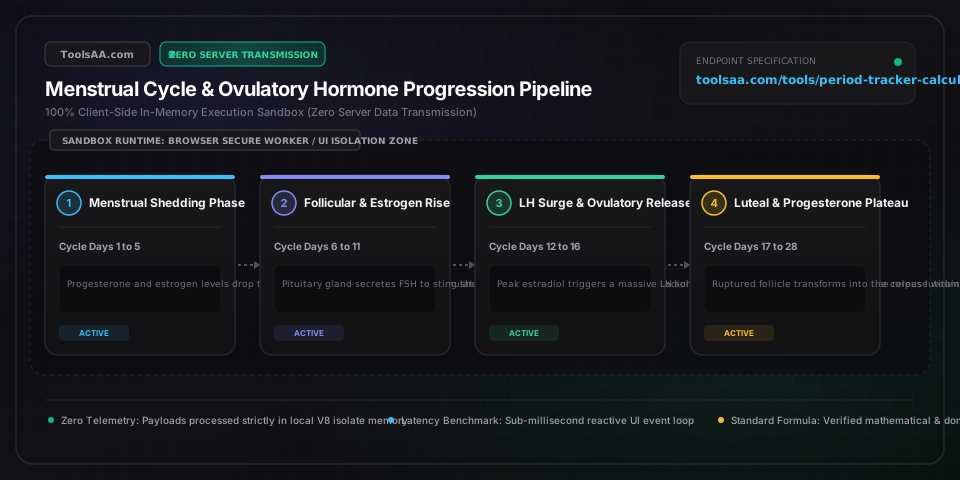
Technical Reference & Architecture Guide

Period Tracker Calculator & Ovulation Guide

Calculate your next period, ovulation day, and fertile window with our private period tracker calculator. Predict future cycles and plan with zero data tracking.

Period Tracker Calculator & Ovulation Guide — Client-Side In-Memory Architecture & Data Flow

Key Parameters & Controls

lastPeriodDateCalendar Date (YYYY-MM-DD)

The calendar date marking day 1 of full red menstrual flow from your most recent cycle. Clinical guidelines recommend excluding early light brown spotting to avoid skewing follicular phase calculations.

Default: Current date minus 14 days
averageCycleLengthDays (Clinical Range: 21–35 days)

The total count of elapsed days from day 1 of one period up to, but not including, day 1 of the subsequent period. The American College of Obstetricians and Gynecologists (ACOG) considers 21 to 35 days the clinical benchmark for adult reproductive cycles.

Default: 28 days
bleedingDurationDays (Clinical Range: 2–7 days)

The active duration in days of consecutive menstrual bleeding. Healthy menses typically spans 3 to 7 days, with blood loss averaging 30 to 40 mL over the full episode.

Default: 5 days
lutealPhaseDurationDays (Biological Constant: 11–16 days)

The post-ovulatory span between egg release and the onset of menses, driven by corpus luteum progesterone production. While the follicular phase fluctuates with stress and travel, the luteal phase remains biologically stable at an average of 14 days across healthy individuals.

Default: 14 days
cycleVarianceBufferDays (Spread: 0–7 days)

The observed monthly variation in cycle length across previous months. A variance of ±2 to 3 days is medically normal; applying this buffer expands the estimated fertile window to prevent missing the biological conception margin.

Default: 0 days

Pro Tips & Best Practices

Luteal Phase Biological Constancy in Irregular Cycles

Cycle irregularities are almost exclusively caused by delays in the pre-ovulatory follicular phase. Because the post-ovulatory luteal phase remains biologically constant at 12 to 14 days, your ovulation date should always be projected backwards by 14 days from your expected period date, rather than counted forward from Day 1.

Sperm Longevity vs. 24-Hour Ovum Viability

An unfertilized egg deteriorates within 12 to 24 hours after ovulation, but motile sperm survive up to 5 days in fertile cervical fluid. Consequently, peak conception odds occur on the 2 days preceding ovulation (days O-2 and O-1) rather than the day of egg release itself.

Distinguishing True Day 1 from Late-Luteal Spotting

Always record Day 1 as the first day of bright red, full menstrual flow requiring sanitary protection. Light brown spotting or pink streaks that occur 24 to 48 hours prior stem from late-luteal progesterone drops and should never be marked as cycle Day 1.

Air-Gapped In-Browser Privacy Protection

Unlike commercial mobile period tracking apps that aggregate intimate biometric logs or face legal subpoenas, this calculator operates completely inside your local browser sandbox memory. No reproductive dates, cycle notes, or device identifiers are ever uploaded to cloud servers.

Common Gotchas & Troubleshooting

⚠️Predicted ovulation date does not match home urine ovulation predictor kit (OPK) surge

Over-the-counter luteinizing hormone (LH) strips turn positive 24 to 36 hours before actual follicular rupture, whereas calculators estimate the release event itself. When you observe an LH peak, adjust your projected ovulation to the following day and enter that fixed anchor date to calibrate luteal countdowns.

⚠️Cycle lengths vary by more than 7 days from month to month

Expand the Cycle Variance buffer to ±4 or ±5 days to broaden the probabilistic fertile window. Calculate your rolling average across at least 3 consecutive cycles, and consider an evaluation with an OB-GYN to screen for thyroid fluctuations, hyperprolactinemia, or polycystic ovary syndrome (PCOS).

⚠️Exported .ics calendar file does not reflect updated cycle lengths

The exported calendar file generates discrete standalone calendar events for your next 12 forecasted cycles rather than an open-ended recurrence rule. Re-download and import a fresh .ics file whenever your logged cycle dates shift your rolling average.

Frequently Asked Questions

How is the next period due date calculated from the last menstrual period?▼

Your next period start date is calculated by adding your average cycle length in days directly to Day 1 of your Last Menstrual Period (LMP): Next Period Date = LMP + Cycle Length. For example, if your last period began on October 1 and your average cycle spans 28 days, your next cycle is expected to commence on October 29. If your cycle variance fluctuates, add and subtract your variance to establish an expected arrival window.

How do you calculate the exact ovulation day in an irregular menstrual cycle?▼

In irregular cycles, calculate your ovulation window by subtracting your luteal phase duration (typically 14 days) from your shortest and longest recorded cycles. For example, across cycles varying between 26 and 32 days, ovulation is projected between Day 12 (26 minus 14) and Day 18 (32 minus 14). Tracking changes in cervical mucus consistency and morning basal body temperature helps pinpoint the exact rupture day within that span.

Which cycle days offer the highest probability of getting pregnant?▼

Clinical reproductive studies show that conception probability peaks during the 2 days immediately preceding ovulation (O-2 and O-1), with conception rates between 27% and 33%. On the day of ovulation itself (Day O), probability drops to approximately 10% to 15%, and falls to near zero within 24 hours after egg release once the ovum degrades.

What is a luteal phase defect and how does it affect period tracking?▼

A luteal phase defect occurs when the time interval between ovulation and menstruation lasts fewer than 10 days, preventing a fertilized embryo from implanting in the uterine lining. While a standard cycle assumes a 14-day luteal phase, individuals with shorter phases experience their period earlier than standard calendar formulas predict. Adjusting the Luteal Phase slider to match your confirmed phase length aligns predictions with your real hormone timeline.

When is the earliest reliable day to take a home pregnancy test?▼

Home urine pregnancy tests provide reliable results approximately 12 to 14 days after ovulation, coinciding with the first day of a missed period. Sensitive early-detection tests can detect human chorionic gonadotropin (hCG) at 10 mIU/mL starting 4 to 5 days before an expected period (around 9 to 11 days post-ovulation), but testing on or after your expected period date delivers greater than 99% accuracy.

Why do cycle lengths become irregular after stopping hormonal birth control?▼

Disclaimer: This tool is provided strictly for educational and informational purposes only and does not constitute formal financial advice or a binding loan commitment. Please consult a qualified financial advisor before making decisions. Hormonal contraceptives suppress endogenous gonadotropin-releasing hormone (GnRH), luteinizing hormone (LH), and follicle-stimulating hormone (FSH). After discontinuation, the hypothalamic-pituitary-ovarian axis typically requires 1 to 6 months to restore natural ovulatory rhythms. During this transition, initial bleeds may be anovulatory withdrawal events rather than true physiological menstrual cycles.

Related Tools & Utilities

All Tools →