Hint lmp
Hint cycle explain
May 30, 2027
210 Unit days remaining•1st Trimester
NIPT cell-free maternal DNA screening window opens
Calculate your pregnancy due date and estimated gestational age by LMP, conception date, or IVF transfer. Get a personalized trimester timeline and milestones.
Hint lmp
Hint cycle explain
210 Unit days remaining•1st Trimester
NIPT cell-free maternal DNA screening window opens
Calculate your pregnancy due date and estimated gestational age by LMP, conception date, or IVF transfer. Get a personalized trimester timeline and milestones.
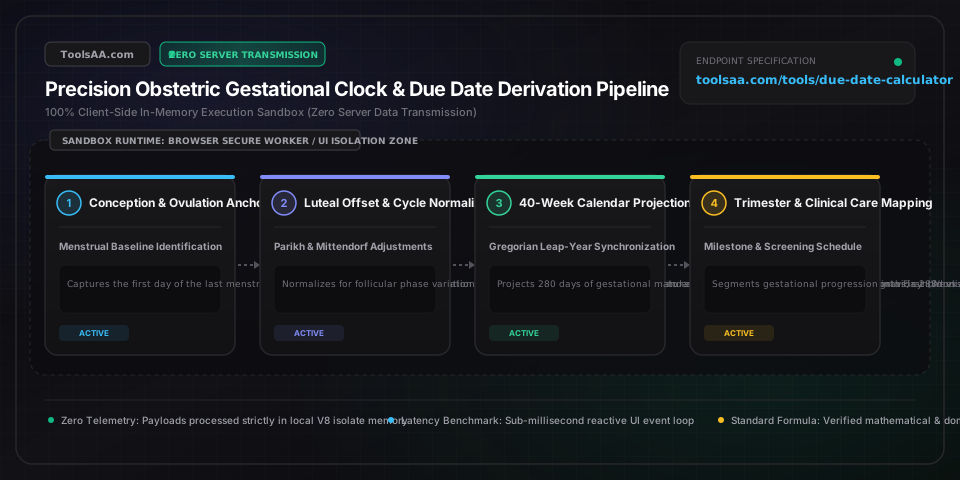
The first calendar day of normal menstrual bleeding preceding conception. Standard clinical obstetrics adds 280 days (40 completed gestational weeks) to this date under Naegele's rule to establish your baseline estimated delivery date.
The average number of elapsed days from cycle day 1 to the start of your next period. Because the post-ovulatory luteal phase remains biologically constant at roughly 14 days, each day above or below the standard 28-day benchmark shifts your ovulation timing and delivery date by exactly ±1 day.
The precise calendar date of fertilization, confirmed ovulation via luteinizing hormone (LH) surge, or basal body temperature shift. Obstetric calculation adds exactly 266 days (38 completed developmental weeks) from this date to pinpoint delivery timing without cycle variance.
The developmental age of the cultured embryo on the day of uterine transfer in assisted reproductive cycles. Day 5 blastocyst transfers add 261 days to your transfer date (266 post-conception days minus 5 days of prior laboratory culture), bypassing all menstrual cycle timing uncertainties.
The maximum straight-line length of the embryo from the top of the head (crown) to the bottom of the buttocks (rump) measured during a first-trimester sagittal ultrasound between 7 and 13+6 gestational weeks. CRL serves as the obstetric gold standard for dating precision within ±5 to 7 days.
Stratification based on delivery history. Obstetric data and the Mittendorf-Williams rule demonstrate that healthy, uncomplicated first-time pregnancies (primigravida) progress to a natural median of 288 days (8 days past the 40-week Naegele mark), whereas subsequent pregnancies (multipara) average 283 days.
Under American College of Obstetricians and Gynecologists (ACOG) Committee Opinion No. 700, if an ultrasound before 9 weeks of gestation differs from your LMP date by more than 5 days, the ultrasound date officially becomes your clinical due date. Between 9 weeks 0 days and 13 weeks 6 days, a discrepancy greater than 7 days mandates adopting the ultrasound date. Never recalculate due dates based on third-trimester scans, where natural genetic size variations introduce margins of error exceeding ±3 weeks.
Standard pregnancy wheels naively assume every woman ovulates on cycle day 14. In reality, the post-ovulatory luteal phase remains biologically constant at ~14 days, while the pre-ovulatory follicular phase expands or contracts. A woman with a 35-day cycle ovulates on day 21, not day 14. Using an unadjusted 28-day wheel falsely inflates gestational age by 7 days, putting healthy pregnancies at risk of unnecessary early labor induction for 'post-term' status.
Approximately 25% of pregnant women experience light pinkish or brownish spotting 6 to 12 days after fertilization as the blastocyst burrows into the uterine lining (decidua). Mistaking this implantation bleeding for a light period artificially shifts your LMP forward by 3 to 4 weeks. This common misinterpretation leads to an erroneously late due date and unwarranted medical anxiety over apparent fetal growth delays.
Only 4% to 5% of spontaneous births happen on the exact 40-week due date. Physiologically normal full-term delivery spans a healthy 5-week window from 37 weeks 0 days to 41 weeks 6 days. For healthy first-time mothers, the true population median for spontaneous labor onset is 40 weeks 5 days (285 to 288 days from LMP), so reaching 40 weeks without contractions is biologically normal.
Early crown-rump length (CRL) on ultrasound is the clinical gold standard because embryonic development is nearly identical across all humans in early pregnancy. If an ultrasound before 14 weeks differs from your LMP calculation by more than 5 days (prior to 9 weeks) or by more than 7 days (weeks 9 to 13+6), adopt the ultrasound due date. Biological ovulation timing varies widely, but early fetal size does not.
When menstrual cycles fluctuate unpredictably (such as varying from 32 to 55 days) or anovulatory cycles occur, calendar formulas based on bleeding dates produce inaccurate timelines. Switch the calculator to 'Confirmed Conception Date' if you tracked ovulation using basal body temperature or home LH surge test strips, or rely on a gentle transvaginal ultrasound scheduled between weeks 7 and 9 for definitive dating.
Never use your last period date for IVF or FET pregnancies, as synthetic hormone protocols override natural cycle timing. Select 'IVF Embryonic Stage at Transfer' and enter your transfer date alongside embryo age (Day 3 cleavage vs Day 5/6 blastocyst). The calculation anchors directly to fertilization age (Transfer Date + 266 days minus embryonic culture days), eliminating all guesswork.
Cycles falling outside the 21-to-45 day physiological window usually reflect irregular follicular development or luteal phase variations where standard calendar offsets break down. Instead of relying on menstrual date math, schedule an early first-trimester dating ultrasound at 8 to 11 weeks, which provides an accurate gestational baseline within ±5 days.
Naegele's rule calculates your estimated due date (EDD) with the formula: First Day of Last Menstrual Period (LMP) + 1 Year − 3 Months + 7 Days, equaling exactly 280 days (40 completed gestational weeks). For menstrual cycles longer or shorter than 28 days, obstetricians adjust this result by adding or subtracting the difference between your actual cycle length and 28 days (for example, a 32-day cycle adds 4 days to the due date).
Gestational age is clinically measured from the first day of your last menstrual period (LMP)—approximately two weeks before ovulation and fertilization take place—making your medical pregnancy age 14 days older than your baby's true biological age. Healthcare providers worldwide use this convention because menstruation is an obvious, observable calendar event, whereas microscopic fertilization inside the fallopian tube has no outward physical signs.
Only approximately 4% to 5% of babies arrive on their exact 40-week due date, as healthy childbirth naturally follows a statistical bell curve spanning a 35-day window from 37 weeks 0 days to 41 weeks 6 days. About 68% of spontaneous deliveries take place within 10 days of the estimated due date, and the natural median for uncomplicated first-time pregnancies is 40 weeks 5 days (285 to 288 days).
Under American College of Obstetricians and Gynecologists (ACOG) guidelines, a first-trimester ultrasound officially replaces your LMP due date if the measured crown-rump length (CRL) differs by more than 5 days before 9 weeks, or by more than 7 days between 9 weeks 0 days and 13 weeks 6 days. Early ultrasound is prioritized because human embryos grow at a virtually identical rate in the first trimester, whereas ovulation dates frequently vary.
Disclaimer: This tool is provided strictly for educational and informational purposes only and does not constitute formal financial advice or a binding loan commitment. Please consult a qualified financial advisor before making decisions. For in vitro fertilization (IVF), your due date is calculated by adding 261 days to your transfer date for a Day 5 blastocyst, or 263 days for a Day 3 embryo transfer (based on 266 total post-conception days minus the embryo's lab culture days). For frozen embryo transfers (FET), the calculation uses the transfer date and the embryo's cryopreservation age, providing the most accurate gestational dating possible.
Calculate exact daily water intake based on body weight, exercise, climate, and pregnancy. Get an hourly hydration schedule, bottle tracker, and electrolyte math.
Calculate body fat percentage using the official US Navy tape measure method. Compute lean mass, fat mass, military BCA tape test standards, and target waist.
Calculate permutations (nPr) and combinations (nCr) with or without repetition. Features step-by-step factorials, item list generator, and lottery odds.
Solve quadratic equations using this quadratic formula calculator and root finder. Find real or complex roots, discriminant, vertex, and exact radical steps.
Calculate your net worth instantly by tallying liquid assets, investments, real estate, and liabilities. Track debt ratios and forecast wealth growth trajectory.
Decode Morse code from audio files or live microphone in real time. Features automatic carrier frequency detection, adaptive noise filtering, WPM tracking, and live spectrogram.