logLogarithm Calculator (Log, Ln & Any Base)
Badge tier•y = log_b(x) ⟺ b^y = x•Badge precision engine

Logarithm Calculator (Log, Ln & Any Base)

Calculate log, natural log (ln), and log base 2 instantly with any base. Free logarithm calculator with step-by-step change of base formulas and antilog solver.

x in (0, +∞)
10⁻³ (0.001)Hint traverse orders10⁶ (1,000,000)
6
Stat base growth factor10.00
Stat decibel equivalent30.0 Unit decibels
Stat binary bits9.97 Unit bits
Mode log badgeRegime academic badge
Hero log result
3.000000
Hero exponential verification10.00^(3.000) ≈ 1000.00000
Hero scientific notation3.000000e+0
Hero residual0.0000000000
Lbl natural log ratio
ln(1000) = 6.907755
ln(10) = 2.302585
Lbl ratio = 3.000000
Lbl common log ratio
log₁₀(1000) = 3.000000
log₁₀(10) = 1.000000
Lbl ratio = 3.000000
Lbl identity checks
Lbl product rule
log_b(u · v) = log_b(u) + log_b(v)
Lbl quotient rule
log_b(u / v) = log_b(u) - log_b(v)
Lbl power rule
log_b(x^k) = k · log_b(x)
Stat base growth factor10.0000Stat base growth desc
Stat decibel equivalent30.00 Unit decibelsStat decibel desc
Stat binary bits9.966 Unit bitsStat binary desc
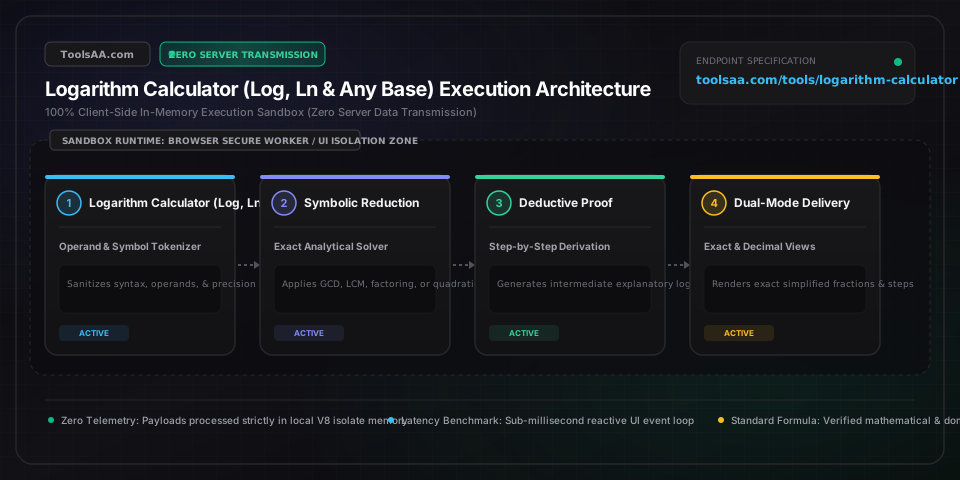
Client-Side Processing

High-performance calculation executed entirely in browser memory.

Zero Server Upload Privacy

All payloads remain strictly local with zero external server communication.

Production Ready Export

Clean, optimized output formats ready for immediate deployment.

Disclaimer
Technical Reference & Architecture Guide

Logarithm Calculator (Log, Ln & Any Base) Guide

Calculate log, natural log (ln), and log base 2 instantly with any base. Free logarithm calculator with step-by-step change of base formulas and antilog solver.

Logarithm Calculator (Log, Ln & Any Base) Guide — Client-Side In-Memory Architecture & Data Flow

Key Parameters & Controls

Logarithmic Input Value (Argument x)Strictly Positive Real Number (x > 0)

The physical magnitude or quantity you want to scale down logarithmically. In real-world physics, chemistry, and sound measurements, this number must strictly exceed zero (x > 0) because multiplying any positive base by itself always yields a positive amount. For instance, you can measure a quiet whisper at 0.00002 Pascals or an earthquake ground motion at 50,000 microns, but zero and negative values cannot exist on a standard physical logarithmic scale.

Default: 100
Logarithmic Base (Base of Exponentiation b)Positive Non-Unit Base (b > 0, b ≠ 1)

The multiplying factor defining the scale. The base must be positive and cannot equal 1, because 1 multiplied by itself always remains 1 and cannot scale numbers. Universal benchmarks include base 10 (the decimal standard used in audio decibels and acidity pH), base e (Euler's mathematical constant ≈ 2.71828, governing biological organism growth, thermal cooling, and continuous compound interest), and base 2 (binary doubling, used for computer data, musical pitch octaves, and tournament brackets).

Default: 10 (Common Log)
Logarithm Value / Exponent (Evaluated Result y)Logarithmic Magnitude / Exponent (y in ℝ)

The exact power or compounding level needed for the base to reach your input value (satisfying b^y = x). When your input is greater than 1, the logarithm is positive; when your input is exactly 1, the result is always 0 (since any base to the power of 0 equals 1); and when your input is a fraction between 0 and 1, the result becomes negative, reflecting fractional decay, sound attenuation, or chemical dilution.

Default: 2.0 (for log₁₀(100))
Inverse Antilog Value (Base Raised to Exponent)Exponential Reconstructed Quantity (x = b^y)

The exact reverse operation of a logarithm, converting a compressed logarithmic score back into a tangible, linear real-world quantity. Given a base b and a logarithmic magnitude y, the antilog calculates x = b^y. For example, converting an acidity reading of pH 3 back to hydrogen ion concentration yields 10^-3 = 0.001 moles per liter, or converting an audio gain of +20 dB back to sound pressure amplification yields a 10-fold increase.

Default: 100 (from 10²)
Display Precision (Significant Decimals)Decimal Rounding Threshold (2 to 16 Decimals)

The number of decimal digits displayed for transcendental, non-repeating results. Because logarithms of values that are not exact whole-number powers of the base produce infinite non-repeating decimals, rounding to 4 to 8 decimal places provides the ideal balance between clean student readability and rigorous scientific laboratory precision.

Default: 8 Decimals
Mathematical Notation StandardScientific Domain Convention

The notation convention used to interpret unqualified 'log' expressions. In everyday secondary school curricula, chemistry, and audio acoustics, 'log' defaults to base 10 and 'ln' defaults to natural base e. In university physics, statistics, and advanced calculus, 'log' defaults to the natural logarithm (base e). In information theory and music acoustics, logarithms often default to base 2.

Default: Standard School & Engineering (log = base 10, ln = base e)
Pro Tips & Best Practices

The Change of Base Theorem and Exact Integer Power Precision

When using standard calculators without a dedicated custom-base key, you calculate any custom logarithm using the universal Change of Base formula: log_b(x) = ln(x) / ln(b) or log₁₀(x) / log₁₀(b). However, dividing approximate decimal values often introduces tiny rounding artifacts—such as evaluating log₂(8) and getting 2.999999999 or 3.000000001 instead of exact 3. To maintain pure mathematical fidelity, check whether your input is an exact integer power of the base (for example, 2³ = 8, 3⁴ = 81, or 5³ = 125) before accepting rounded decimal approximations for homework or engineering reports.

The Notation Collision: Why log(x) Means Base e in Higher Math but Base 10 on School Calculators

On standard classroom scientific calculators (Texas Instruments, Casio), 'LOG' invariably stands for common logarithm base 10, while 'LN' stands for natural logarithm base e (≈ 2.71828). However, in university calculus textbooks, advanced biology, physics, and scientific research papers, the unadorned symbol 'log(x)' almost universally denotes the natural logarithm (base e). If you see a formula in a college biology or physics paper writing log(100), it often evaluates to 4.605 rather than 2. Always confirm whether the author follows standard secondary school notation (base 10) or academic research convention (natural log) before applying formulas.

Decibel Scaling Rule: When Sound and Signal Ratios Use Factor 10 vs Factor 20

A widespread confusion in audio acoustics, hearing protection, and radio signals is knowing when to multiply by 10 versus 20. When measuring energy, power, or acoustic intensity (measured in watts), decibels follow the formula dB = 10 × log₁₀(P₁ / P₀), where every 10-fold power increase adds +10 dB. However, when measuring physical amplitude or sound pressure level (measured in Pascals or microvolts), power is proportional to the square of pressure. Applying the logarithm power rule log(P²) = 2 × log(P) doubles the multiplier: dB = 20 × log₁₀(V₁ / V₀). Consequently, doubling electrical power adds +3.01 dB, whereas doubling acoustic sound pressure perceived by your eardrum adds +6.02 dB.

The Asymptotic Wall at Zero and Why pH Rushes Near Neutrality

The logarithm curve f(x) = log_b(x) and the exponential curve g(x) = b^x are exact geometric mirror reflections across the 45-degree diagonal line y = x. While exponential growth accelerates toward positive infinity, the logarithmic curve plunges vertically toward negative infinity as your input approaches zero. Between 1 and 0.1, the log drops by 1 unit; between 0.1 and 0.001, it drops by 2 units; and as input nears zero, it drops off an infinite mathematical cliff. This steep cliff explains why a swimming pool or human bloodstream experiences massive, rapid swings in acidity (pH) when even trace amounts of acid are added near the neutral pH 7 mark.

Common Gotchas & Troubleshooting

⚠️Entering zero or a negative input number displays 'Domain Error: Argument Must Be Greater Than Zero'

In real-world physical measurements and standard mathematics, logarithms are only valid for strictly positive numbers greater than zero (x > 0). Because multiplying any positive base by itself can never equal zero or a negative amount (for example, 10 raised to any power is always positive), there is no real exponent that produces zero or a negative result. If you are calculating logarithmic differences or rates of return with negative values, convert the problem into a relative ratio (such as final value divided by initial value) or take the absolute magnitude.

⚠️Setting the base to 1 or a negative value produces 'Base Error: Base Must Be Positive and Not Equal to 1'

A logarithm base must always be strictly positive and cannot equal 1 (b > 0 and b ≠ 1). If the base were 1, the equation 1^y = x is impossible whenever x is anything other than 1, and completely undefined when x is 1 (because 1 raised to any power whatever always equals 1). If the base were negative, raising it to fractional powers (like taking square roots of negative numbers) produces non-real imaginary numbers rather than a smooth, continuous scale. Set your base to a positive number such as 10, 2, or Euler's constant e (2.71828).

⚠️Spreadsheet formula =LOG(number, [base]) returns #NUM! or inverted results

In spreadsheet software like Microsoft Excel and Google Sheets, the formula syntax is =LOG(number, [base]), where the base defaults to 10 if left blank. A common mistake is flipping the order of the numbers: entering =LOG(10, 100) calculates log₁₀₀(10) = 0.5 instead of log₁₀(100) = 2. Additionally, for natural logarithms, always use the dedicated =LN(number) formula instead of typing base 2.71828 manually to avoid truncation errors. Ensure the measured value comes first, followed by your custom base.

⚠️Extremely large numbers in scientific notation (like 10³⁰⁰) causing calculator display overflow

When dealing with colossal scientific figures (such as astronomical star distances or molecular Avogadro counts), ordinary calculators can struggle with raw digit limits. You can evaluate the logarithm of any large number in scientific notation (m × 10^k) instantly by applying the Logarithmic Product Rule: log₁₀(m × 10^k) = log₁₀(m) + k. For instance, to find log₁₀(4.5 × 10⁸⁴), simply calculate log₁₀(4.5) ≈ 0.6532 and add 84 to get 84.6532 without entering dozens of zeros.

Frequently Asked Questions

How do you calculate a logarithm with any base on a standard calculator?▼

To calculate a logarithm with any base b on a standard calculator, divide the natural log (ln) or common log (log₁₀) of the number by the log of the base using the Change of Base Formula: log_b(x) = ln(x) / ln(b) = log₁₀(x) / log₁₀(b). For example, to find log₃(81), enter ln(81) / ln(3), which equals 4.394449 / 1.098612 = 4, confirming that 3⁴ = 81.

What is the difference between log and ln?▼

The difference between log and ln is the base number being raised to a power: common log (log or log₁₀) uses base 10, whereas natural log (ln or log_e) uses Euler's constant e (approximately 2.71828). For example, log₁₀(100) = 2 because 10² = 100, while ln(100) ≈ 4.605 because e^4.605 ≈ 100. Base 10 is standard in human decimal measurements like earthquake Richter scales and sound decibels, while base e governs natural exponential growth, biological decay, and compound interest.

Why can you not take the logarithm of zero or a negative number?▼

You cannot take the real logarithm of zero or a negative number because raising any positive base number to any power always results in a positive number greater than zero. In the exponential formula b^y = x, as the exponent y becomes extremely negative (such as 10⁻⁵ or 10⁻¹⁰⁰), the result gets infinitely close to zero (0.00001) but never reaches zero or crosses into negative territory. Consequently, logarithms have a vertical boundary line at zero, making log(0) and log of negative numbers mathematically undefined in real arithmetic.

How do you calculate the inverse logarithm (antilog)?▼

To calculate the antilogarithm (inverse log), raise the base number to the power of the logarithm result: x = b^y. For a common base-10 logarithm, the antilog of y is 10^y (for example, the antilog of 3 is 10³ = 1,000). For a natural logarithm (ln), the antilog of y is e^y (for example, the antilog of 2 is e² ≈ 7.389). For a binary logarithm (base 2), the antilog of y is 2^y (for example, the antilog of 8 is 2⁸ = 256).

What are the essential logarithm rules used to simplify math formulas?▼

The five essential logarithm rules for simplifying expressions are: 1) Product Rule: log_b(u × v) = log_b(u) + log_b(v); 2) Quotient Rule: log_b(u / v) = log_b(u) - log_b(u); 3) Power Rule: log_b(u^k) = k × log_b(u); 4) Base Identity Rules: log_b(b) = 1 and log_b(1) = 0; and 5) Inverse Rules: b^(log_b(x)) = x and log_b(b^x) = x. These algebraic identities allow complex multiplication and division to be converted into simple addition and subtraction.

How do logarithmic scales work in real-world measurements like decibels, Richter magnitude, and pH?▼

Logarithmic scales compress massive ranges of physical intensity into simple, manageable numbers where each whole-number step represents a multiplying factor rather than an addition. In water chemistry, pH is defined as -log₁₀[H⁺], meaning a pH of 5 has 10 times more acid ions than pH 6, and 100 times more than pH 7. In acoustics, every +10 decibels (dB) represents a 10-fold increase in sound energy (+20 dB is 100-fold). In seismology, each 1.0 increase on the Richter earthquake scale represents approximately 31.6 times more released seismic energy.

Related Tools & Utilities

All Tools →