401k Calculator & Retirement Savings Estimator
Badge cfa standardBadge decimal engine

401k Calculator & Retirement Savings Estimator

Calculate 401(k) retirement savings growth with employer match, SECURE 2.0 catch-up, inflation drag, Traditional vs Roth tax, and reverse goal target solving.

Lbl quick presets
Banner match captured title100% Lbl captured

Banner match captured desc

Title regime profile

IRS SECURE 2.0
Lbl annual salary$95,000
$
Lbl salary growth3%
Hint salary growth
Lbl current balance$45,000
$

Title employee contrib

Lbl contrib rate8%
Lbl annual est $7,600Lbl monthly est $633
Lbl auto escalation
Lbl annual step+1.0% / yr
Lbl max escalation cap15.0% of pay

Title employer match

Max Captured
Lbl match rateHint match rate
Lbl match up toHint match cap
Lbl annual dollar capHint dollar cap
Lbl vesting schedule

Title market tax

2.5% Lbl inflation
Lbl pre return7.5%
Lbl post return5%
Lbl inflation rate
Lbl current tax
Lbl retire tax
Lbl projected nest egg
$4,330,842
Lbl at age 6545.6x Lbl salary multiple
Lbl real purchasing power
$1,824,892
2.5% Lbl annual inflation42% Lbl purchasing retained
Lbl monthly retirement income
$14,436/mo
Lbl safe rate 4.00%$173,234/yr
Lbl match capture efficiency
100%
Lbl max money captured$172,317 Lbl total earned

Title capital breakdown

Lbl employee principal$812,39318.8%
Lbl employer principal$172,3174.0%
Lbl compound growth$3,301,13276.2%
Lbl secure2 notice title

Lbl secure2 notice desc

Primary Metric$4,330,842
Efficiency / Capacity100% (Max Captured)
Net OutputLbl super catchup available

Disclaimer text

Client-Side Processing

High-performance calculation executed entirely in browser memory.

Zero Server Upload Privacy

All payloads remain strictly local with zero external server communication.

Production Ready Export

Clean, optimized output formats ready for immediate deployment.
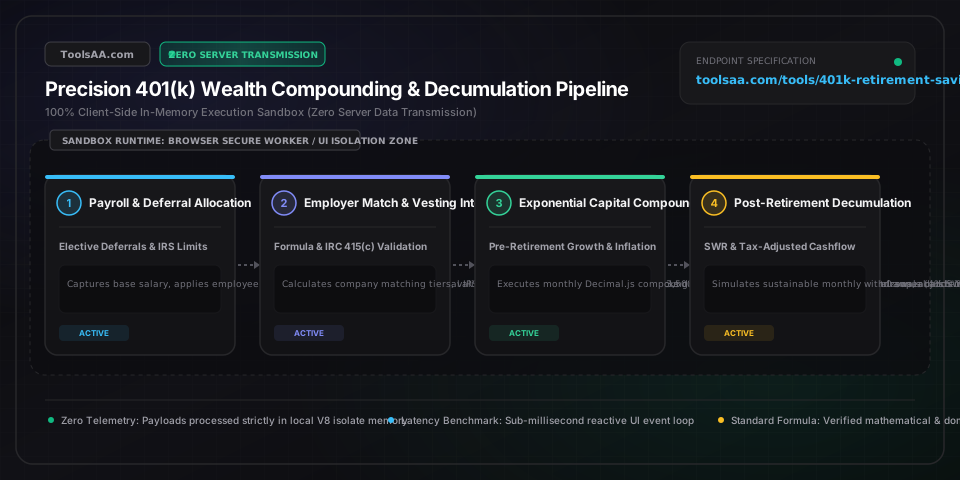
Technical Reference & Architecture Guide

401k Calculator & Retirement Savings Estimator Guide

Calculate 401(k) retirement savings growth with employer match, SECURE 2.0 catch-up, inflation drag, Traditional vs Roth tax, and reverse goal target solving.

401k Calculator & Retirement Savings Estimator Guide — Client-Side In-Memory Architecture & Data Flow

Key Parameters & Controls

Current Age & Target Retirement AgeTemporal Horizon (Years)

Starting age and planned retirement age defining the compounding horizon (t = Retirement Age - Current Age). Under exponential compounding, extending the accumulation window allows annual returns to compound on prior gains, with a 35-year horizon yielding more than double the terminal balance of a 20-year horizon at identical contribution rates.

Default: Age 30 to Age 65 (35-year compounding horizon)
Annual Base Salary & Wage Growth RateMonetary Compensation & Escalation ($ and %)

Current gross annual earned income and projected annual merit or cost-of-living raise. Annual salary expansion scales nominal elective deferrals over time, accelerating total dollar contributions until reaching statutory limits or the IRS compensation cap ($350,000 under IRC Section 401(a)(17) in 2025/2026).

Default: $95,000 base salary with 3.0% annual raise
Employee Elective Deferral & Auto-EscalationElective Deferral Ratio (% of Gross Pay)

Percentage or fixed dollar amount deducted from each paycheck under IRC Section 402(g), bounded by annual statutory limits ($23,500 base in 2025/2026; $31,000 for ages 50+; $34,750 for ages 60–63 under SECURE 2.0). Optional auto-escalation automatically increments contributions by 1% annually to optimize savings without noticeable net pay reductions.

Default: 8.0% of salary with 1.0% annual auto-escalation
Employer Match Structure & Vesting ScheduleEmployer Matching Formula & Vesting Schedule

Corporate matching formula (e.g., 50% match up to 6% of compensation, yielding an effective 3% employer contribution) combined with graded or cliff vesting schedules. Unvested employer contributions forfeit back to the plan trust if separation occurs prior to the full vesting milestone (typically 3 to 6 years).

Default: 50% match up to 6% of compensation (3-year graded vesting)
Annual Portfolio Rate of ReturnAnnualized Geometric Compound Return (%)

Estimated annual compound rate of return across asset allocation mixes (equities, fixed income, target-date index funds). CFA standard benchmarks project a 7.0%–8.0% nominal return (approximately 4.5%–5.5% real return net of inflation) during accumulation and a more conservative 4.0%–5.5% return during retirement preservation.

Default: 7.5% pre-retirement, 5.0% post-retirement
Inflation Rate & Purchasing Power DeflatorAnnual Headline CPI Inflation Rate (%)

Projected annual Consumer Price Index inflation rate used to discount nominal future account balances back to present-day purchasing power (Real Value = Nominal Value / (1 + i)^t). At a standard 2.5% inflation rate, purchasing power declines by approximately 52% over 30 years.

Default: 2.5% annualized inflation rate

Pro Tips & Best Practices

Always Capture 100% of the Employer 401(k) Match First

An employer match provides an immediate 50% to 100% risk-free return on capital that public financial markets cannot guarantee. For example, contributing 6% on an $80,000 salary ($4,800) with a 50% match generates an instant $2,400 in employer-paid compensation. Contributing below the matching threshold forfeits guaranteed, non-market compensation and permanently reduces compounding terminal wealth.

Capitalize on the SECURE 2.0 Super Catch-Up Window for Ages 60 to 63

Under Section 109 of the SECURE 2.0 Act, pre-retirees aged 60 through 63 receive an enhanced "Super Catch-Up" contribution limit of $11,250 in 2025/2026 (the greater of $10,000 or 150% of the standard $7,500 catch-up limit). Maxing out this four-year window permits up to $34,750 in annual employee deferrals, injecting an extra $45,000+ into your retirement nest egg during peak earnings years before reverting to regular catch-up limits at age 64.

Traditional vs Roth 401(k) Arbitrage Based on Marginal Tax Spread

Select Traditional pre-tax contributions if your current combined federal and state marginal tax rate (e.g., 24% to 37%) exceeds your projected effective tax rate in retirement distributions, allowing you to invest current-year tax deductions. Choose Roth 401(k) contributions if you currently sit in lower brackets (10% to 12%) or anticipate that future legislative tax increases and substantial Required Minimum Distributions (RMDs) will elevate your retirement tax burden.

The Save More Tomorrow 1% Auto-Escalation Compounding Multiplier

Enabling annual 1% automatic contribution escalation synchronized with merit salary reviews transitions an 8% deferral rate to 15% across seven years without reducing nominal take-home pay. Over a 30-year accumulation period, this behavioral finance intervention captures hundreds of thousands of dollars in incremental compound earnings that would otherwise be absorbed by lifestyle creep.

Common Gotchas & Troubleshooting

⚠️Total annual additions exceed the IRS IRC Section 415(c) statutory ceiling

IRC Section 415(c) caps total annual additions—aggregating employee elective deferrals, employer matching contributions, and discretionary profit sharing—at the lesser of 100% of earned compensation or $70,000 for 2025/2026 ($77,500 including standard catch-up; $81,250 for SECURE 2.0 super catch-up). If payroll audits detect an overage, plan administrators must process a timely corrective distribution of excess deferrals with attributable earnings before April 15 of the following year to prevent double taxation under IRC Section 402(g).

⚠️Inflation-adjusted retirement balance appears significantly smaller than future nominal total

Long-term compounding inflation causes the money illusion: at an average 2.5% inflation rate over 35 years, a $2,000,000 nominal nest egg provides only ~$842,700 in base-year purchasing power. Always toggle between nominal future value and real purchasing power to calibrate target withdrawal rates against true future living expenses, such as escalating healthcare and non-discretionary costs.

⚠️Front-loading early annual deferrals forfeits subsequent employer match (Missing True-Up)

Maxing out the $23,500 elective deferral early in the calendar year drops remaining paycheck contributions to 0%. If your employer plan calculates matching on a per-pay-period basis without an annual "True-Up" provision, you forfeit matching contributions for all subsequent zero-deferral pay periods. Pace contributions evenly across all 24 or 26 annual pay cycles, or confirm in writing with HR that your plan includes an automated year-end true-up reconciliation.

Frequently Asked Questions

How much will $23,500 maxed out annually in a 401(k) grow to in 30 years?▼

Maxing out the 2025/2026 employee deferral limit of $23,500 annually at an average 7% annual compound return produces approximately $2,219,900 after 30 years, assuming $705,000 in personal contributions and over $1,514,900 in cumulative compound earnings. If your employer provides a standard 50% match on the first 6% of an average $100,000 salary ($3,000 per year), the total terminal retirement balance expands to over $2,503,000 in nominal wealth.

What is the most common employer 401(k) match formula in the United States?▼

The most common employer 401(k) matching formula is 50% of employee contributions up to 6% of salary, providing an effective employer contribution of 3% of annual compensation. The second most frequent structure is the Safe Harbor matching formula: a 100% dollar-for-dollar match on the first 3% of pay, plus a 50% match on the next 2% of pay, delivering an effective 4% employer contribution with immediate 100% vesting rights.

How does the SECURE 2.0 Act change catch-up contributions for ages 60 to 63?▼

Section 109 of the SECURE 2.0 Act introduces an enhanced "Super Catch-Up" contribution for workers aged 60, 61, 62, and 63, setting the limit at the greater of $10,000 or 150% of the regular catch-up limit ($11,250 for 2025/2026). This elevates the maximum employee elective deferral ceiling to $34,750 per year for those four ages, after which the allowable catch-up reverts to the regular $7,500 limit at age 64.

Should I contribute to a Traditional 401(k) or a Roth 401(k)?▼

Choose a Traditional 401(k) if your current marginal tax bracket (such as 24%, 32%, or 35%) is higher than your expected effective tax rate in retirement, allowing you to maximize tax deductions today and reinvest the tax savings. Opt for a Roth 401(k) if you are currently in an entry-level tax bracket (10% or 12%) or expect growing career earnings, policy-driven tax hikes, or large portfolio balances to place you in higher tax brackets during retirement.

How much monthly retirement income does a $1,000,000 401(k) balance provide?▼

Disclaimer: This tool is provided strictly for educational and informational purposes only and does not constitute formal financial advice or a binding loan commitment. Please consult a qualified financial advisor before making decisions. Under the classic Bengen 4% Safe Withdrawal Rate (SWR), a $1,000,000 portfolio generates $40,000 per year, or exactly $3,333.33 per month in gross retirement income adjusted annually for inflation. For modern extended 35-to-40-year retirements, adopting a conservative 3.5% withdrawal rate provides $35,000 annually ($2,916.67 monthly), lowering historical portfolio depletion risk close to zero across broad stock and bond index allocations.

Related Tools & Utilities

All Tools →