Stripe Fee Calculator & Net Payout Estimator

Stripe Fee Calculator & Net Payout Estimator

Calculate exact Stripe credit card fees, net payouts, and reverse gross-up invoice totals with multi-currency rates, cross-border FX, and add-on cost modeling.

Lbl active regime
USD•US
Lbl presets

Title control deck

Lbl interactive

Hint forward mode

USD ($)
$
Lbl cross border fx
Lbl climate
Lbl dispute reserve0.0%

Hint dispute reserve

Lbl schedule year2.9% + $0.30
Kpi net payout
$96.80
Sub net deposit
Kpi total stripe fees
$3.20
3.20% Lbl take rate
Kpi net margin
96.8%
Sub gross retained
Kpi customer paid
$100.00
Lbl single charge
Chart fee allocation100% = $100.00
Lbl net payout (96.8%)Th base processing

Table detailed breakdown

USD Lbl denominated
Th fee componentTh pricing basisTh calculated costTh effective share
Th base processing2.90% + $0.30$3.203.20%
Kpi total stripe fees3.20% Lbl effective$3.203.20%
Lbl zero driftLbl client secured

Stat instant payout title

Stat instant payout desc

Stat reserve title

Stat reserve desc

Stat tax title

Stat tax desc

Disclaimer title

Disclaimer text

Client-Side Processing

High-performance calculation executed entirely in browser memory.

Zero Server Upload Privacy

All payloads remain strictly local with zero external server communication.

Production Ready Export

Clean, optimized output formats ready for immediate deployment.
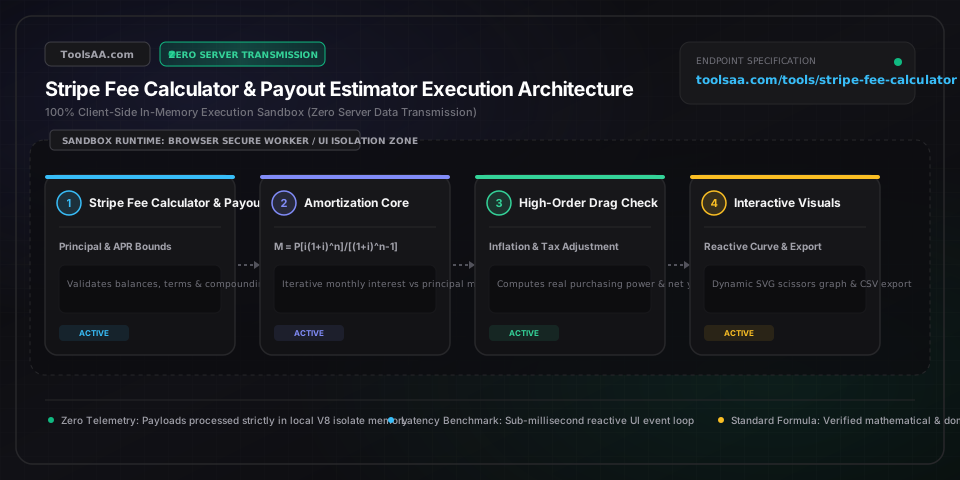
Technical Reference & Architecture Guide

Stripe Fee Calculator & Net Payout Estimator Guide

Calculate exact Stripe credit card fees, net payouts, and reverse gross-up invoice totals with multi-currency rates, cross-border FX, and add-on cost modeling.

Stripe Fee Calculator & Net Payout Estimator Guide — Client-Side In-Memory Architecture & Data Flow

Key Parameters & Controls

Gross Transaction Volume (Gross Ticket Amount)Monetary Value (ISO 4217 Currency Units)

Gross invoice face value charged to customer cardholder before fee deductions. Stripe enforces a hard network clearance floor of $0.50 USD (or local statutory equivalent: £0.30 GBP, €0.50 EUR, ¥50 JPY). On transaction sizes below $10.00, fixed clearing charges ($0.30 USD) trigger severe fee drag, raising effective processing costs to between 5.90% and 32.90% of gross revenue.

Default: 100.00
Card Origin Routing & Currency Settlement MatrixJurisdiction & Interchange Assessment Category

Payment network clearing route dictating underlying interchange tiers and cross-border surcharges. Domestic transactions clear at standard statutory benchmark rates (US: 2.90%, UK/EU: 1.50%, AU: 1.75%, JP: 3.60%). Cross-border payment rails trigger a mandatory +1.00% (US/CA/JP) or +1.50% to +1.75% (UK/EU/AU) interchange surcharge. If the presentment currency diverges from the merchant bank settlement currency, an additional +1.00% to +2.00% foreign exchange spot spread is assessed.

Default: Domestic Card (Same Settlement Currency)
Stripe Ecosystem Add-On ModulesModular Value-Added Software Service (VAS)

Ancillary merchant SaaS modules stacked atop base network processing. Configurations include Radar for Fraud Teams (+$0.05 per transaction for custom risk logic), Stripe Tax (+0.50% on taxable sales volume within registered jurisdictions), Stripe Billing (+0.50% to +0.70% on recurring ARR volume), and Stripe Invoicing Plus (+0.50% per finalized invoice). Instant Payout liquidity carries a +1.00% treasury markup (subject to a $0.50 minimum fee).

Default: Standard Radar (Machine Learning Free Tier)
Target Net Disbursement (Reverse Gross-Up Target)Liquid Working Capital Settlement Target

Target net liquidity required to hit corporate merchant treasury accounts post-clearing. Reverse gross-up models the exact billing figure required to insulate gross margin against processing erosion via the formula Gross = (Target Net + Fixed Fee) / (1 - Variable Fee Rate). Completely eliminates the 0.09% to 0.50% undercharge deficit caused by naive additive percentage pricing.

Default: 1000.00

Pro Tips & Best Practices

Interchange-Plus Negotiation Thresholds ($80k-$100k Monthly GMV Cliff)

Stripe's standard 2.90% + $0.30 blended pricing model subsidizes expensive credit rewards cards at the direct expense of high-volume merchants. Under the US Durbin Amendment (12 CFR Part 235), regulated debit card interchange is capped at 0.05% + $0.21. When your processing scale surpasses $80,000 to $100,000 in monthly Gross Merchandise Value (GMV) with an average ticket above $80, request custom Interchange-Plus (IC+) pricing from Stripe Sales. Migrating a 60% debit card customer base from blended to IC+ captures immediate margin expansion of 110 to 160 basis points.

Multi-Currency Settlement Eliminates the 200 bps Foreign Exchange Double-Dip

Accepting payments in non-domestic currencies without dedicated local currency bank accounts triggers both the +1.00% international card surcharge AND a +1.00% to +2.00% foreign exchange spread. To neutralize this 200–300 bps drag, connect multi-currency merchant bank accounts (e.g., routing native EUR via SEPA or native GBP via Faster Payments). Stripe allows native settlement directly into matching currency accounts without executing forced dynamic currency conversion.

Mitigating the Statutory 0.75% Dispute Ratio Reserve Trap

Card schemes (Visa Dispute Monitoring Program and Mastercard Excessive Chargeback Program) enforce strict dispute thresholds at 0.75% to 1.00% of transaction count (not dollar volume). Breaching this ceiling triggers mandatory $15.00 dispute fees per case and causes Stripe Risk to enforce a 5% to 15% rolling reserve held for 90 to 180 days. Implement automated pre-dispute deflection rails (Verifi CDRN and Ethoca) to issue proactive refunds before chargebacks settle on Visa/Mastercard clearing networks.

ACH Direct Debit Capped Fee Optimization for Invoices Exceeding $200

Credit card processing fees scale linearly with invoice size, causing a $5,000 B2B invoice to incur $145.30 in Stripe fees. Routing domestic payments through Stripe ACH Direct Debit assesses a 0.80% fee capped strictly at $5.00. For any invoice exceeding $200, enabling ACH over credit cards yields an immediate 96.5% reduction in payment clearance overhead while preserving net working capital.

Common Gotchas & Troubleshooting

⚠️Reverse Gross-Up Mathematical Deficit (Naive Additive Percentage Pricing)

Merchants attempting to pass processing fees to buyers often make the fatal arithmetic mistake of calculating Gross = Net + (Net × 0.029) + $0.30. On a $100 invoice, charging $103.20 yields a Stripe fee of ($103.20 × 0.029) + $0.30 = $3.29, resulting in a net payout of only $99.91 ($0.09 under-recovery). To achieve 100% margin recovery, apply algebraic reverse gross-up: Gross = (Desired Net + Fixed Fee) / (1 - Variable Rate). For $100 net at 2.9% + $0.30: ($100 + $0.30) / (1 - 0.029) = $100.30 / 0.971 = exactly $103.30.

⚠️Unexplained Payout Shortfall from Return Fee Friction and Tax Clawbacks

If daily bank deposits do not match gross revenue minus standard fees, audit your Stripe dashboard balance for three hidden deductions: (1) Refunded transaction fee retention: Since April 2020, Stripe does not refund original processing fees on customer returns, leaving the merchant to fund the initial fee out-of-pocket; (2) Stripe Tax automated deductions (0.50% per transaction where registration is live); and (3) Monthly post-billing charges for Stripe Invoicing Plus (0.50% on finalized invoices) or Radar for Fraud Teams ($0.05/charge) deducted directly from the rolling payout balance.

⚠️Cross-Border FX Spot Slippage on International Presentment Currencies

When foreign customers pay in non-domestic fiat currency, merchants frequently notice effective fee deductions reaching 4.90% to 5.90%. This occurs because Stripe stacks the domestic fee (2.90% + $0.30), the cross-border card surcharge (+1.00%), and the foreign exchange conversion markup (+1.00% to +2.00%). Remedy this by navigating to Stripe Settings > Bank Accounts and Payouts and configuring secondary native bank settlement currencies, or adjusting your checkout logic to bill solely in your primary base operating currency.

Frequently Asked Questions

How do I calculate Stripe fees so the customer pays them?▼

To calculate Stripe fees so the customer pays them, you must use the reverse gross-up formula: Gross Charge = (Target Net + Fixed Fee) / (1 - Percentage Rate). For example, to receive exactly $100.00 net in the United States on standard 2.90% + $0.30 pricing, the calculation is ($100.00 + $0.30) / (1 - 0.029) = $100.30 / 0.971 = $103.30. Adding 2.9% + $0.30 naively ($103.20) causes a fee shortfall because Stripe charges its 2.9% fee against the inflated total, yielding only $99.91.

What are current Stripe processing fees by country in 2026?▼

Current Stripe domestic standard processing fees are: United States: 2.90% + $0.30 USD; Canada: 2.90% + CA$0.30 CAD; United Kingdom: 1.50% + £0.20 GBP for standard domestic consumer cards; Eurozone: 1.50% + €0.25 EUR for domestic European Economic Area cards; Australia: 1.75% + A$0.30 AUD; and Japan: 3.60% + ¥0 JPY. Commercial credit cards and cards issued outside the merchant's home jurisdiction incur additional regional interchange markups.

Why does Stripe charge an extra fee for international cards and currency conversion?▼

Stripe assesses two distinct cross-border surcharges: an International Card Surcharge (+1.00% in the US/Canada; +1.50% to +1.75% in the UK/EU/AU) to cover higher cross-border interchange clearing schedules imposed by Visa and Mastercard, and a Currency Conversion Fee (+1.00% to +2.00%) applied when the buyer's payment currency must be converted into the merchant's nominated bank payout settlement currency.

Does Stripe refund credit card processing fees on customer refunds?▼

No, Stripe does not return original payment processing fees when a customer refund is issued. If a merchant refunds a $100.00 customer purchase in the US, Stripe credits the entire $100.00 back to the customer's card, but retains the original $3.20 processing fee, which is deducted directly from the merchant's operational balance. Businesses with elevated refund rates must budget a 1.00% to 2.50% gross margin buffer to absorb unrecoverable return fee friction.

What is the exact mathematical formula for Stripe fee calculations?▼

The forward Stripe fee equation is Fee = (Gross Charge × Total Percentage Fee) + Total Fixed Fee, yielding Net Payout = Gross Charge - Fee. The reverse gross-up equation is Gross Charge = (Desired Net Payout + Total Fixed Fee) / (1 - Total Percentage Fee). To prevent IEEE 754 floating-point rounding errors in software billing engines, all financial computations must be executed using arbitrary-precision decimal math (e.g., Decimal.js or integer cents) with standard banker's half-up rounding.

How do fixed transaction fees affect microtransactions on Stripe?▼

Disclaimer: This tool is provided strictly for educational and informational purposes only and does not constitute formal financial advice or a binding loan commitment. Please consult a qualified financial advisor before making decisions. Stripe's fixed clearing fee ($0.30 USD) causes severe regressive fee drag on small purchases: on a $1.00 charge, the $0.30 fixed fee combined with 2.9% creates an effective processing rate of 32.90% ($0.33 fee, $0.67 net). At $5.00, the effective fee rate remains high at 8.90% ($0.45 fee). Digital product merchants should mitigate microtransaction drag by bundling purchases, implementing prepaid store balance credits, or using ACH rails.

Related Tools & Utilities

All Tools →