Title control deck
Title dosage summary
Desc forward recipe
Explain contraction25.6 fl ozExplain contraction end
Ymyl notice desc
Alcohol dilution calculator to calculate exact water needed to dilute spirits, moonshine, or ethanol to any target ABV or proof with volume contraction physics.
Desc forward recipe
Explain contraction25.6 fl ozExplain contraction end
Ymyl notice desc
Alcohol dilution calculator to calculate exact water needed to dilute spirits, moonshine, or ethanol to any target ABV or proof with volume contraction physics.
The unadjusted alcoholic strength of the base spirit stock. High-purity neutral grain spirit typically measures 95% to 96% ABV (190-192 Proof), barrel-entry whiskeys range from 55% to 65% ABV (110-130 Proof), and raw pot-still hearts average 70% to 85% ABV (140-170 Proof).
The exact liquid volume of undiluted spirit in the blending tank or carboy before solvent addition. Accurate volume measurement requires temperature stabilization at official gauging baselines to prevent thermal expansion discrepancies.
The legally regulated or sensory target strength of the finished product. Common benchmarks: 40% ABV (80 Proof US statutory minimum for whiskey, vodka, gin, rum), 43% ABV (86 Proof export standard), 50% ABV (100 Proof US Bottled-in-Bond Act of 1897 standard), and 70% v/v (USP antiseptic disinfectant threshold).
The negative volume change (Delta V_mix) resulting from intermolecular hydrogen bonding and interstitial packing between water dipoles and ethanol molecules. Shrinkage peaks at 3.5% to 4.0% total volume in the 40% to 54% ABV range, requiring excess water addition to hit targeted proofs.
The thermal baseline at which the physical glass hydrometer stem was calibrated. US TTB hydrometers are calibrated at 60 °F (15.56 °C) pursuant to 27 CFR Part 19, whereas European and international OIML instruments are standardized to 20 °C (68 °F).
The actual physical temperature of the spirit sample when the hydrometer float reading is taken. Spirits expand as temperature rises, lowering liquid density and causing the hydrometer to sink deeper, registering an artificially elevated apparent proof.
The chemical composition of the cutting liquid. High-purity reverse osmosis or demineralized distilled water prevents magnesium/calcium saponification and chill haze. Sugar syrups add dissolved sucrose Brix, altering mixture viscosity and specific gravity.
The alcohol concentration of a secondary blending spirit when operating in multi-barrel or two-stock compounding mode. Used to compute cross-allocation fractions without adding pure water.
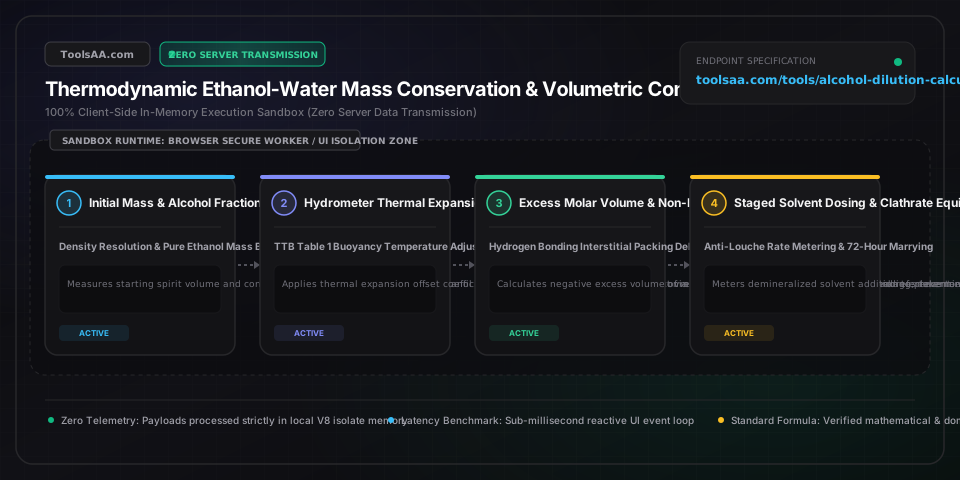
Ethanol and water molecules do not behave like rigid billiard balls. Water molecules are tiny (molecular weight 18.02 g/mol) compared to ethanol (46.07 g/mol), allowing water dipoles to pack neatly into the interstitial voids between ethanol chains while forming tight hydrogen bond clusters. When you combine 500 ml of absolute ethanol with 500 ml of pure water, the resulting mixture measures approximately 965 ml, not 1,000 ml—a 3.5% volume contraction. If a distiller relies on naive arithmetic dilution, adding only the ideal volume of water, the finished spirit will register a higher ABV than targeted and the batch will produce fewer bottles than planned. Always utilize mass-density contraction compensation.
High-proof distillates—particularly gin, absinthe, ouzo, and barrel-aged whiskeys—contain hydrophobic botanical essential oils (anethole, terpenes, pinene) and wood lactones dissolved in high-strength ethanol. When water is dumped rapidly into high-proof spirit, localized micro-pockets drop below the critical solubility threshold (typically 45% to 50% ABV), causing spontaneous emulsification (the Ouzo effect) where oil droplets precipitate into a permanent colloidal suspension. To keep spirits sparkling clear, temper slowly: add chilled demineralized water in small, staged batches over several days while maintaining gentle mechanical agitation, or chill-filter at 0 °C to remove insoluble long-chain fatty acid esters.
Glass alcohol hydrometers do not measure alcohol directly; they measure specific gravity via buoyancy displacement. Because ethanol and water expand significantly with warmth, a spirit at 75 °F (24 °C) is less dense than the same spirit at the US TTB standard calibration temperature of 60 °F (15.56 °C). Consequently, the hydrometer bulb sinks deeper into warm liquid, falsely displaying an apparent proof roughly 1.5 to 2.0 Proof higher than the spirit actually contains. Proofing spirit directly off a warm condenser without applying TTB Table 1 temperature corrections causes distillers to add too much water, accidentally dropping the final batch below the legal 80 Proof threshold.
Diluting high-strength alcohol with water is a chemically exothermic process, releasing approximately 800 Joules of enthalpy per mole of ethanol mixed. This reaction fractures the existing ethanol-water clathrate hydrate cages, temporarily liberating unassociated ethanol molecules. Tasting freshly diluted spirit reveals a fiery, harsh, disconnected alcohol burn on the tongue. Commercial distilleries enforce a mandatory 48-to-72-hour 'marrying rest' in inert stainless steel holding tanks, allowing hydrogen bonds to reorganize into stable supramolecular clathrate complexes that round out mouthfeel and integrate aroma.
This cloudiness stems from two distinct mechanisms: the Ouzo effect (hydrophobic botanical essential oils and whiskey fatty acid ethyl esters dropping out of solution below 45% ABV) or calcium/magnesium carbonate flocculation from hard tap water. To prevent this, always cut spirits with demineralized reverse osmosis or distilled water (TDS < 5 ppm). If clouding has already occurred in gin or whiskey, rest the batch at 28-32 °F (-2 to 0 °C) for 48 hours to coagulate oils, then pass through a 1-micron depth filter sheet, or slowly blend in a small aliquot of high-proof base to raise ABV above the oil solubility cliff.
This discrepancy occurs when dilution is calculated using naive volume math (C1*V1 = C2*V2) without accounting for the 3.5% thermodynamic volume contraction, compounded by taking hydrometer readings on liquid warmed by the exothermic heat of mixing. The mixture shrunk in total volume, leaving the alcohol more concentrated. Correct this by measuring the liquid temperature with a calibrated laboratory thermometer, applying the temperature correction to determine true proof, and using this calculator with 'Contraction Physics' enabled to dose the precise supplemental water required.
You fell victim to the thermodynamic excess volume of mixing. When combining high-proof alcohol and water, interstitial molecular packing eliminates empty space between molecules, causing 100 gallons of components to produce only ~96.5 gallons of finished 80 Proof spirit. To eliminate bottling shortfalls, switch the calculator to 'Reverse Batch Container Fill' mode. This calculates the precise volume of spirit and water needed to fill your exact target case count after contraction occurs.
The spirit is suffering from hydration disequilibrium. Diluting high-proof alcohol breaks intermolecular hydrogen bonds and releases heat, creating unshielded ethanol molecules that aggressively vaporize and irritate trigeminal nerve endings. Store the sealed batch in a cool, dark room for 72 hours to 2 weeks without agitation. This allows water molecules to form protective hydrogen-bonded clathrate cages around ethanol clusters, yielding a smooth, integrated mouthfeel.
To calculate water needed for ideal dilution, use the formula: Water to Add = V1 * (C1 / C2 - 1), where V1 is the starting spirit volume, C1 is the starting ABV percentage, and C2 is the target finished ABV percentage. For example, to dilute 1,000 ml of 80% ABV spirit down to 40% ABV, calculate 1,000 * (80 / 40 - 1) = 1,000 ml of water. However, because alcohol and water undergo a ~3.5% volumetric contraction when mixed, commercial distillers add approximately 1,036 ml of water to reach exactly 40% ABV and 2,000 ml of finished liquid.
Mixing alcohol and water causes non-ideal thermodynamic volume contraction due to interstitial molecular packing and hydrogen bonding. Water molecules (H2O) are significantly smaller than ethanol molecules (C2H5OH). When combined, the tiny water molecules slip into the intermolecular spaces between ethanol molecules and form strong hydrogen bonds, drawing the mixture into a denser configuration. At room temperature, this contraction reaches a maximum shrinkage of 3.8% around 45% to 50% ABV, meaning 500 ml of pure ethanol and 500 ml of water yield only ~965 ml of solution.
In the United States, Proof is exactly double the Alcohol By Volume percentage (Proof = 2 * ABV), meaning 40% ABV equals 80 Proof and 100% pure ethanol is 200 Proof. In the United Kingdom and Commonwealth nations, the historic Sikes proof scale defined 100° Proof as spirit having an alcohol concentration of 4/7 by volume (approximately 57.14% ABV), based on the historic 17th-century Royal Navy test where gunpowder soaked in spirit would still ignite. While the UK adopted standard metric % ABV in 1980 pursuant to EU regulations, Sikes proof remains a vital historical benchmark for distillers.
To dilute 1,000 ml of 99% isopropyl alcohol down to the CDC-recommended 70% v/v antiseptic standard, add 414 ml of distilled water (yielding 1,414 ml of 70% solution). For 1,000 ml of 91% isopropyl alcohol, add 300 ml of distilled water (yielding 1,300 ml of 70% solution). The CDC and WHO recommend 70% alcohol over 91% or 99% because pure alcohol instantly coagulates the outer protein coat of bacteria and viruses, creating a protective barrier; the presence of 30% water slows evaporation and allows the alcohol to penetrate the cell wall to destroy internal pathogen lipids.
Hydrometers measure specific gravity via buoyancy and are calibrated at a specific baseline temperature, typically 60 °F (15.56 °C) for US TTB hydrometers or 20 °C (68 °F) for international instruments. Alcohol and water expand as temperature increases, reducing the fluid density. In warm distillate (such as 75 °F / 24 °C coming off a condenser), the hydrometer sinks deeper into the lighter liquid, displaying an apparent proof that is 1.5 to 2.5 Proof higher than the actual alcohol content. Distillers must cross-reference hydrometer reading with fluid temperature using TTB Gauging Table 1 to determine true proof.
Diluted spirits should rest (or 'marry') for a minimum of 48 to 72 hours, while premium commercial whiskeys and brandies are often rested for 2 to 4 weeks. When water is added to alcohol, the exothermic reaction disrupts intermolecular hydrogen bonds, creating unassociated ethanol molecules that taste harsh, burning, and astringent. Resting allows the ethanol and water molecules to achieve thermodynamic equilibrium, forming stable clathrate hydrate clusters where water molecules encapsulate ethanol dipoles, resulting in a noticeably softer and smoother mouthfeel.
Calculate cat age to human years with precision. Convert kitten months, reverse human age to cat years, explore feline life stage benchmarks, and view charts.
Stair stringer calculator for exact rise, run, stringer length, and cut layout. Calculate throat depth, bottom riser reduction, framing square marks, and IRC code.
Calculate volume & surface area for 12+ 3D solids including sphere, cylinder, cone, and cube. Get instant step-by-step formulas, dynamic SVG nets, and unit charts.
Self employment tax calculator to estimate 1099 SE taxes, Schedule C net earnings, Social Security, and Medicare. Calculate quarterly payments and write-offs.
Estimate total home closing costs and buyer cash to close accurately. Calculate loan origination fees, title insurance, appraisal, escrow prepaid taxes, and fees.
Compare tire sizes side by side with instant diameter, width, sidewall, circumference, and speedometer error calculations. Inspect clearance and speed reading.