Self Employment Tax & 1099 Calculator
Badge statutory framework•2024 Tax year label (Cap2024 short Lbl wage cap short)•Badge cfa spec

Self Employment Tax & 1099 Calculator

Self employment tax calculator to estimate 1099 SE taxes, Schedule C net earnings, Social Security, and Medicare. Calculate quarterly payments and write-offs.

Lbl quick scenarios
Lbl tax regime

Title forward deck

USD
$85,000
$
$12,000
$
$0
Lbl remaining cap$168,600
$0
$15,000
Fact title Fact body
Kpi total se tax$10,315Kpi fica portion
Kpi total income tax$6,513Kpi fed state
Kpi effective rate19.8%Kpi on gross
Kpi net take home$56,173$4,681/Unit month

Title waterfall chart

$85,000Lbl gross rev$12,000Lbl deductions$10,315Lbl se tax$6,513Lbl inc tax$56,173Lbl take home
Title statutory auditLbl irc code ref
Th statutory stepTh calculation ruleTh amount
Row gross revRule gross rev$85,000
Row schedule c expRule schedule c-$12,000
Row net profitRule net profit$73,000
Row base adjRule base adj$67,416
Row ss taxRule ss cap prefix Cap2024 short$8,360
Row medicare taxRule uncapped med$1,955
Row addl medRule addl med threshold$0
Row total se taxRule total se line$10,315
Row above the lineRule schedule1 line-$5,157
Compliance note
Stat schedule c margin
85.9%
$73,000 Stat net retained
Stat marginal se rate
15.30%
Stat cap unexhausted
Stat quarterly target
$3,750
Stat quarterly cadence

Client-Side Processing

High-performance calculation executed entirely in browser memory.

Zero Server Upload Privacy

All payloads remain strictly local with zero external server communication.

Production Ready Export

Clean, optimized output formats ready for immediate deployment.

Disclaimer title Disclaimer text

Technical Reference & Architecture Guide

Self Employment Tax & 1099 Calculator Guide

Self employment tax calculator to estimate 1099 SE taxes, Schedule C net earnings, Social Security, and Medicare. Calculate quarterly payments and write-offs.

Self Employment Tax & 1099 Calculator Guide — Client-Side In-Memory Architecture & Data Flow

Key Parameters & Controls

Gross 1099 Revenue & Receipts (Schedule C Line 1)Annual Gross Currency Receipts ($ / £ / € / ¥)

Total top-line payments received from clients, online marketplaces, and 1099-NEC or 1099-K tax statements before subtracting any business expenditures or write-offs. This represents your full incoming business cash flow across the entire calendar year.

Default: $85,000.00
Ordinary & Necessary Business Expenses (Schedule C Line 28)Deductible Operational Expenditures ($)

Legitimate, everyday business expenditures allowable under tax regulations (IRC Section 162). This includes software subscriptions, equipment depreciation, home office expenses, marketing, health care adjustments, and professional insurance that directly lower your taxable baseline.

Default: $12,000.00
Net Schedule C Self-Employment ProfitNet Business Operating Income ($)

True take-home business earnings determined by subtracting allowable operating expenses from gross revenue. Under statutory IRS rules, if your net earnings for the year are under the $400 statutory threshold, no self-employment tax is owed.

Default: $73,000.00
Statutory SE Taxable Base Adjustment (92.35% Factor)Statutory Adjustment Ratio (%)

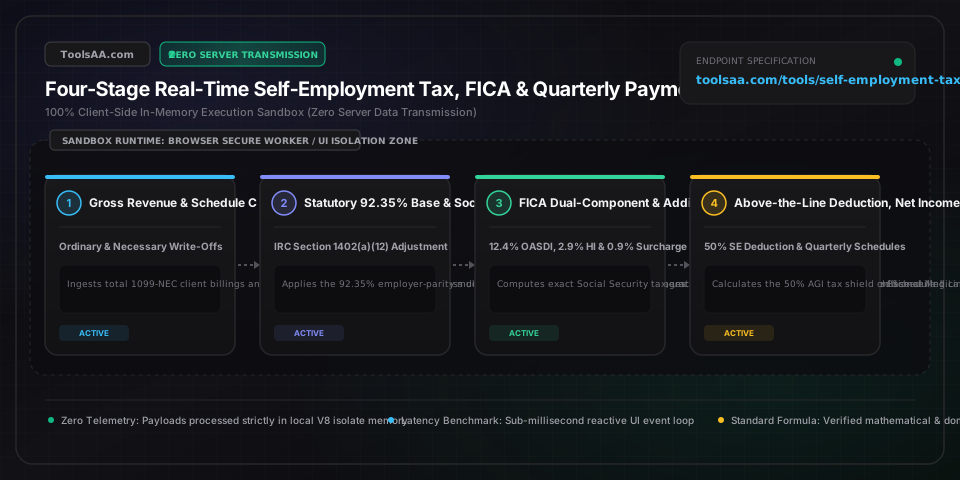
The statutory legal multiplier mandated by tax law (IRC Section 1402(a)(12)) where only 92.35% of net profit is subject to self-employment tax. This provides independent workers fair tax parity with traditional corporations by accounting for the half of payroll taxes that employers normally deduct.

Default: 92.35% (Statutory IRS Constant: 100% - 7.65%)
Social Security Tax & Wage Base Limit (12.4%)Statutory OASDI Rate & Capped Threshold ($ / %)

The 12.40% contribution funding Old-Age, Survivors, and Disability Insurance (OASDI). This rate applies only up to the statutory annual earnings ceiling ($168,600 for 2024; $176,100 for 2025) across all combined W-2 wages and freelance net profits, shielding earnings beyond that limit.

Default: 12.40% up to $168,600 (2024 Base)
Medicare Tax & Additional Medicare Surcharge (2.9% + 0.9%)Uncapped Statutory Healthcare Contribution Rate (%)

The 2.90% Hospital Insurance contribution that funds Medicare, applied across all net business earnings without an upper cap. An Additional Medicare Tax of 0.90% (3.80% combined) applies only to earnings above high-income thresholds ($200,000 for single filers or $250,000 for married couples filing jointly).

Default: 2.90% Uncapped (+ 0.90% over statutory thresholds)
Above-the-Line SE Tax Deduction (50% Adjustment)Adjusted Gross Income Reduction ($)

A tax-saving adjustment permitted under tax law (IRC Section 164(f)) equal to exactly half (50%) of your total self-employment tax. Claimed on Form 1040 Schedule 1 (Line 15), this directly reduces your Adjusted Gross Income (AGI) before your federal income tax brackets are calculated.

Default: 50.00% of Total SE Tax
Section 199A Qualified Business Income (QBI) Deduction (20%)Pass-Through Small Business Deduction (%)

A federal tax deduction allowing qualifying sole proprietors and independent contractors to deduct up to 20% of net business income from income taxes, subject to annual taxable income phase-out ranges ($191,950 for single filers or $383,900 for married couples in 2024).

Default: Up to 20.00% of Qualified Net Income
Pro Tips & Best Practices

The 92.35% Net Earnings Multiplier Prevents Double Taxation on the Employer Half

Never calculate your 15.3% self-employment tax directly on 100% of your Schedule C net profit. Under tax law (IRC Section 1402(a)(12)), you are legally entitled to multiply your net business profit by 92.35% (1.0 minus 0.0765) before applying the 15.3% tax rate. This statutory adjustment ensures self-employed individuals receive tax parity with traditional businesses, which deduct the employer-paid half of payroll taxes as an operating expense. On an $80,000 net profit, this statutory adjustment saves you $936 in self-employment tax.

Concurrent W-2 Employment Wipes Out the 12.4% Social Security Self-Employment Tax

If you balance a traditional corporate job alongside your 1099 side hustle or freelance business, your W-2 wages are credited first toward the annual Social Security Wage Base limit ($168,600 for 2024; $176,100 for 2025). If your day job salary already reaches or exceeds this cap, your 1099 freelance earnings are 100% exempt from the 12.4% Social Security tax portion. You will only owe the 2.9% Medicare tax on your side business profits, immediately dropping your self-employment tax rate from 15.3% to just 2.9%.

The 50% Above-the-Line SE Tax Deduction Lowers Your Adjusted Gross Income (AGI)

Every dollar you pay in self-employment tax creates a built-in tax shield against your regular federal income tax. Under tax rules (IRC Section 164(f)), exactly half of your calculated self-employment tax is deducted on Form 1040 Schedule 1 (Line 15) as an Above-the-Line adjustment. This reduces your Adjusted Gross Income (AGI), which directly softens your income tax bracket exposure and helps safeguard your eligibility for income-sensitive benefits such as the Child Tax Credit, student loan interest deductions, and deductible IRA contributions.

S-Corporation Election (Form 2553) Slashes SE Tax on Profits Exceeding Reasonable Salary

Once your net annual self-employment profit consistently surpasses $80,000 to $100,000, consider electing S-Corporation tax status via IRS Form 2553. In an S-Corp, you divide your business profit into a market-standard 'Reasonable W-2 Salary' (subject to standard payroll taxes) and owner dividend distributions (which are entirely free from the 15.3% self-employment tax). On $150,000 of profit structured as $75,000 salary and $75,000 distribution, this can save between $10,500 and $11,500 in payroll taxes annually after factoring in administrative payroll setup.

Common Gotchas & Troubleshooting

⚠️Estimated tax underpayment penalty triggered despite paying on time in equal installments

This frequently happens when freelance earnings surge in the second half of the year. The IRS assumes income is earned evenly across all four calendar quarters, so paying later in the year can trigger automated underpayment penalties for Q1 or Q2. To eliminate this penalty, file IRS Form 2210 using Schedule AI (Annualized Income Installment Method), which recalculates your quarterly tax obligations based on the actual revenue earned within each specific quarter.

⚠️Calculated self-employment tax appears lower than 15.3% of total gross profit

This is mathematically correct and represents statutory compliance. Because the 15.3% rate applies only to 92.35% of your net Schedule C earnings, the effective self-employment tax rate relative to your full net profit is 15.3% × 0.9235 = 14.13%. Furthermore, if your combined earned income surpasses the annual Social Security wage cap ($168,600 in 2024), earnings above that threshold incur only the 2.9% Medicare tax, lowering your blended effective rate even further.

⚠️Overpaying Social Security tax when transitioning from W-2 employment to 1099 mid-year

If you left a corporate job where Social Security was already withheld on $120,000 of wages and subsequently generated $80,000 in freelance profit, only $48,600 ($168,600 cap minus $120,000 W-2 earnings) is subject to the 12.4% Social Security tax. Be sure your year-to-date W-2 earnings are properly accounted for on Schedule SE. If your tax return fails to credit prior W-2 withholdings, you will overpay Social Security tax and must claim an excess Social Security tax credit on Schedule 3.

⚠️Deducting health insurance premiums as a Schedule C business expense instead of an Above-the-Line adjustment

Never list your health insurance premiums as an ordinary business operating expense on Schedule C. While doing so reduces self-employment tax, IRS regulations strictly prohibit this. Qualified self-employed health insurance premiums must be deducted on Form 1040 Schedule 1 (Line 17) as an Above-the-Line deduction to lower your Adjusted Gross Income. Deducting health insurance on Schedule C improperly depresses your reported Social Security earnings record, which permanently reduces your future retirement benefit payments.

Frequently Asked Questions

How much is self-employment tax in 2024 and 2025?▼

The self-employment tax rate is 15.30%, consisting of 12.40% for Social Security and 2.90% for Medicare. In 2024, the 12.4% Social Security portion applies to the first $168,600 of combined net business earnings and W-2 wages (increasing to $176,100 in 2025). The 2.9% Medicare tax applies to all net self-employment earnings without any income limit, plus a 0.9% Additional Medicare Tax on earnings exceeding $200,000 for single filers or $250,000 for married couples filing jointly.

How do you calculate self-employment tax on 1099 income?▼

Self-employment tax is calculated in three steps: First, determine your net business profit by subtracting allowable business expenses from gross 1099 revenue on Schedule C. Second, multiply net profit by 92.35% (0.9235) to determine taxable self-employment income pursuant to IRC Section 1402(a)(12). Third, multiply that taxable base by 15.30% (or 2.9% on amounts exceeding the Social Security wage cap). For example, a $100,000 net profit yields $92,350 in taxable SE earnings, resulting in $14,129.55 in self-employment tax ($92,350 × 0.153).

What is the difference between self-employment tax and income tax?▼

Self-employment tax covers Social Security and Medicare contributions (FICA taxes that traditional W-2 employees share equally with employers), whereas income tax is a separate tax assessed on total taxable income across progressive federal and state tax brackets (ranging from 10% to 37% federally). Traditional employees pay 7.65% with their employer paying 7.65%, while self-employed professionals pay the combined 15.3% rate on net profits in addition to ordinary federal and state income taxes.

How does concurrent W-2 salary affect self-employment tax?▼

W-2 salary is credited first toward the annual Social Security wage base limit ($168,600 for 2024; $176,100 for 2025). If your W-2 wages reach or exceed this cap, your 1099 freelance profit is 100% exempt from the 12.4% Social Security portion, meaning you only pay the 2.9% Medicare tax on your business earnings. If your W-2 wages fall below the cap, only the remaining gap up to the ceiling is taxed at 12.4%, substantially lowering your total tax bill.

How much should an independent contractor set aside for taxes?▼

Independent contractors should generally set aside 25% to 35% of their net business profit (gross revenue minus allowable expenses) in a dedicated savings reserve for quarterly taxes. This allocation covers the ~14.1% effective self-employment tax, 10% to 15% for federal income tax (after standard and QBI deductions), and 3% to 6% for state taxes. High-earning freelancers in states with higher tax rates (such as California or New York) earning over $150,000 should reserve 35% to 40% of net profits.

How do you calculate estimated quarterly self-employment tax payments?▼

Disclaimer: This tool is provided strictly for educational and informational purposes only and does not constitute formal financial advice or a binding loan commitment. Please consult a qualified financial advisor before making decisions. To calculate estimated quarterly tax payments (Form 1040-ES), project your expected annual tax obligation (combined self-employment tax plus federal and state income tax) and divide that total by 4. Payments are due April 15, June 15, September 15, and January 15. To avoid IRS underpayment penalties under statutory Safe Harbor guidelines, ensure you pay at least 90% of your current year tax liability or 100% of your prior year tax liability (110% if your prior year Adjusted Gross Income exceeded $150,000).

Related Tools & Utilities

All Tools →