Short title

Loan Amortization Schedule (Loan Calculator)

Calculate loan amortization schedules with monthly and annual breakdowns, extra payments, PMI drop-off, and payoff savings. Export to Excel or PDF.

Lbl load sample
Tab cockpit
$400,000
$320,000
6.750%
30 Lbl years suffix (360 Lbl months suffix)
2026-12-01
Sec extra payments+$250/Lbl month
Sec escrow
Kpi monthly p i$2,075.51Kpi monthly total: $2,592
Kpi total interest$296,625Kpi total cost: $616,625
Kpi payoff date2049-0122.2 Lbl years suffix (266 Lbl cycles suffix)
Kpi interest saved$130,563-94 Lbl months early

Chart title

Chart subtitle

Lbl balance curveLbl cumulative interest curveLbl equity curve
0k80k160k240k320k
Lbl first payment$2,592.18
Lbl principal share: $526 (18%)Lbl interest share: $1,800 (63%)Lbl escrow share: $517 (19%)
Cfa insight title

Cfa insight body

Kpi monthly p i$2,075.51
Kpi total interest$296,625
Kpi payoff years22.2 Lbl years suffix
Kpi interest saved$130,563
Lbl front loaded ratio87%
Kpi payoff date2049-01
Disclaimer title

Disclaimer body

Technical Reference & Architecture Guide

Loan Amortization Schedule (Loan Calculator) Guide

Calculate loan amortization schedules with monthly and annual breakdowns, extra payments, PMI drop-off, and payoff savings. Export to Excel or PDF.

Loan Amortization Schedule (Loan Calculator) Guide — Client-Side In-Memory Architecture & Data Flow

Key Parameters & Controls

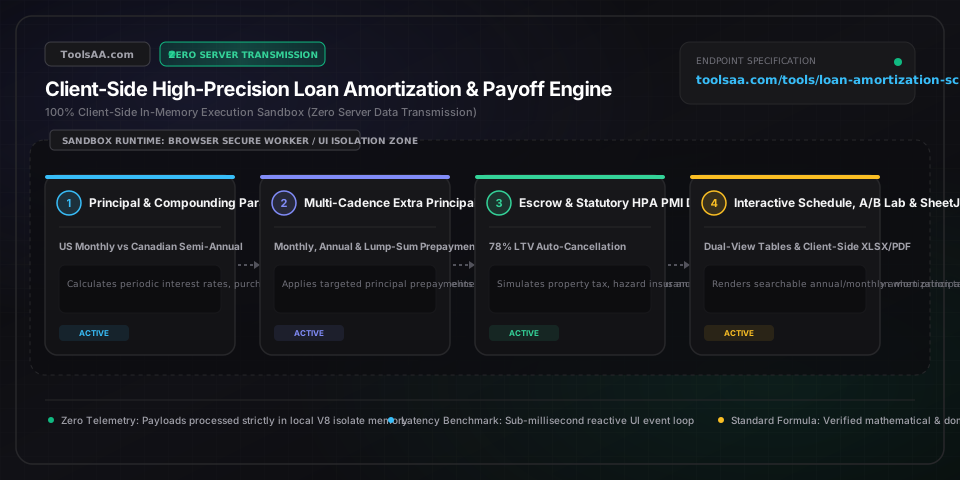
Principal Loan Amount & Down Payment (principalLoanAmount)Currency Metric (USD $, CAD $, GBP £, EUR €, AUD $)

The net amount borrowed from the lender after subtracting the cash down payment from the total property purchase price. For example, a $500,000 property with a 20% down payment ($100,000) results in a starting principal balance of $400,000. Interest is calculated solely on the outstanding principal balance remaining at the start of each payment cycle.

Default: $320,000 (80% LTV on $400,000 Home Purchase)
Annual Percentage Rate & Compounding Frequency (interestRateCompounding)Percentage APR with Compounding Mode (Monthly vs Semi-Annual)

The contractual annual interest rate charged on unpaid principal. In the United States, mortgage interest compounds monthly (periodic rate = APR / 12). In Canada, the Interest Act mandates semi-annual compounding not in advance for fixed-rate mortgages [periodic monthly rate = (1 + APR/2)^(2/12) - 1], which slightly lowers the effective monthly interest rate compared to US calculations.

Default: 6.75% APR (Standard 30-Year Fixed Benchmark)
Loan Amortization Term & Payment Cadence (loanTermAndCadence)Duration (Years/Months) & Frequency (Monthly / Bi-Weekly / Accelerated)

The total duration over which the loan balance is scheduled to amortize to zero. Common terms are 15, 20, 25, and 30 years. Payment frequencies include Monthly (12/yr), Bi-Weekly (26/yr), and Accelerated Bi-Weekly. Accelerated bi-weekly splits the monthly payment in half and pays 26 times per year, effectively making 13 full monthly payments each year and shaving 4 to 6 years off a 30-year term.

Default: 30 Years (360 Monthly Payments)
Extra Principal Prepayments & Debt Snowball Engine (extraPaymentsEngine)Multi-Cadence Currency Inputs (Monthly, Annual Lump-Sum, One-Time)

Additional cash payments applied 100% toward outstanding principal rather than interest. Because amortization heavily front-loads interest, extra principal payments made early in the loan schedule produce an exponential debt snowball effect, permanently reducing the compounding principal base and saving tens of thousands in lifetime interest.

Default: Monthly Extra: $0 | Annual Extra: $0 | One-Time: $0
Escrow Expenses: Property Tax, Hazard Insurance & HOA (escrowComponents)Monthly / Annual Escrow Deductions (Taxes, Insurance, HOA Dues)

Ancillary homeownership expenses collected monthly by the mortgage servicer and held in an escrow impound account to pay annual county property taxes and hazard insurance premiums on the borrower's behalf. HOA dues are factored into total monthly housing cash flow but are typically paid directly by the borrower.

Default: Taxes: 1.2% ($4,800/yr) | Insurance: $1,400/yr | HOA: $0
Private Mortgage Insurance & HPA 1998 Cancellation (pmiAndCancellation)Percentage Fee (0.3% to 1.5%/yr) with 78% LTV Statutory Auto-Drop

Insurance required by conventional lenders when down payments are less than 20% (Loan-to-Value > 80%). Under the federal US Homeowners Protection Act of 1998 (HPA), lenders are legally required to automatically cancel PMI when the principal balance reaches 78% of the original property value, or upon borrower written request at 80% LTV with a good payment history.

Default: 0.85% Annual PMI (Auto-cancelled at 78% Original LTV)
Pro Tips & Best Practices

Apply the 1/12th Extra Payment Rule to Shave 4-6 Years Off Your 30-Year Loan

Dividing your monthly principal-and-interest payment by 12 and adding that exact amount to your regular payment each month produces the exact financial equivalent of making one full additional mortgage payment each calendar year. On a $400,000 30-year mortgage at 6.75%, this simple discipline shortens the repayment timeline by approximately 4.8 years and eliminates over $88,000 in compound interest.

Enforce the US Homeowners Protection Act of 1998 to Eliminate PMI at 78% LTV

Never rely on your loan servicer to voluntarily drop your Private Mortgage Insurance. By federal law (HPA of 1998), servicers must automatically terminate PMI when your principal balance is scheduled to reach 78% of the original purchase value, provided your payments are current. Track your amortization schedule milestone date and send written notification to your servicer when your balance drops to 80% LTV to request cancellation months earlier.

Front-Load Extra Principal Payments During Years 1 Through 5 for Maximum Impact

Due to the mathematical geometry of standard amortization curves, payments in the first 5 years are overwhelmingly interest (>70-80%). Making extra principal prepayments during years 1 through 5 delivers 3x to 5x greater lifetime interest savings per dollar compared to extra payments made in year 20, because you permanently truncate 25+ years of subsequent compound interest accrual on that principal.

Distinguish True Accelerated Bi-Weekly Payments from Regular Bi-Weekly

Many lenders offer 'bi-weekly' payment options that simply calculate your annual payment divided by 26. This changes payment frequency but delivers zero acceleration! To achieve genuine mortgage acceleration, demand 'Accelerated Bi-Weekly': take your full monthly payment, divide it by 2, and pay that half-amount every 2 weeks. Because there are 52 weeks (26 bi-weekly periods) in a year, you make 13 full monthly payments annually.

Beware of US Amortization Calculators When Analyzing Canadian Mortgages

Under the Canadian Bank Act and Interest Act, mortgage interest on fixed-rate loans must be compounded semi-annually, not in advance. In contrast, US mortgages compound monthly. Running a Canadian mortgage through a standard US calculator results in slightly inaccurate monthly payments and distorted amortization curves. Always select the Canadian regime to ensure the semi-annual compounding formula is applied.

Common Gotchas & Troubleshooting

⚠️Lender's monthly mortgage statement differs from the calculator by a few cents

Small differences of $0.01 to $0.05 between lenders and independent calculators typically stem from mid-month per-diem interest calculated between your closing date and the first of the month, or differences in rounding methods (rounding each intermediate monthly interest amount to the nearest cent versus rounding cumulative balance tables). Our engine utilizes Decimal.js arbitrary precision to reflect standard commercial banking rounding conventions.

⚠️Extra payment applied as an advance payment on future interest rather than principal reduction

Loan servicing computer systems frequently misclassify extra funds as 'unapplied funds' or prepayments toward the following month's scheduled bill (which includes future interest). Whenever making an extra payment online or by check, explicitly designate the transaction as 'Principal-Only Extra Payment' and verify on your subsequent monthly statement that the principal balance dropped by the exact extra payment amount.

⚠️Mortgage servicer continues billing PMI after principal drops below 80% Loan-to-Value

The federal Homeowners Protection Act of 1998 mandates automatic cancellation at 78% of the original value based on the original amortization schedule. However, if you accelerated payments to reach 80% LTV early, cancellation is not automatic—you must submit a formal written cancellation request. The servicer may require an appraisal to confirm property value has not declined below the purchase price and verify zero late payments in the past 12 months.

⚠️Remaining loan balance does not reach exactly zero on the final scheduled payment month

This is a normal consequence of periodic interest penny-rounding across 360 monthly iterations. In real-world lending, the 360th payment is adjusted by a few pennies (or up to a few dollars if extra payments were made mid-cycle) to perfectly zero out the remaining debt balance. Our calculator automatically handles this terminal balancing adjustment in both monthly and annual schedule views.

⚠️Canadian mortgage monthly payment is lower than a US mortgage at identical rate and loan amount

This is completely normal and mathematically correct. Under Canadian law, mortgages compound semi-annually, which produces an effective monthly interest rate of (1 + APR/2)^(2/12) - 1. For a 6.0% APR, the US monthly periodic rate is 0.5000%, whereas the Canadian monthly rate is approximately 0.4939%. Over a 25-year amortization, this legal compounding distinction saves Canadian borrowers thousands of dollars compared to US monthly compounding.

Frequently Asked Questions

How is a loan amortization schedule calculated?▼

A loan amortization schedule is calculated using the standard annuity formula: Monthly Payment = Principal * [r(1+r)^n] / [(1+r)^n - 1], where 'r' is the periodic monthly interest rate (APR / 12) and 'n' is the total number of monthly payments (Years * 12). For each payment period, interest is determined by multiplying the outstanding beginning balance by 'r'. The principal reduction is calculated by subtracting interest from the scheduled payment. Finally, the principal reduction is subtracted from the beginning balance to establish the new ending balance for the next month.

How much interest do you save by making an extra mortgage payment each month?▼

Making an extra principal payment every month produces massive interest savings because 100% of the extra funds bypass interest and directly reduce the compounding loan balance. For example, on a $400,000 30-year fixed mortgage at 6.75% APR (monthly P&I of $2,594.30), adding just $200 per month toward principal saves $76,145 in total lifetime interest and pays off the loan 5 years and 2 months ahead of schedule. Adding $500 per month saves over $151,000 and eliminates nearly 10 years of payments.

What is the difference between bi-weekly and accelerated bi-weekly payments?▼

In a standard bi-weekly schedule, your annual payment (12 monthly payments) is divided by 26 and paid every two weeks. This matches your cash flow to bi-weekly paychecks but does not accelerate debt payoff. In an accelerated bi-weekly schedule, your regular monthly payment is divided by 2, and you pay that amount every two weeks. Because there are 52 weeks (26 bi-weekly periods) in a year, you make 26 half-payments, which equals 13 full monthly payments per year—shaving roughly 4 to 6 years off a 30-year mortgage.

When does Private Mortgage Insurance (PMI) automatically drop off an amortization schedule?▼

Under the US Homeowners Protection Act of 1998 (HPA), conventional lenders must automatically cancel Private Mortgage Insurance (PMI) on the date when the principal balance is scheduled to reach 78% of the original property purchase price, provided the loan is current. Alternatively, borrowers have the legal right to request PMI cancellation in writing as soon as the loan balance reaches 80% of original value. For FHA loans originated after June 2013 with less than 10% down, annual Mortgage Insurance Premiums (MIP) persist for the entire loan life unless refinanced into a conventional loan.

Why is most of my monthly loan payment going toward interest in the early years?▼

In the early years of an amortized loan, the outstanding principal balance is at its absolute highest. Because monthly interest equals the entire remaining balance multiplied by the monthly interest rate, interest consumes the vast majority of your fixed payment. As payments gradually chip away at the principal over time, the interest charge diminishes each month, allowing an increasingly larger portion of each subsequent payment to go toward principal reduction until reaching the 'Tipping Point' (typically around year 14 to 16 of a 30-year loan) where principal exceeds interest.

How does Canadian mortgage compounding differ from US mortgage compounding?▼

Disclaimer: This tool is provided strictly for educational and informational purposes only and does not constitute formal financial advice or a binding loan commitment. Please consult a qualified financial advisor before making decisions. In the United States, mortgage contracts compound interest monthly, meaning the annual percentage rate (APR) is simply divided by 12 to establish each month's periodic interest rate. In Canada, the federal Bank Act and Interest Act mandate that fixed-rate mortgages compound semi-annually not in advance. Canadian lenders calculate the effective monthly rate using the formula: r_monthly = (1 + APR/2)^(2/12) - 1. Because compounding occurs only twice per year rather than twelve times, the effective monthly rate is slightly lower in Canada, resulting in slightly lower payments and interest charges for identical nominal rates.

Related Tools & Utilities

All Tools →