Card inputs title
Lbl exact oil header1.00 Unit gallons short Lbl fuel
Lbl fluid ounces2.56≈ 2 9/16 oz
Lbl metric milliliters75.75.1 Unit tbsp | 15.4 Unit tsp
Calculate exact 2-stroke gas and oil mix ratios for chainsaws, dirt bikes, and outboards. Convert 50:1, 40:1, 32:1 in oz or ml with instant fuel rebalancing.
Calculate exact 2-stroke gas and oil mix ratios for chainsaws, dirt bikes, and outboards. Convert 50:1, 40:1, 32:1 in oz or ml with instant fuel rebalancing.
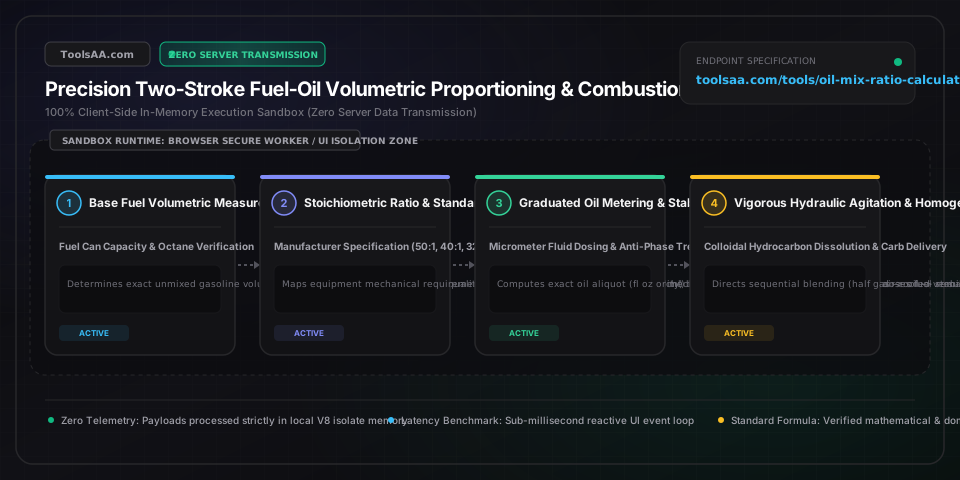
The volumetric relationship between base gasoline and lubricating oil, designated as R:1. Commercial manufacturers mandate specific ratios (ranging from 16:1 for vintage bushing-bearing engines up to 50:1 for modern needle-bearing equipment) to preserve hydrodynamic oil film thickness without inducing plug fouling.
The unmixed quantity of fresh, untreated gasoline poured into the blending container prior to oil addition. Small engines operate with highest thermal stability on 89 to 93 AKI octane fuel devoid of alcohol phase contamination.
The precise volume of specialized two-stroke oil required to satisfy the engine manufacturer's hydrodynamic boundary lubrication requirements. Inadequate oil volume (< 50:1 on a 40:1 engine) induces catastrophic friction welding between piston ring lands and cylinder walls.
The certification rating dictating thermal shear resistance and additive chemistry. JASO FD and ISO-L-EGD feature low-ash sulfated detergents engineered for high-RPM air-cooled engines exceeding 350 °F (175 °C) cylinder temperatures. NMMA TC-W3 is an ashless formulation formulated exclusively for low-temperature water-cooled marine outboards operating below 150 °F (65 °C).
The percentage of ethanol present in pump fuel. E10 blends absorb atmospheric moisture over 30 to 60 days, precipitating an alcohol-water mixture to the bottom of the fuel tank that starves two-stroke engines of lubricating oil and corrodes aluminum carburetor passages.
The target volumetric ratio applied to correct an improperly mixed fuel batch. Calculates the exact fluid volume of pure gasoline or concentrated oil needed to restore factory specifications without discarding tainted fuel.
Many operators assume adding 'a little extra oil for safety' protects their engine, but it actually causes lean overheating. In a carburetor, fuel passes through fixed mechanical orifices (jets). Two-stroke oil is substantially more viscous than gasoline and does not combust as a volatile fuel. When you increase the oil ratio from 50:1 to 32:1 without re-jetting, the thicker mixture flows slower through the main jet, reducing the total mass of combustible hydrocarbons entering the combustion chamber. This leans out the air-fuel ratio (AFR) from stoichiometric equilibrium (12.5:1) to a dangerously lean 14.5:1, skyrocketing cylinder head temperatures and causing the exact piston ring seizure the user tried to avoid.
Never interchange marine two-stroke oil with chainsaw or dirt bike oil. NMMA TC-W3 oils are designed for water-cooled outboard marine engines that circulate lake or ocean water and operate at relatively cool cylinder temperatures (120 °F to 150 °F / 50 °C to 65 °C). TC-W3 uses ashless polyisobutylene detergents that burn completely cleanly at low temperatures but thermally decompose and vaporize when subjected to air-cooled chainsaw or weed trimmer cylinder head temperatures (300 °F to 400 °F / 150 °C to 204 °C). Conversely, air-cooled JASO FD oils contain metallic sulfated ash detergents that form a thermal barrier to prevent scuffing at 14,000 RPM. Running TC-W3 in a chainsaw causes rapid exhaust port carbon clogging, ring sticking, and piston skirt scuffing within 10 operating hours.
Standard E10 automotive pump gasoline contains 10% ethanol by volume. Ethanol is highly hygroscopic, actively absorbing ambient humidity directly through vented fuel can spouts and trimmer fuel tank breathers. When moisture reaches approximately 0.5% by weight (only 3 to 4 drops of water per gallon), phase separation occurs: ethanol detaches from the gasoline hydrocarbon chains, bonds with water, and precipitates to the bottom of the tank as a cloudy, dense layer. Because two-stroke oil dissolves only in the non-polar gasoline fraction and cannot dissolve in the polar water-ethanol layer, the fuel pickup tube at the bottom of the tank feeds pure, unlubricated alcohol directly into the high-revving crankcase, wiping out bearings in seconds. Always use ethanol-free recreation fuel (E0) or mix fuel with an antioxidant, corrosion-inhibiting stabilizer, and never store mixed fuel for longer than 30 days.
Never pour concentrated two-stroke oil into an empty fuel jug before adding gasoline. Two-stroke oil is dense and viscous; pouring it into an empty container causes it to pool at the bottom and adhere tenaciously to the plastic base and crevices of the jug. When gasoline is poured on top, the hydrostatic pressure fails to dislodge the stagnant oil layer, leading to incomplete colloidal dissolution. The correct industrial procedure is the 50-100-50 method: fill the container halfway with fresh gasoline, pour the exact measured oil dose, seal the cap and agitate vigorously for 10 seconds to create a homogeneous solution, then add the remaining gasoline to achieve the final target volume. This ensures immediate, complete hydrocarbon dispersion.
The fuel-to-oil mixture is excessively rich (e.g., 20:1 or 25:1 in an engine calibrated for 50:1), or the operator used an inappropriate high-viscosity oil grade. The unburned oil is fouling the spark plug gap, dampening the spark kernel, and coating the spark arrestor screen. Remove and torch or replace the spark plug, scrub the spark arrestor screen with a brass wire brush and carburetor cleaner, and utilize this calculator's 'Ratio Rebalance Mode' to dilute the remaining tank fuel with fresh pure gasoline to restore the exact factory 50:1 specification.
The fuel has undergone hygroscopic ethanol phase separation and oxidative degradation. The volatile light-end hydrocarbons (butane, pentane) have evaporated, lowering octane, while moisture absorption has caused the ethanol and two-stroke oil to separate into distinct chemical phases. Do not shake the jug and do not use this fuel in any two-stroke tool, as the bottom layer will starve the cylinder of oil. Safely dispose of the bad fuel at a recycling center, rinse the container, and mix fresh fuel using ethanol-free 91+ octane gasoline.
Do not discard the fuel. In a 5-gallon batch mixed at 25:1, there are 25.6 fl oz of oil in 5 gallons of gasoline. To dilute this mixture back to a safe 50:1 ratio, the 25.6 fl oz of oil requires a total of 10 gallons of gasoline (25.6 * 50 / 128 = 10 gal). Simply add exactly 5.0 gallons of pure, unmixed gasoline to the container (or split the 5-gallon batch evenly into two 2.5-gallon jugs and top each up with 2.5 gallons of pure fresh gas). Use the 'Ratio Rebalance Mode' for precise custom volumes.
To calculate a 50:1 gas to oil mix ratio, divide the volume of gasoline by 50. In US customary units, one US gallon contains 128 fluid ounces; dividing 128 by 50 gives exactly 2.56 fluid ounces of 2-stroke oil per gallon of gas (or 5.12 oz for 2 gallons, and 12.8 oz for 5 gallons). In the metric system, one liter equals 1,000 milliliters; dividing 1,000 by 50 gives exactly 20 ml of oil per liter of gas (or 100 ml for a 5-liter can).
The amount of 2-stroke oil needed for 1 US gallon of gasoline depends on your engine's specified ratio: for 50:1, add 2.56 fluid ounces (75.7 ml); for 40:1, add 3.20 fluid ounces (94.6 ml); for 32:1, add 4.00 fluid ounces (118.3 ml); for 25:1, add 5.12 fluid ounces (151.4 ml); and for 20:1, add 6.40 fluid ounces (189.3 ml). Always verify the ratio specified on your engine's fuel cap or user manual.
A 40:1 fuel mixture contains 2.44% oil by volume (3.2 oz of oil per gallon of gas), whereas a 50:1 mixture contains 1.96% oil by volume (2.56 oz of oil per gallon of gas). A 40:1 mixture provides a thicker hydrodynamic lubrication barrier and is standard in homeowner trimmers and older chainsaws, while 50:1 is engineered for modern high-efficiency engines utilizing high-detergency synthetic JASO FD lubricants to minimize exhaust smoke and spark arrestor carbon buildup.
No, you should not run a 50:1 mixture in an engine designed for 40:1. Running 50:1 provides approximately 20% less lubricating oil to the crankshaft needle bearings, wrist pin, and cylinder walls than the manufacturer intended. Under sustained full-throttle high-temperature operation, this reduced oil film increases boundary friction, accelerating piston skirt wear and risking cylinder seizure. Always use the manufacturer-recommended ratio or a slightly richer mixture (40:1) with modern JASO FD synthetic oil.
TC-W3 is an ashless oil certification developed by the NMMA specifically for water-cooled marine outboard engines operating at low cylinder temperatures (120 °F to 150 °F). JASO FD is a Japanese certification specifying high-detergency, low-ash lubricants engineered to withstand the extreme thermal demands (over 350 °F) and 14,000+ RPM of air-cooled chainsaws, blowers, and dirt bikes. Using TC-W3 oil in an air-cooled chainsaw leads to rapid piston ring sticking and cylinder scuffing because the oil breaks down at high temperatures.
To correct an improperly mixed fuel batch, use volumetric dilution instead of discarding the fuel. If you mixed fuel too oily (e.g., 25:1 instead of 50:1), calculate the additional pure gasoline needed using the formula: Added Gas = Existing Oil Volume * Target Ratio - Existing Gas Volume; for 1 gallon mixed at 25:1, adding 1 more gallon of pure gas corrects the entire mixture to 50:1. If you mixed too lean (e.g., 50:1 instead of 32:1), add supplemental oil: Added Oil = (Existing Gas Volume / Target Ratio) - Existing Oil Volume.
Calculate dog age to human years accurately using veterinary breed size weight curves and epigenetic DNA formulas. Free canine life stage & senior health chart.
Calculate precise sourdough hydration, baker's percentages, and water-to-flour ratios. Factor starter hydration, multi-grain flours, salt, and batch loaf yields.
Calculate body recomposition calories and macro targets to lose fat and build muscle simultaneously. Get custom TDEE, protein intake, and deficit projections.
Calculate your BMR (Basal Metabolic Rate) and daily TDEE calorie burn using Mifflin-St Jeor, Katch-McArdle, Cunningham, and Harris-Benedict formulas. Set deficit or surplus goals for fat loss.
Pythagorean theorem calculator to find hypotenuse, leg a, or leg b instantly. Get exact radical simplified roots, step-by-step proofs, area, and angles.
Calculate safe meat internal temperature, resting carryover heat rise, and target pull time. Features USDA food safety charts, doneness presets, and audio timer.