Short title

Meat Internal Temperature & Cooking Timer

Calculate safe meat internal temperature, resting carryover heat rise, and target pull time. Features USDA food safety charts, doneness presets, and audio timer.

Lbl presets title
Lbl species cut
°F / Unit inches / Unit lbs

Desc species cut

Desc doneness level

1.5 Unit inches (3.8 Unit cm)
1 Unit lbs (0.45 Unit kg)

Desc cooking method

Lbl advanced thermodynamics

Desc enclosure

Lbl pull temp
127.2°F
Hint pull temp
Lbl target temp
130°F
Hint target temp
Lbl carryover rise
+2.8°F
Hint carryover rise
Lbl resting time
5 Unit minutes
Hint resting time
Lbl est cook time
~35 Unit minutes
Hint est cook time
Title doneness gauge
Lbl juice retention: 99.2%Lbl gray band depth: 3%
Lbl outer crust: 340°FLbl pull temp: 127.2°FLbl target temp: 130°FBeef — Medium-Rare

Desc doneness gauge

Title trajectory
Lbl safe slicing window0 Unit minutes: 127.2°F (Lbl pull marker)5 Unit minutes: 130°F (Lbl peak doneness marker)0 Unit minutes5 Unit minutes18 Unit minutes

Desc trajectory

Disclaimer text

Lbl pull temp127.2°F
Lbl target temp130°F
Lbl carryover rise+2.8°F
Lbl juice retention99.2%
Lbl resting time5 Unit minutes
Lbl est cook time~35 Unit minutes
Technical Reference & Architecture Guide

Meat Internal Temperature & Cooking Timer Guide

Calculate safe meat internal temperature, resting carryover heat rise, and target pull time. Features USDA food safety charts, doneness presets, and audio timer.

Meat Internal Temperature & Cooking Timer Guide — Client-Side In-Memory Architecture & Data Flow

Key Parameters & Controls

Target Internal TemperatureDegrees Fahrenheit / Celsius (°F / °C)

The peak core thermal doneness reached at the geometric center of the thickest cut after carryover resting. Benchmark safety and texture thresholds range from 125°F (51.7°C) for rare beef to 165°F (73.9°C) for whole poultry, aligning with USDA Food Safety and Inspection Service (FSIS) bacterial reduction standards.

Default: 130°F (54.4°C) for medium-rare beef
Carryover Cooking Rise DeltaThermal Elevation Range (°F / °C)

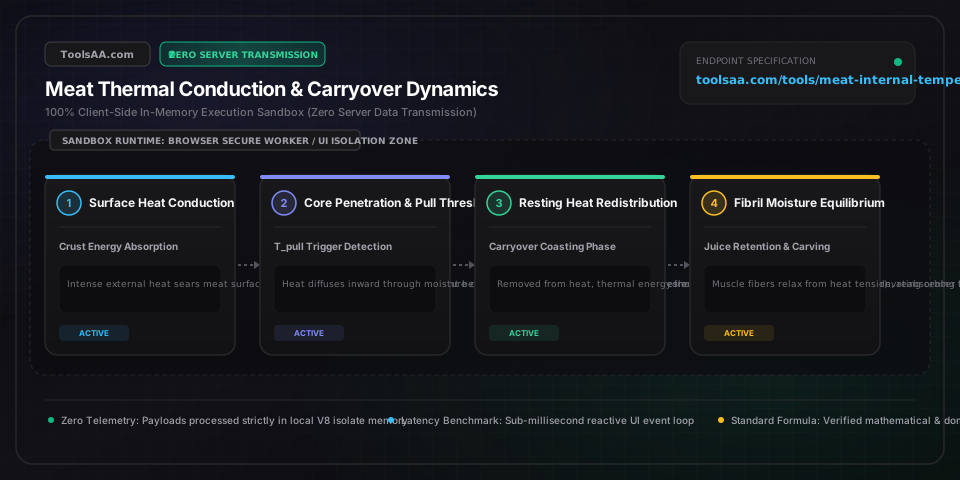
The post-heat temperature rise driven by heat transfer inward from searing exterior layers toward the cooler core while resting. High-heat searing (>400°F/204°C) produces a steep thermal gradient adding 5°F to 10°F (3°C to 6°C), whereas low-and-slow smoking (<250°F/121°C) produces an even gradient adding only 2°F to 4°F (1°C to 2°C).

Default: 5°F to 10°F (3°C to 6°C) for high-heat cooking
Target Pull TemperatureDigital Probe Sensor Reading (°F / °C)

The precise thermometer reading at which meat must be removed from the heat source so carryover heat coasts the core into desired doneness. Calculated as Target Internal Temperature minus Estimated Carryover Rise Delta (e.g., target 130°F minus 8°F carryover yields a 122°F pull threshold).

Default: 122°F to 125°F (50.0°C to 51.7°C) for 130°F target
Resting DurationCapillary Relaxation Interval (Minutes)

Elapsed rest time on an elevated cutting rack allowing constricted muscle fibers to relax and reabsorb moisture. Cutting immediately expels up to 15% to 20% of intracellular juices, whereas resting 8 to 15 minutes stabilizes internal capillary pressure and reduces cutting board moisture loss below 5%.

Default: 8 to 15 minutes depending on cut thickness
Pathogen Pasteurization Log ReductionLethality Factor (7.0 Log10 Salmonella Reduction)

The official USDA FSIS thermal death curve ensuring a 99.99999% reduction of Salmonella and foodborne pathogens. Pathogen lethality is a dual function of temperature and time: instantaneous (<1 second) at 165°F (73.9°C), 44 seconds at 155°F (68.3°C), or 2.8 minutes at 150°F (65.6°C).

Default: Instantaneous (<1s) at 165°F or 2.8 min at 150°F

Pro Tips & Best Practices

Probe Insertion Geometry: The True Thermal Center

Always insert your instant-read digital probe horizontally through the side or lateral edge of steaks, pork chops, and chicken breasts rather than straight down from the top. A vertical stab risks passing through thin meat into the hot cooking surface or stopping short in the outer heated layer. Angle the probe sensor directly into the geometric midpoint, keeping at least 0.5 inches clear of bone or dense fat deposits, which conduct thermal energy faster and give deceptively high readings.

Carryover Scales with Heat Gradient, Not Just Meat Size

Carryover heat rise is governed by the difference between exterior crust temperature and core temperature, not meat thickness alone. A steak seared in a screaming-hot 500°F (260°C) cast iron skillet builds a massive outer heat gradient, causing internal temperature to surge 8°F to 10°F (4°C to 6°C) while resting. The exact same cut cooked gently using reverse-sear at 225°F (107°C) maintains an even temperature gradient across the entire cut, coasting upward by merely 2°F to 3°F (1°C to 2°C) after pulling.

Rest Uncovered on an Elevated Wire Rack

Never tent hot rested meat tightly in aluminum foil. Sealing foil creates a high-humidity sauna that traps escaping steam, dissolving hard-earned Maillard crust into soggy skin and accelerating carryover heat deep into the muscle, easily overcooking your target by 5°F or more. Rest on an elevated wire cooling rack set over a rimmed baking sheet. This allows 360-degree ambient airflow to preserve crispy bark while preventing the underside from stewing in pooling juices.

Juice Redistribution Physics

Slicing meat immediately off the heat releases up to 15% to 20% of its total fluid weight onto the cutting board because high heat contracts actin and myosin proteins, squeezing liquid into extracellular spaces under high pressure. Resting for 8 to 10 minutes drops the surface temperature slightly, allowing tight muscle fibers to relax and internal capillary pressure to equalize. This reabsorbs free liquid back into the protein matrix, locking over 90% of natural moisture inside every slice.

Common Gotchas & Troubleshooting

⚠️Meat Core Passed the Target Temperature During Rest (Overcooked)

This occurs when meat is removed from the pan or grill at the final desired doneness instead of calculating the pull temperature beforehand, or when wrapping hot meat tightly in foil. For high-heat cooking (>400°F/204°C), always pull the meat 5°F to 10°F (3°C to 6°C) below your target doneness and rest it uncovered on an open wire cooling rack at room temperature so residual heat equalizes gently without overshooting.

⚠️Poultry Breast is Dry and Stringy Despite Pulling at 165°F

Pulling lean white poultry meat at 165°F (73.9°C) on high heat causes carryover to drive the core to 172°F+ (78°C), causing actin proteins to denature and squeeze out intracellular water. Instead, apply the official USDA FSIS pasteurization time-temperature schedule: pull boneless chicken breast at 155°F (68.3°C) and let it rest for 1 minute. Maintaining 155°F for at least 44 seconds achieves certified 7.0-log10 Salmonella lethality while keeping breast meat tender and succulent.

⚠️Thermometer Reading Fluctuates Wildly by 15°F Within Seconds

Erratic temperature swings occur when the thermometer sensor tip contacts dense bone (which conducts thermal energy much faster than meat tissue) or rests inside an intramuscular fat pocket. Retract the probe by 0.5 inches (1.3 cm) and re-angle the needle into the thickest section of lean muscle tissue, rotating slightly to confirm the lowest reading across the core zone.

Frequently Asked Questions

How many degrees does meat internal temperature rise during resting carryover?▼

Carryover cooking raises internal core meat temperature by 5°F to 12°F (3°C to 7°C) for cuts cooked at high heat (such as pan-seared steaks, broiled chops, or 400°F roasted meats), 5°F to 8°F (3°C to 4°C) for moderate roasting, and only 2°F to 4°F (1°C to 2°C) for low-and-slow smoking (225°F/107°C) or reverse-searing. The exact rise depends on thermal mass and the temperature differential between the hot exterior crust and the cooler interior center.

Why does USDA recommend 165°F for chicken when chefs cook breast to 150°F?▼

The USDA 165°F (73.9°C) guideline guarantees instantaneous (<1 second) 7.0-log10 destruction of Salmonella bacteria with zero holding time required, providing an foolproof margin of safety for home cooks. However, USDA FSIS 7120.1 pasteurization tables show that pathogen reduction is a dual function of temperature and dwell time: chicken held at 150°F (65.6°C) for 2.8 minutes or 155°F (68.3°C) for 44 seconds achieves identical safety. Because hot poultry rests for 5 to 10 minutes, pulling at 155°F easily satisfies safety standards while preventing stringy, dry meat.

At what internal temperature should you pull a medium-rare ribeye steak?▼

Pull a medium-rare ribeye steak off high heat (cast iron skillet or direct flame grill) when the internal thermometer reaches 122°F to 125°F (50.0°C to 51.7°C) to reach a final rested target of 130°F to 135°F (54.4°C to 57.2°C). If you are using the two-stage reverse-sear method in a low 225°F (107°C) oven, carryover rise is minimal, so pull at 115°F to 118°F (46°C to 48°C) before giving it a 60-second sear per side to coast safely to 130°F.

Is pork safe to eat with pink meat at 145°F internal temperature?▼

Yes, whole cuts of pork (chops, roasts, and tenderloins) are completely safe to consume at 145°F (62.8°C) with a mandatory 3-minute rest, as officially established in USDA safety updates. At 145°F, foodborne pathogens and Trichinella spiralis parasites are eradicated, while the meat retains a pale pink tint, delicate texture, and optimal juiciness. Note that ground pork and sausage must still reach 160°F (71.1°C) because grinding mixes surface bacteria throughout the meat.

Why must ground meat be cooked to a higher internal temperature than whole cuts?▼

Ground meat must reach 160°F (71.1°C) for beef, pork, and lamb, or 165°F (73.9°C) for poultry, because the grinding process distributes surface bacteria (such as E. coli and Salmonella) throughout the entire interior mass. With whole intact steaks and roasts, harmful microorganisms remain isolated on the exterior surface, where cooking heat instantly kills them even when the interior remains rare at 125°F (51.7°C). Ground patties lack this sterile interior core and require thorough heating to pasteurize the center.

Related Tools & Utilities

All Tools →