Solver ready fast
Lbl daily schedule title
Tip electrolytes
Tip pre workout
Val post workout
Tip evening
Lbl medical disclaimer title Medical disclaimer
Calculate creatine dosage for loading and daily maintenance based on body weight. Track muscle saturation curves, monohydrate vs HCL, and hydration targets.
Solver ready fast
Tip electrolytes
Tip pre workout
Val post workout
Tip evening
Lbl medical disclaimer title Medical disclaimer
Calculate creatine dosage for loading and daily maintenance based on body weight. Track muscle saturation curves, monohydrate vs HCL, and hydration targets.
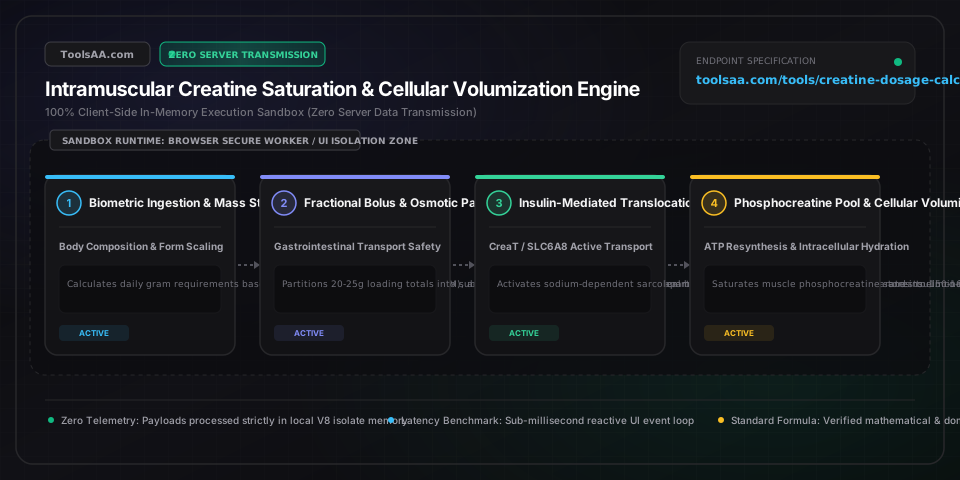
Gross athlete mass utilized to determine baseline creatine turnover rate. Standard skeletal muscle represents 40-45% of total body mass in active individuals, harboring 95% of total bodily creatine stores.
ISSN gold-standard protocol to reach complete muscle phosphocreatine saturation in 5 to 7 days. Divided into 4 equal daily boluses (morning, noon, post-workout, evening) of 4-7g each to prevent saturating intestinal transport capacity.
Daily dose required to balance irreversible non-enzymatic conversion of creatine into creatinine (1.5-2.0% of total intramuscular pool excreted daily via kidneys). Typically ranges from 3g to 5g/day, or up to 8-10g/day for athletes exceeding 90 kg.
Precision dosing model factoring out non-storing adipose tissue. Prevents severe gastrointestinal osmotic distress and excessive urinary excretion in individuals with body fat percentages above 20%.
Target daily hydration incorporating baseline physiological turnover (35 ml/kg) plus 100-150 ml additional water per 1.0g of creatine to facilitate intracellular muscle sarcoplasmic volumization without extracellular edema.
Intracellular phosphocreatine density measured in millimoles per kilogram of dry muscle mass. Increases from an un-supplemented baseline of 110-125 mmol/kg to the physiological ceiling of 150-160 mmol/kg dry muscle weight.
Ingesting more than 7 to 10 grams of creatine monohydrate in a single bolus exceeds the absorptive capacity of intestinal sodium-dependent creatine transporters (CreaT). The unabsorbed solute remains in the intestinal lumen, exerting a potent hyperosmotic draw of water into the colon that triggers acute cramping and osmotic diarrhea within 30 to 60 minutes. During a 20-25g daily loading phase, always divide your intake into 4 or 5 separate servings of 4-5g spaced at least 3 hours apart.
Insulin activates sodium-potassium ATPase pumps and stimulates the translocation of CreaT transporters directly to the skeletal muscle sarcolemma. Co-ingesting 5g of creatine with 50 to 75 grams of simple carbohydrates (such as dextrose, fruit juice, or maltodextrin) or a 50/50 carbohydrate-protein shake enhances intramuscular creatine accumulation by up to 25% compared to taking creatine alone, especially during the initial 3 days of loading.
Dry scooping (swallowing dry creatine powder directly without liquid) offers zero physiological advantage and poses serious medical risks. Creatine monohydrate is a crystalline powder with low immediate aqueous solubility; inhaling stray micro-particles can trigger bronchospasms, laryngospasms, or chemical aspiration pneumonia. In the stomach, a dry powder clump creates a hyperosmotic nidus against the gastric mucosa, causing localized nausea and severe cramps. Always dissolve creatine in at least 250-350 ml (8-12 fl oz) of water or warm beverage.
While chronic low-to-moderate caffeine consumption does not blunt creatine storage, acute simultaneous ingestion of high doses of caffeine (>5 mg/kg body weight) alongside creatine can counteract creatine ergogenic benefits during sprint trials. Caffeine shortens muscle relaxation time while creatine lengthens it via sarcoplasmic reticulum calcium-ATPase regulation. For optimal power output during high-intensity training, take your creatine post-workout or with meals and reserve pre-workout caffeine for 45 minutes prior to lifting.
Creatine spontaneously and non-enzymatically degrades into creatinine at a constant rate of 1.5% to 2% daily. When you supplement with creatine, total bodily creatine stores rise by 20% to 40%, which naturally elevates serum creatinine (e.g. from 0.9 mg/dL to 1.3-1.5 mg/dL) and lowers calculated eGFR, creating a false alarm for kidney dysfunction. If your BUN (blood urea nitrogen), urinary albumin, and Cystatin C levels remain normal, this elevation represents harmless muscular byproduct turnover, not renal damage. Inform your physician of your creatine intake or abstain for 3-4 weeks prior to blood panels.
Creatine is an intracellular osmolyte that transports water into the muscle sarcoplasm alongside glycogen. A rapid 1 to 3 kg scale jump during the first 5 to 7 days is not adipose fat gain or extracellular puffiness; it is purely intracellular muscle hydration (water volumization). This intracellular swelling acts as an anabolic stimulus that boosts mechanical cellular tension and muscle protein synthesis. Do not drop your calories or discontinue supplementation; this scale increase stabilizes as muscle saturation reaches its ceiling.
Standard creatine monohydrate has a room-temperature solubility limit of approximately 14 grams per liter. Mixing 5 grams into a small glass of ice-cold water will leave undispersed crystalline grit. To maximize dissolution, stir the powder into room-temperature or slightly warm water, tea, or a carbohydrate drink, or switch to micronized 200-mesh Creapure which suspends uniformly in liquid. Avoid leaving dissolved creatine in liquid for more than 12-24 hours, as prolonged aqueous exposure slowly degrades it into inactive creatinine.
Muscle phosphocreatine stores do not plummet overnight. Once muscles reach full saturation (~150-160 mmol/kg DMM), it takes 4 to 6 weeks of complete cessation for creatine levels to return to pre-supplementation baseline. If you miss one or two days of maintenance, do not double-dose or restart the 20g/day loading phase (which causes unnecessary stomach distress). Simply resume your normal 3-5g daily maintenance dose the following day.
To calculate your creatine loading dose, multiply your body weight in kilograms by 0.3 grams (or your body weight in pounds by 0.14 grams), resulting in roughly 20 to 25 grams per day for 5 to 7 days, split into 4 equal servings of 5 grams. For your daily maintenance dose, multiply your body weight in kilograms by 0.03 grams (or body weight in pounds by 0.014 grams), which yields 3 to 5 grams per day taken in a single serving.
No, a loading phase is not physiologically mandatory. Taking a steady daily maintenance dose of 3 to 5 grams per day achieves the exact same 100% muscle phosphocreatine saturation after 28 days as a 5-day loading protocol. The loading phase is only advantageous if you want maximum strength, power, and cellular hydration benefits within 5 to 7 days rather than waiting 4 weeks.
When taking creatine, you should drink an extra 100 to 150 milliliters (3.5 to 5 fluid ounces) of water for every 1 gram of creatine consumed, added to your baseline daily fluid need of 35 milliliters per kilogram of body weight. For an 80 kg individual taking 5 grams of creatine daily, target 3.5 to 4.0 liters (120 to 135 fluid ounces) of total water per day to support intracellular muscle volumization and prevent muscle cramping.
Creatine Monohydrate is 87.9% elemental creatine by molecular weight and is supported by over 1,000 peer-reviewed clinical trials demonstrating superior safety and efficacy. Creatine Hydrochloride (HCL) binds creatine to a hydrochloride salt, dramatically increasing aqueous solubility in cold water and allowing smaller doses (1.5 to 2.0 grams daily) without digestive upset, but clinical studies show it does not achieve higher intramuscular creatine saturation than standard monohydrate.
Research indicates that taking creatine immediately post-workout alongside a meal or recovery shake containing carbohydrates and protein produces slightly superior gains in lean muscle mass and muscular strength compared to pre-workout ingestion. Post-exercise muscular hyperemia (elevated blood flow) and insulin secretion upregulate sodium-dependent creatine transporters (CreaT), enhancing uptake into depleted muscle fibers.
Disclaimer: This tool is provided strictly for educational and informational purposes only and does not constitute formal financial advice or a binding loan commitment. Please consult a qualified financial advisor before making decisions. Creatine draws water directly into skeletal muscle cells via osmosis, co-storing roughly 2.7 grams of water for every gram of glycogen and intracellular osmolyte. During an initial 20-gram daily loading phase, rapid muscle saturation causes a transient 1 to 3 kilogram (2 to 6 pounds) increase on the scale. This gain represents intracellular muscle volumization rather than body fat, which expands muscle cell volume and triggers anabolic mechanical tension.
Calculate potting soil volume for pots, planters, and raised beds. Convert quarts, cubic feet, and liters to exact bag counts with compaction and cost estimates.
Calculate roofing shingles, squares, and bundles with pitch multipliers, waste factor, ridge caps, starter shingles, nails, and material cost takeoff.
Free rental property ROI calculator to analyze real estate cash flow, cap rate, cash-on-cash return, and IRR. Project 30-year appreciation and rental yields.
Calculate Roth IRA growth and compound interest with annual IRS limits, catch-up age rules, inflation drag, and tax-free retirement withdrawal forecasts.
Calculate single and multiple event probabilities, odds ratios, conditional Bayes outcomes, and independent or mutually exclusive event series with steps.
Solve proportion and ratio equations (A/B = C/D) instantly. Find unknown X values, simplify ratios, scale recipes, and calculate direct or inverse proportions.