Roth IRA Growth & Retirement Calculator Guide
Calculate Roth IRA growth and compound interest with annual IRS limits, catch-up age rules, inflation drag, and tax-free retirement withdrawal forecasts.
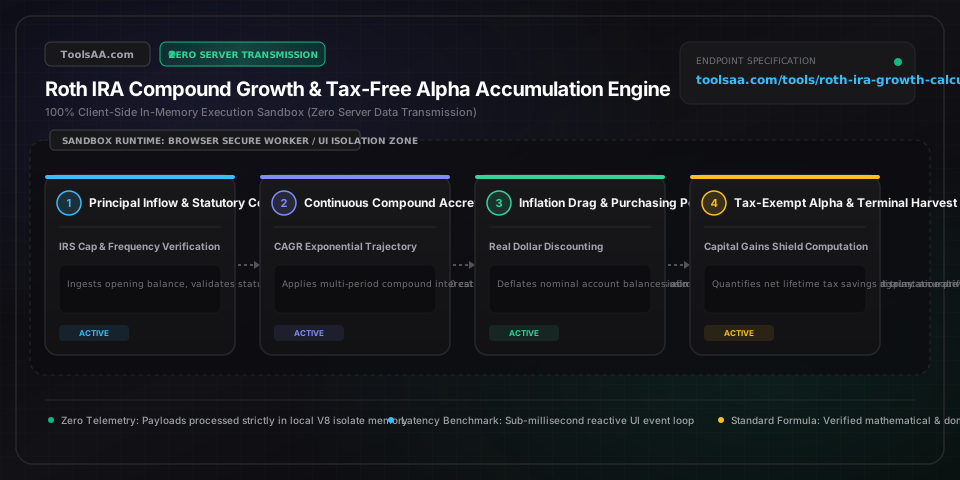
Key Parameters & Controls
Chronological investor age defining the total compound runway before entering the penalty-free qualified distribution phase at age 59½.
IRS statutory maximum ceiling under IRC Section 408A ($7,000 base, with an automatic $1,000 catch-up allowance for taxpayers aged 50 and older).
Expected annualized nominal investment yield. S&P 500 historical 50-year nominal benchmark is 10.2%, balanced 60/40 portfolio benchmark is 7.2%.
Long-term Consumer Price Index (CPI) deflation factor used to compute real purchasing power equivalents in today's constant currency.
Combined long-term capital gains tax rate plus annual dividend turnover drag incurred in taxable brokerage accounts to isolate Roth Tax Alpha.
Lump-sum deployment at the beginning of the tax year versus 12 equal monthly installments, affecting multi-period compound interest accrual.
Pro Tips & Best Practices
Unlike 401(k)s or Traditional IRAs, IRS rules stipulate that Roth IRA distributions are taken on a strict ordering basis: original regular contributions are always returned first. This means you can withdraw 100% of your contributed principal at any time, at any age, completely penalty-free and tax-free, without triggering early distribution penalties.
Do not conflate the regular Roth 5-year clock with the conversion clock. The primary 5-year rule for tax-free earnings begins on January 1 of the tax year you made your very first contribution to any Roth IRA. However, each subsequent Roth conversion (e.g., from Traditional IRA or 401k) carries its own separate 5-year aging requirement to withdraw converted principal without a 10% penalty if under age 59½.
Deploying the maximum statutory limit on the first trading day of January provides 12 additional months of compound dividend reinvestment and capital appreciation compared to trailing monthly contributions. Historically, front-loaded lump-sum investing outperforms monthly dollar-cost averaging in equity markets roughly 68% of rolling multi-decade periods.
Because all qualified capital gains and dividends in a Roth IRA are permanently tax-exempt upon distribution, locate your highest-expected-return assets (such as high-beta equities, small-cap value, or REITs that generate non-qualified ordinary income dividends) inside your Roth IRA rather than in taxable brokerage accounts.
Common Gotchas & Troubleshooting
⚠️Excess Contribution 6% Annual Excise Tax Penalty
If your Modified Adjusted Gross Income (MAGI) exceeds IRS phase-out thresholds ($146,000–$161,000 for single filers; $230,000–$240,000 for married filing jointly) or you contribute beyond your earned compensation, IRC Section 4973 levies a 6% excise penalty per year on the excess amount. Rectify this before the tax filing deadline (including extensions) by withdrawing the excess principal plus its net attributable earnings, or recharacterizing the funds to a Traditional IRA.
⚠️The Pro-Rata Rule Trap on Backdoor Roth Conversions
High earners using the Backdoor Roth maneuver must report all non-Roth IRA balances under IRS Form 8606. If you hold existing pre-tax dollars in any Traditional, SEP, or SIMPLE IRA, the IRS aggregates all accounts and taxes the conversion proportionally. To achieve a 100% tax-free backdoor conversion, roll your pre-tax Traditional IRA balances into an active employer-sponsored 401(k) before December 31 of the conversion year.
⚠️Premature Non-Qualified Earnings Withdrawal Penalties
Withdrawing investment earnings before reaching age 59½ or prior to satisfying the 5-year aging rule incurs ordinary income tax plus an IRS 10% early withdrawal penalty. To access earnings penalty-free prior to age 59½, ensure the withdrawal qualifies under statutory exceptions: up to $10,000 lifetime for a first-time home purchase, qualified higher education expenses, unreimbursed medical expenses exceeding 7.5% of AGI, or permanent disability.
⚠️Zero Earned Income Contribution Ineligibility
Under IRS regulations, annual Roth IRA contributions cannot exceed your taxable earned compensation (wages, salaries, tips, bonuses, self-employment net income). Investment income, rental dividends, capital gains, pensions, and Social Security do not count. For non-working spouses, verify eligibility for a Spousal Roth IRA funded from the working spouse's earned income on a joint tax return.
Frequently Asked Questions
How to calculate Roth IRA compound growth and future value?▼
Roth IRA compound growth is calculated using the future value of an annuity formula combined with compounding initial balance: FV = P * (1 + r/k)^(k*t) + PMT * [((1 + r/k)^(k*t) - 1) / (r/k)], where P is starting principal, PMT is periodic contribution, r is expected annual rate of return, k is compounding frequency per year, and t is total investment years. For example, contributing $7,000 annually ($583.33/month) at an 8% annual return over 30 years yields approximately $793,000 at retirement, of which $583,000 is pure 100% tax-free compound growth on just $210,000 of contributed principal.
What is a realistic average return rate to expect for a Roth IRA?▼
A realistic long-term planning rate is 7.0% to 8.5% nominal CAGR for a diversified equity portfolio. Over the past 50 years, the S&P 500 index generated an annualized nominal return of approximately 10.2% (~7.1% real after accounting for inflation). For conservative retirement forecasting, financial planners typically model 6.0% for balanced stock/bond allocations, 8.0% for all-equity index portfolios, and subtract 2.5% for inflation to assess true purchasing power.
Roth IRA vs Traditional IRA: which yields higher retirement wealth?▼
The decision depends on your marginal tax rate today versus your effective tax rate in retirement. If your current tax rate is lower than or equal to your anticipated retirement tax rate, a Roth IRA yields significantly higher net spendable wealth because all multi-decade growth and distributions are 100% tax-free. If you are currently in your peak earning years in the highest federal and state tax brackets and expect a substantial drop in income during retirement, a Traditional IRA's upfront tax deduction may provide immediate tax arbitrage unless you prioritize the Roth IRA's exemption from Required Minimum Distributions (RMDs).
What happens if I withdraw money from my Roth IRA before age 59½?▼
Disclaimer: This tool is provided strictly for educational and informational purposes only and does not constitute formal financial advice or a binding loan commitment. Please consult a qualified financial advisor before making decisions. Withdrawals follow the strict IRS ordering rule: your regular contributions come out first and are always 100% tax-free and penalty-free at any time. Converted balances come out second, incurring a 10% penalty only if withdrawn within 5 years of conversion unless an exception applies. Investment earnings come out last: if withdrawn before age 59½ or before meeting the 5-year rule, earnings are subject to ordinary income tax plus a 10% early withdrawal penalty, unless qualifying for exceptions such as first-time home purchases (up to $10,000 lifetime), qualified higher education expenses, or disability.
Related Tools & Utilities
All Tools →Calculate single and multiple event probabilities, odds ratios, conditional Bayes outcomes, and independent or mutually exclusive event series with steps.
Solve proportion and ratio equations (A/B = C/D) instantly. Find unknown X values, simplify ratios, scale recipes, and calculate direct or inverse proportions.
Calculate daily protein intake by body weight, activity level, and fitness goals. Find your optimal grams per day for muscle building, fat loss, and maintenance.
Calculate gas mileage and MPG fuel economy instantly. Track trip gas cost, compare US and UK gallons, convert L/100km, and estimate annual commute fuel spending.
Calculate engine horsepower from torque and RPM, or convert wheel horsepower to crank BHP with drivetrain loss. Estimate quarter-mile ET and speed instantly.
Calculate credit card minimum payments, payoff time, and interest costs. Compare minimum payments vs fixed plans to save thousands and become debt-free faster.