Tachometer sub
Waterfall desc
Disclaimer text
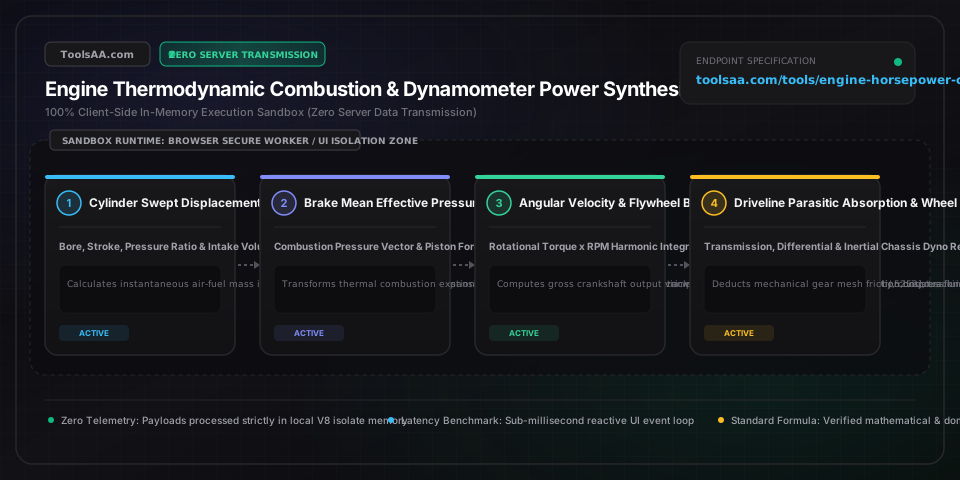
Calculate engine horsepower from torque and RPM, or convert wheel horsepower to crank BHP with drivetrain loss. Estimate quarter-mile ET and speed instantly.
Tachometer sub
Waterfall desc
Disclaimer text
Calculate engine horsepower from torque and RPM, or convert wheel horsepower to crank BHP with drivetrain loss. Estimate quarter-mile ET and speed instantly.
The rotational twisting force generated by engine combustion acting upon the crankshaft journal lever arm. In Imperial measurements, torque is expressed in pound-feet (lb-ft); in SI metric, it is measured in Newton-meters (N*m), where 1 lb-ft = 1.355818 N*m. Torque represents the engine capacity to perform instantaneous work regardless of time or rotational speed.
The operating rotational speed of the engine crankshaft in revolutions per minute. In internal combustion thermodynamics, horsepower is the mathematical product of torque and angular velocity. Production street engines peak between 5,500 and 7,200 RPM, while dedicated racing powertrains (Formula 1, MotoGP, GT3) operate from 8,500 to over 15,000 RPM.
The percentage of flywheel brake horsepower dissipated as frictional heat, bearing resistance, hypoid gear tooth sliding, and hydraulic fluid shearing before reaching the drive wheels. Standard industry dyno benchmarks: FWD manual 10% to 12%, FWD automatic 13% to 15%, RWD manual 14% to 16%, RWD automatic 16% to 18%, and AWD mechanical systems 20% to 25%.
A theoretical average combustion pressure that, if applied uniformly to the pistons throughout the power stroke, would produce the measured brake torque. Normalizes engine performance across varying engine displacements. Naturally aspirated street engines produce 130 to 160 psi (9.0 to 11.0 bar); race engines reach 180 to 215 psi (12.4 to 14.8 bar); turbocharged engines operate at 250 to 420+ psi (17.2 to 29.0 bar).
Standardized atmospheric normalization factor reconciling chassis dyno runs across varying weather conditions. SAE J1349 standard references 99.0 kPa (29.23 inHg) dry air pressure, 25 deg C (77 deg F) air temperature, and 0% relative humidity. Correction Factor CF = 1.180 * [(99 / P_dry) * sqrt((T_amb + 273) / 298)] - 0.18. Multiplies uncorrected raw dyno power to yield repeatable net horsepower.
The terminal vehicle velocity clocked as the car passes the 1,320-foot (1/4-mile) finish beam. Because trap speed measures kinetic energy and momentum rather than tire launch traction during the initial 60 feet, it provides a significantly more accurate empirical indication of true engine flywheel horsepower than elapsed time (ET).
On any dynamometer chart plotting horsepower and torque in pound-feet (lb-ft) against RPM, the two curves must cross at exactly 5,252.113 RPM. This is not an engine characteristic—it is a mathematical identity derived from James Watt definition of horsepower (33,000 ft-lb/min divided by 2*pi radians per revolution = 5252.113). If a dyno sheet displays horsepower and lb-ft curves crossing at any number other than 5,252, the graph has mismatched vertical axes or fraudulent scaling.
Assuming a flat 15% or 20% drivetrain loss on modified vehicles severely overestimates engine flywheel horsepower. Drivetrain resistance is comprised of two distinct components: fixed mechanical drag (bearing seal preload, ring-and-pinion sliding friction, oil churning) and a small variable load-dependent friction (typically 4% to 7%). A 1,000 WHP build does not lose 200 HP in the driveline—dissipating 200 HP (149 kW) as continuous thermal energy would melt the gearbox casing and boil transmission fluid within minutes. True crank power for a 1,000 WHP car is typically 1,080 to 1,120 BHP, not 1,250 BHP.
Dynamometer shops frequently toggle between SAE J1349 (current OEM net standard) and SAE J607 / STD (older aftermarket standard). SAE J607 assumes 60 deg F (15.5 deg C) intake air and 29.92 inHg barometric pressure, resulting in horsepower numbers that read 4.0% to 4.5% higher than SAE J1349 on the exact same engine pull. When evaluating aftermarket camshaft, intake, or ECU tune claims, always demand SAE J1349 corrected figures to avoid inflated marketing numbers.
When estimating engine horsepower from drag strip timeslips, always prioritize terminal trap speed over elapsed time (ET). Elapsed time is heavily biased by launch traction, clutch slippage, torque converter stall speed, and the first 60-foot split. A vehicle that spins off the launch line might run an unimpressive 12.8-second ET due to wheelspin, yet still trap 125 mph because high engine horsepower is fully exerted once traction is established in higher gears. Trap speed reflects true power-to-weight ratio.
First verify that torque is plotted in pound-feet (lb-ft) and not Newton-meters (N*m). In SI metric, torque in N*m and power in Kilowatts cross at 9,549 RPM, while torque in N*m and power in PS cross at 7,024 RPM. If units are in lb-ft and HP, check the left and right Y-axis scaling: dynamometer software frequently autoscales the left axis (Horsepower, e.g. 0-600) independently from the right axis (Torque, e.g. 0-500). When both axes share identical numerical scales, the crossover point will align precisely at 5,252 RPM.
A large divergence indicates either severe launch traction deficit or excessive aerodynamic drag. If the trap speed formula predicts 500 HP but the ET formula suggests only 400 HP, the vehicle suffered poor 60-foot traction (spinning tires at launch). Conversely, if the ET formula predicts higher horsepower than the trap speed formula, the vehicle achieved exceptional launch traction (slicks and all-wheel drive) but encountered severe high-speed aerodynamic drag or hit an engine rev limiter prior to crossing the finish beam.
Ambient temperature increases and altitude drops directly reduce intake air oxygen density. At 5,000 feet elevation (Denver), atmospheric pressure drops to approximately 24.9 inHg, starving naturally aspirated engines of ~17% of their sea-level mass airflow. Additionally, modern engine control units (ECUs) automatically retard ignition timing when intake air temperature (IAT) exceeds 120 deg F (49 deg C) to prevent destructive detonation/knock, reducing power by 5% to 15%.
Chassis dynamometer brands utilize fundamentally different loading mechanisms. Inertia roller dynos (Dynojet) calculate power from drum acceleration, reading approximately 10% to 12% higher than eddy-current load-cell dynos (Mustang, Dyno Dynamics), which apply real-time electromagnetic road drag. Applying a generic 15% drivetrain loss to a low-reading Mustang dyno (often called a 'heartbreaker dyno') will artificially underestimate true flywheel horsepower. Normalize your dyno baseline to standard SAE Dynojet equivalent before calculating crank BHP.
Horsepower is calculated using the formula: Horsepower = (Torque in lb-ft * RPM) / 5252. For metric units, Power in Kilowatts (kW) = (Torque in N*m * RPM) / 9549, which can be converted to metric horsepower (PS) by multiplying by 1.35962. For example, an engine producing 400 lb-ft of torque at 6,000 RPM generates exactly (400 * 6000) / 5252 = 456.96 brake horsepower (BHP).
Brake horsepower (BHP) is the raw mechanical power measured directly at the engine crankshaft flywheel without drivetrain parasitic drag. Wheel horsepower (WHP) is the actual usable power transmitted through the gearbox, driveshaft, differential, axles, and tires to the road surface as measured on a chassis dynamometer. WHP is typically 10% to 25% lower than BHP due to mechanical friction, gear meshing, bearing drag, and rotational tire inertia.
Horsepower is not a directly measured physical quantity; it is a calculated rate of work over time derived from torque. James Watt defined 1 horsepower as 33,000 foot-pounds of work per minute. In rotational mechanics, work completed per revolution equals Torque multiplied by 2*pi radians (6.283185). Dividing 33,000 by 6.283185 yields exactly 5,252.113. Consequently, whenever crankshaft speed equals 5,252 RPM, the RPM and 5,252 constant cancel out in the equation, making Horsepower identical to Torque in pound-feet.
A standard 3,500 lb (1,588 kg) performance car requires approximately 600 to 650 flywheel brake horsepower (or ~520 to 560 wheel horsepower) to run a 10.99-second quarter-mile pass at roughly 125 to 128 mph trap speed, assuming high-grip drag radials and a 1.5-second 60-foot launch. According to the Wallace Racing formula [HP = Weight / (ET / 5.825)^3], a 3,500 lb vehicle clocking a 10.50-second pass requires 637 crank horsepower.
Every 14.7 psi (1.0 bar) of boost pressure at sea level forces approximately double the mass of oxygen and fuel into the engine combustion chambers compared to natural atmospheric pressure. In an idealized system with 100% intercooler thermal efficiency and zero exhaust backpressure, adding 14.7 psi of boost doubles naturally aspirated baseline horsepower. In real-world tuning, compressor heating, charge air density reduction, and turbine pumping losses yield roughly a 70% to 85% net horsepower increase per atmosphere of positive manifold pressure.
No, engine displacement measures only swept cylinder volume, not combustion pressure or engine operating speed. Horsepower is determined by Brake Mean Effective Pressure (BMEP) and rotational speed using the formula: HP = (Displacement in cubic inches * RPM * BMEP in psi) / 792,000. A high-revving 2.0-liter engine running at 9,000 RPM with 180 psi BMEP produces 240 naturally aspirated horsepower, whereas a low-revving 5.0-liter truck engine at 3,500 RPM produces the same 240 HP while generating vastly higher low-end torque.
Calculate credit card minimum payments, payoff time, and interest costs. Compare minimum payments vs fixed plans to save thousands and become debt-free faster.
Calculate your final grade and the exact exam score needed to pass or get an A. Supports weighted syllabus categories, grade curves, points, and GPA impact.
Calculate heat index and wind chill apparent temperature instantly. Assess humidity heat stroke risk, frostbite danger times, and outdoor safety thresholds.
Convert baking ingredients from cups to grams, ounces, and milliliters. Accurately scale recipes, adjust pan sizes, and calculate baker's percentages instantly.
Calculate dew point, relative humidity, and vapor pressure from air temperature and moisture. Solve psychrometric comfort, mold risk, and condensation thresholds.
Calculate board footage, lumber tally cutting lists, material costs, and shipping weights. Supports hardwood quarter sizing (4/4 to 16/4), softwood framing (2x4, 2x6), waste margins, and metric m³ conversion.