Lbl callout headline
Lbl callout body
Lbl card act benchmark
Lbl card act mandate
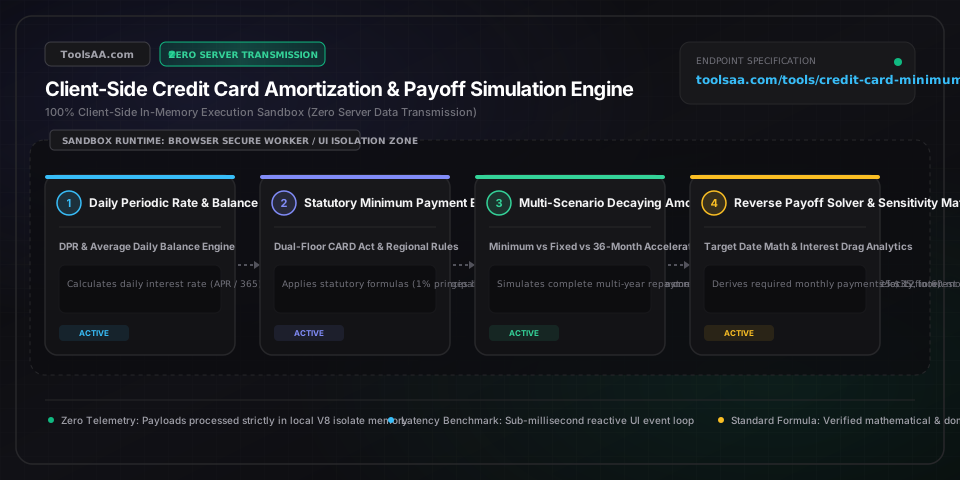
Calculate credit card minimum payments, payoff time, and interest costs. Compare minimum payments vs fixed plans to save thousands and become debt-free faster.
Lbl callout body
Lbl card act mandate
Disclaimer body
Calculate credit card minimum payments, payoff time, and interest costs. Compare minimum payments vs fixed plans to save thousands and become debt-free faster.
The closing revolving credit card balance billed on your latest statement cycle. Unlike installment loans with fixed amortizations, credit cards utilize an open-ended revolving line of credit where outstanding principal compounds daily whenever a balance is carried past the monthly payment due date.
The annualized nominal interest rate assessed on revolving balances. Card issuers divide this rate by 365 (or 360) to establish the Daily Periodic Rate (DPR). For example, a 21.99% APR yields a DPR of 0.060247%. Because interest compounds on the Average Daily Balance (ADB), the effective annual yield (APY/EAR) typically exceeds the stated nominal APR by 1.5% to 2.5%.
The mathematical rule mandated by law or credit agreement. The standard US CARD Act formula requires the greater of a fixed floor ($25-$35) or 1% of statement principal balance plus accrued finance charges and late fees. Alternative formulas use a flat percentage of the total statement balance (typically 2.0% to 3.5% in the US/EU, or a statutory 5.0% in Quebec).
The statutory minimum dollar amount the card issuer will bill if the percentage-based formula yields a smaller figure. If your total statement balance is less than this floor (e.g. your balance is $18.50 and the floor is $35), the minimum payment due equals the remaining balance in full.
Comparative strategy determining whether your monthly contribution remains locked at a steady dollar amount or floats downward as your balance declines. Keeping payments fixed at your initial minimum payment amount transforms a decaying geometric repayment curve into an accelerated linear payoff, saving thousands in interest.
The standard accounting method used by over 95% of major card issuers: the balance is calculated at the end of each day of the billing cycle, summed across all cycle days (28 to 31 days), and divided by the total cycle days before applying the monthly periodic interest rate.
Credit card minimum payment formulas are structurally designed as decaying percentage curves (e.g., 2% of current balance). As your balance decreases each month, your required minimum payment also decreases. This prevents significant principal reduction, keeping you locked in debt for 15 to 25 years. The simplest way to defeat this is freezing your payment at the first month's minimum dollar amount (e.g. paying $150 every month rather than letting it drop to $145, $140, $135).
Under the Credit Card Act of 2009, US issuers are legally required to print two figures on your monthly statement: (1) how many years it will take to pay off your balance making only minimum payments, and (2) the exact monthly payment needed to extinguish the debt in 36 months (3 years). Paying the 36-month figure typically requires only $30 to $60 more per month than the initial minimum payment, but routinely eliminates 70% to 85% of total lifetime finance charges.
Credit cards only provide an interest-free grace period (typically 21 to 25 days between statement close and payment due date) if your statement balance was paid in full the previous billing cycle. If you carry even $1 of revolving debt past the due date, the grace period is revoked entirely: all new purchases begin accruing interest on the exact date of purchase, compounding your effective cost of borrowing.
When you finally pay off a credit card balance in full, expect to receive one final bill the following month containing trailing or residual interest. Because interest accrues daily on your Average Daily Balance between the date your billing cycle closes and the date your final payment is credited, this inter-cycle interest is billed on the subsequent statement. Contact your card issuer to request an official payoff balance for an exact date.
If you hold a credit card with split balances (for example, a $3,000 cash advance balance at 27.99% and a $2,000 purchases balance at 19.99%), the CARD Act mandates that any payment amount exceeding the minimum payment must be allocated to the balance with the highest APR. However, the bank is legally permitted to apply the minimum payment itself to the lowest APR balance. Paying significantly above the minimum ensures high-cost debt burns down first.
This happens when the calculated percentage falls below your card issuer statutory minimum floor ($25 to $35), or when overdue past-due balances and late fees are legally added directly on top of the regular minimum payment requirement. Review your statement fine print for your card specific minimum floor dollar amount.
This is mathematically expected under minimum-only payments at APRs above 18%. In the first several years of minimum payments, 70% to 85% of each payment is consumed entirely by accrued finance charges, with only 15% to 30% touching principal. Increase your monthly payment by even $25 to $50 above the minimum to immediately tilt the amortization balance in your favor.
This indicates negative amortization: your ongoing monthly new purchases or recurring card fees exceed the principal reduction portion of your minimum payment. Under statutory rules, minimum payments must cover accrued interest for that cycle, but if you continue making new charges after the statement closes, your balance will expand into a debt spiral. Suspend new card usage entirely until the balance is retired.
Credit card APR is a nominal rate, but interest is calculated using a Daily Periodic Rate (APR / 365) and compounded onto your balance monthly. This daily compounding causes the true Effective Annual Rate (EAR) to be higher than the advertised APR (for example, a nominal 24.99% APR with daily compounding equates to an effective 28.36% annual yield).
Be extremely cautious between true 0% APR and deferred interest retail promotions. In deferred interest agreements, if even $1 of principal remains unpaid on the exact day the promotional period expires, the issuer retroactively charges the full APR (often 29.99%+) on the entire original purchase amount dating back to Day 1. Always set your target payoff horizon to conclude at least 1 to 2 months prior to promo expiration.
Most credit card issuers calculate your minimum payment using one of two methods mandated under the Credit Card Act of 2009: either (1) 1% of your current statement principal balance plus all accrued monthly interest charges and late fees, or (2) a flat 2% to 3% of your total statement balance, subject to a statutory minimum dollar floor of $25 to $35 (or your full balance if it is lower than the floor).
Paying only the minimum payment typically takes between 12 and 25 years to pay off an average credit card balance. For example, paying only the minimum on a $5,000 balance at a 21.99% APR takes approximately 18 years and 4 months, racking up over $6,200 in interest charges alone—more than doubling the original cost of your purchases.
Paying only the minimum payment keeps your account in good standing and avoids late fees and negative credit bureau reporting, but it extends your debt payoff over decades and maximizes the total interest paid to the bank. Furthermore, carrying a high balance relative to your credit limit keeps your credit utilization ratio elevated, which can suppress your FICO and VantageScore credit scores.
Minimum payments take decades because the required payment decreases as your balance shrinks. Because the payment is calculated as a percentage of your remaining debt, you pay less and less money toward principal each month. This decaying geometric payment schedule drags out the final thousands of dollars of debt over many years unless you manually keep your payment fixed at a higher dollar amount.
Paying even $25 to $50 extra per month above the minimum drastically cuts payoff time and interest. On a $5,000 balance at 21.99% APR with an initial $125 minimum payment, adding a fixed $50 extra per month (paying $175 total) reduces your payoff time from 18+ years down to approximately 3.5 years, saving over $4,800 in interest charges.
Disclaimer: This tool is provided strictly for educational and informational purposes only and does not constitute formal financial advice or a binding loan commitment. Please consult a qualified financial advisor before making decisions. The US Credit Card Accountability Responsibility and Disclosure (CARD Act) of 2009 legally requires credit card issuers to include a Minimum Payment Warning table on every monthly statement. This table must show how long minimum payments take to clear the debt, as well as the exact fixed monthly payment required to extinguish the balance in 36 months (3 years) along with the total interest savings.
Calculate your final grade and the exact exam score needed to pass or get an A. Supports weighted syllabus categories, grade curves, points, and GPA impact.
Calculate heat index and wind chill apparent temperature instantly. Assess humidity heat stroke risk, frostbite danger times, and outdoor safety thresholds.
Convert baking ingredients from cups to grams, ounces, and milliliters. Accurately scale recipes, adjust pan sizes, and calculate baker's percentages instantly.
Calculate dew point, relative humidity, and vapor pressure from air temperature and moisture. Solve psychrometric comfort, mold risk, and condensation thresholds.
Calculate board footage, lumber tally cutting lists, material costs, and shipping weights. Supports hardwood quarter sizing (4/4 to 16/4), softwood framing (2x4, 2x6), waste margins, and metric m³ conversion.
Plan travel budgets and daily trip costs with our travel budget planner. Estimate lodging, dining, transit, multi-traveler splits, and emergency buffers.