Travel Budget & Daily Trip Cost Planner
All Tools/Travel Budget & Daily Trip Cost Planner

Travel Budget & Daily Trip Cost Planner

Plan travel budgets and daily trip costs with our travel budget planner. Estimate lodging, dining, transit, multi-traveler splits, and emergency buffers.

US ($)
Quick scenarios
Title jurisdiction
1.0x
$3,500
$
Title horizon and party
14 Unit days
Lbl travelers
1 Lbl room singular Lbl required
Lbl saving $2,450 Lbl vs solo
Title pre trip fixed

Desc pre trip sunk

$
$
$
$
$
Lbl subtotal fixed$2,240($1,120 / Unit person)
Title in destination daily
$175/Unit night
$
$55/Unit day
$
$
Title friction and buffer
0.0%
Lbl travel card zeroLbl bank card standard
$
10% ($778)

Hint contingency

Title decision cockpit
Kpi grand total
$8,560
14 Unit days · 2 Unit pax
Kpi daily per person
$306
Lbl includes flights
Kpi daily party burn
$611
Lbl entire group burn
Kpi net in dest daily
$226
Lbl per person ex flights
Lbl budget consumption $8,560 / $3,500-$5,060 Lbl deficit
Lbl pre trip fixed share 26.2%Lbl in dest share 73.8%

Title sunk vs variable

26% Lbl sunk
30% Lbl hotel
18% Lbl dining
Cat flights ($2,240)Cat lodging ($2,534)Cat dining ($1,540)Cat buffer ($778)
Title room sharing economics1 Lbl rooms / 2 Lbl travelers

Desc room sharing economics $91/Unit person/Unit night, saving $2,450 Lbl over solo rate

Primary Metric$8,560
Efficiency / Capacity$306/d
Net Output$778

Disclaimer financial

Technical Reference & Architecture Guide

Travel Budget & Daily Trip Cost Planner Guide

Plan travel budgets and daily trip costs with our travel budget planner. Estimate lodging, dining, transit, multi-traveler splits, and emergency buffers.

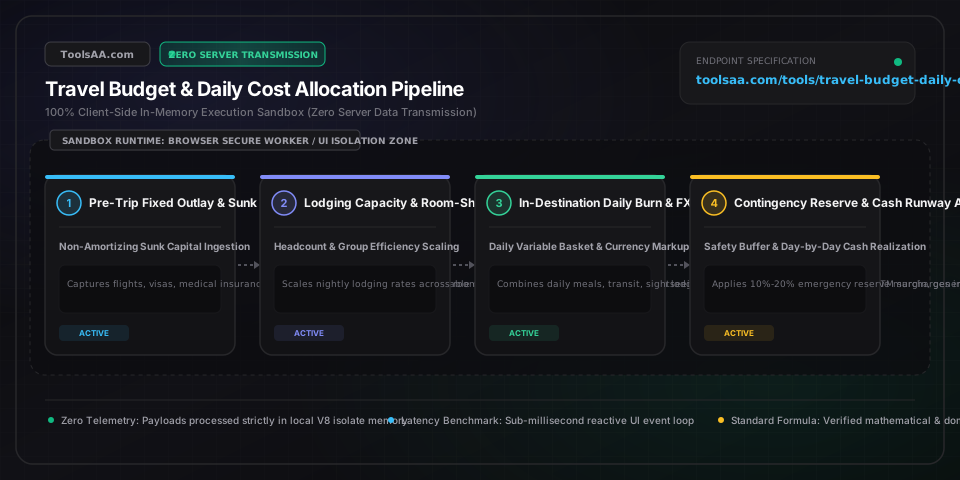
Travel Budget & Daily Trip Cost Planner Guide — Client-Side In-Memory Architecture & Data Flow

Key Parameters & Controls

Trip Duration & Calendar DaysTemporal Duration (Days)

Total calendar duration of the itinerary abroad. Directly dictates all marginal daily operating expenditures (OpEx: lodging, per diem dining, local ground transit, sightseeing) while amortizing pre-trip fixed sunk capital outlays (CapEx: long-haul flights, visas, gear, vaccinations) across a larger denominator ($Amortized Fixed Cost/Day = Total Fixed Costs / Days$).

Default: 14 Days
Travel Party Size & Room Sharing RatioHeadcount & Room Allocation (People)

Total traveler headcount and double-occupancy room configuration. While per capita dining, admissions, and municipal transit passes scale strictly linearly (1:1 per person), private hotel rooms and vacation rentals exhibit substantial economies of scale, slashing per-person lodging outlays by 50% under double-occupancy room sharing (Rooms = ceil(Travelers / 2)).

Default: 2 Travelers (1 Shared Room)
Pre-Trip Fixed Sunk Capital OutlaysCapital Expenditures (USD / EUR / GBP / JPY)

Inelastic capital expenditures committed prior to departure, encompassing non-refundable commercial airfare, consular entry visas, comprehensive travel medical insurance, passport renewals, destination gear, and long-term airport parking. These outlays remain strictly invariant to incremental changes in destination length of stay.

Default: $2,240.00
Nightly Lodging & Municipal Occupancy RateAccommodation Expense per Room-Night

Nightly base accommodation expense per room, benchmarked against global hospitality pricing tiers: $20–$45 for licensed hostel dorms, $70–$130 for budget private rooms, $150–$280 for midscale boutique hotels, and $450+ for luxury 5-star properties. Must factor in mandatory local municipal occupancy tourist taxes (e.g., Paris €2.60–€14.95/night, Rome €4.00–€10.00/night) and North American resort fees ($30–$65/night).

Default: $175.00 / night
Daily Food, Dining & Beverage ExpensesPer-Traveler Daily Food Basket

Per-person daily budget covering meals, specialty coffee, bottled water, snacks, and alcohol. Typically absorbs 20% to 30% of in-destination operating budgets. Ranges from $15–$30/day for grocery self-catering and street food to $55–$120/day for midscale sit-down dining including customary gratuity (18%–22% in North America) or statutory cover charges (coperto in Italy).

Default: $55.00 / person / day
Local Transportation & Transit PassesPer-Traveler Daily Ground Transit

Daily per-person expenditure on intra-city mobility, including municipal subway/metro systems, urban buses, commuter regional rail, micromobility (e-bikes/scooters), and on-demand rideshare/taxis. In major metropolitan transit hubs, multi-day tourist transit passes (e.g., London Oyster cap, Tokyo Subway 72hr Ticket, Paris Navigo Easy) reduce point-to-point transit friction and save 25% to 45% compared to single-ride fares.

Default: $22.00 / person / day
Activities, Excursions & Sightseeing AdmissionsPer-Traveler Daily Admissions

Discretionary per-traveler daily allowance for UNESCO heritage monuments, national museums, guided walking tours, observation decks, and nature reserve permits. Purchasing bundled municipal tourist passes (e.g., Paris Museum Pass, Roma Pass) typically breaks even within 3 to 4 museum visits while bypassing standard ticketing queues.

Default: $30.00 / person / day
Foreign Transaction Fees & Currency DragBanking Spread & Card Markup (%)

Blended financial friction imposed by retail banks and payment networks on foreign currency transactions (typically a 1.0% to 3.0% Foreign Transaction Fee markup), plus out-of-network international ATM withdrawal surcharges ($3 to $5 flat fee plus 1.0% to 3.5% currency conversion spread). Selecting a genuine 0% foreign transaction fee card and fee-rebating ATM debit card completely eliminates this financial drag.

Default: 0.0% to 3.0%
Contingency & Emergency Safety ReservePrudential Safety Buffer (5% to 25%)

A liquid risk-management reserve (recommended 10.0% to 20.0% of total travel expenditures) allocated to absorb sudden exogenous shocks, such as flight disruption rebookings, urgent walk-in medical clinic copays, extreme weather rideshare surge pricing, lost baggage replacement, or emergency prescription refills.

Default: 10.0% Reserve Buffer
Pro Tips & Best Practices

The Sunk Cost Amortization Illusion in Trip Duration Planning

Short getaways frequently appear deceptively expensive on a per-day basis because fixed upfront capital expenditures (e.g., a $1,200 transatlantic flight, $160 consular visa, and $110 travel insurance) are divided across a narrow denominator. On a 4-day trip, fixed outlays impose a punishing $367.50/day drag before a single meal or hotel room is purchased. Extending the duration to 14 days cuts that amortized fixed overhead by 71.4% to $105.00/day, significantly improving net purchasing power and experiential value per vacation dollar.

The Dynamic Currency Conversion (DCC) Terminal Trap

When paying with a credit card or withdrawing cash abroad, payment terminals and ATMs routinely present a misleading prompt: 'Charge in USD (Home Currency) or EUR/JPY (Local Currency)?' ALWAYS select the destination's local currency. Opting for your home currency authorizes Dynamic Currency Conversion (DCC), empowering the acquiring merchant bank or ATM operator to execute the FX conversion using an arbitrary exchange rate that includes an exorbitant 4.0% to 8.5% hidden spread markup above the interbank mid-market rate. Coupling local currency billing with a genuine 0% Foreign Transaction Fee credit card completely preserves mid-market purchasing power.

Tourist City Occupancy Taxes and Resort Fee Gotchas

Many popular European and Asian destinations (such as Rome, Paris, Venice, and Tokyo) enforce mandatory municipal tourist city taxes ranging from €2 to €15 per person per night, payable in cash or card directly at hotel check-in. In the United States and Caribbean resorts, mandatory 'resort fees' or 'destination fees' can add $30 to $65 per room per night beyond the advertised online room rate. Always check if hotel rates include local occupancy taxes to prevent unexpected checkout bill shock.

The 70/30 Fixed-to-Variable Split for Stress-Free Travel

Seasoned travelers lock down approximately 70% of their total trip cost before departure (flights, hotels with free cancellation, intercity train tickets, and travel insurance), leaving only 30% as variable daily pocket money (food, local transit, and impulse activities). This eliminates daily financial anxiety on vacation, because the big-ticket items are already fully paid and accounted for.

Common Gotchas & Troubleshooting

⚠️Total Trip Expenses Drastically Exceeding Estimated Daily Budget

This variance almost always stems from treating daily in-destination spending as the whole budget while forgetting pre-trip fixed costs (flights, baggage fees, travel insurance, vaccinations) and exit costs (airport taxis, transit cards). Ensure your budget model separates pre-trip sunk costs from daily variable costs, and verify that all multi-person accommodation costs reflect actual room count rather than multiplying single room rates by every traveler.

⚠️Currency Fluctuation and Hidden Interbank FX Spread Bleed

Credit card companies and banks apply a 1% to 3.5% foreign transaction fee on every international swipe unless you use a dedicated travel credit card (such as Chase Sapphire, Capital One Venture, or Revolut). Furthermore, airport currency exchange kiosks routinely charge spreads of 10% to 18% off the true mid-market rate. To stop foreign exchange bleeding, obtain local cash from bank-affiliated ATMs using a debit card with refunded ATM fees (like Charles Schwab) and pay card transactions exclusively in local currency.

⚠️Underestimating Food and Dining Expenses Due to Local Tipping and Service Charges

In the United States, restaurant menu prices exclude sales tax (5% to 10%) and customary gratuity (18% to 22%), inflating the final check by nearly 30% over menu listings. Conversely, in Europe and Japan, service charges (coperto in Italy, otoshi in Japan) or bread charges are added automatically, while tipping is minimal or non-existent. Always research destination tipping culture and calibrate your daily food budget by adding 20% to North American dining estimates.

⚠️Group Travel Budget Asymmetry and Room Splitting Friction

When traveling with friends or family, individuals possess varying spending thresholds for dining and nightlife, but share fixed costs like Airbnb rentals or rental cars. To eliminate friction, establish a shared group kitty (or Splitwise ledger) strictly for shared accommodations, tolls, and group groceries, while keeping personal dining, souvenir shopping, and individual excursions completely separate.

Frequently Asked Questions

How do you calculate a daily travel budget?▼

To calculate an accurate daily travel budget, use the formula: Daily Budget = (Total Planned Budget - Pre-Trip Fixed Costs) / Number of Trip Days. First, subtract fixed pre-trip expenses (such as round-trip flights, travel visas, and travel insurance) from your total savings. Next, divide the remaining sum by your total travel days to find your maximum daily spending limit. Finally, distribute this daily allowance across four core buckets: accommodation (typically 40%-50%), food and drink (25%-30%), local transit (10%-15%), and sightseeing/activities (10%-15%), while reserving a 10%-15% contingency buffer.

How much money should you budget per day for a trip?▼

Daily travel costs vary widely depending on the destination and travel style. For budget/backpacker travel (hostels, street food, public transit), plan for $35 to $65 per day in Southeast Asia or Eastern Europe, and $70 to $110 per day in Western Europe or North America. For mid-range comfort (3-star boutique hotels, casual sit-down dining, occasional taxis and tours), budget $100 to $175 per day in developing regions and $200 to $350 per day in cities like Tokyo, London, Paris, or New York. For luxury travel (4-5 star hotels, fine dining, private drivers), expect $500 to $1,000+ per day.

What percentage of a travel budget should go to food and accommodation?▼

On average, accommodation accounts for 30% to 45% of total trip costs, while food and dining consume 20% to 25%. Fixed transportation (flights and intercity trains) typically represents 20% to 25%, with the remaining 10% to 15% split between activities, local transit, and emergency reserves. Travelers can adjust these proportions according to personal priorities—for example, choosing budget hostels to allocate more funds toward Michelin-starred dining or adventure excursions.

What is the 50/30/20 rule for vacation and travel budgeting?▼

The 50/30/20 travel rule allocates your overall vacation fund into three strategic categories: 50% for core essentials (flights, accommodation, and intercity transit), 30% for discretionary daily experiences (dining out, entertainment, guided excursions, and shopping), and 20% for unexpected contingencies and safety reserves (travel insurance, surge pricing, emergency taxis, and medical buffers). Following this framework prevents mid-trip cash shortfalls.

How much emergency contingency fund should you have when traveling?▼

Financial planners recommend setting aside a 10% to 20% contingency buffer above your estimated total trip costs. For a $3,000 two-week vacation, this equates to a $300 to $600 emergency reserve. This buffer protects you against common travel contingencies such as unexpected baggage fees, sudden surge pricing during bad weather or peak holidays, pharmacy or urgent care copays, replacement of lost travel gear, and missed transport connections.

How do you budget for a group trip with shared expenses?▼

When budgeting for a group trip, separate shared communal costs from individual discretionary spending. Calculate shared accommodations (vacation rental villas or double rooms) and group transportation (rental cars, gas, highway tolls) based on total cost divided by headcount. Keep daily dining, drinks, souvenirs, and optional paid activities individual, or use an expense-sharing app like Splitwise or a communal physical cash pool for group meals and shared groceries.

Is it better to exchange currency before traveling or withdraw from ATMs abroad?▼

Disclaimer: This tool is provided strictly for educational and informational purposes only and does not constitute formal financial advice or a binding loan commitment. Please consult a qualified financial advisor before making decisions. It is almost always more cost-effective to withdraw cash from a bank ATM in your destination country using a debit card that reimburses ATM fees (like Charles Schwab or Wise) than exchanging currency beforehand. Airport exchange booths and domestic retail banks typically mark up foreign exchange rates by 8% to 18% over the mid-market rate, whereas bank ATMs with no-foreign-fee cards transact at wholesale interbank rates with spreads under 0.5%, provided you decline the ATM's Dynamic Currency Conversion (DCC) prompt.

Related Tools & Utilities

All Tools →