Triangle Angles Calculator & Solver

Badge precisionL3 Dashboard Topology

Triangle Angles Calculator & Solver

Calculate triangle angles and sides from SSS, SAS, ASA, and SSA. Features interactive geometry canvas, SSA ambiguous dual solver, and step-by-step proofs.

Lbl mode
Lbl precision
Kpi area6.0000m²
Kpi perimeter12.0000 m
Kpi inradius1.0000 m
Kpi circumradius2.5000 m
Kpi anglesA + B + C = 180°
Angle A (α):36.8699°
Angle B (β):53.1301°
Angle C (γ):90.0000°
Kpi sidesOpposite Vertices
Side a (BC):3.0000 m
Side b (AC):4.0000 m
Side c (AB):5.0000 m
Kpi classification:
ScaleneRight-Angled (90°)
Lbl toggle layers:
OIc = 5.00 mb = 4.00 ma = 3.00 mA (36.9°)B (53.1°)C (90.0°)
Lbl drag hintA + B + C = 180° / π rad
Client-Side Processing

High-performance calculation executed entirely in browser memory.

Zero Server Upload Privacy

All payloads remain strictly local with zero external server communication.

Production Ready Export

Clean, optimized output formats ready for immediate deployment.

Technical Reference & Architecture Guide

Triangle Angles Calculator & Solver Guide

Calculate triangle angles and sides from SSS, SAS, ASA, and SSA. Features interactive geometry canvas, SSA ambiguous dual solver, and step-by-step proofs.

Triangle Angles Calculator & Solver Guide — Client-Side In-Memory Architecture & Data Flow

Key Parameters & Controls

Euclidean Interior Angle Sum TheoremGeometric Invariant Constant [A + B + C = 180° / π rad]

In flat Euclidean geometry, the sum of all three interior angles in any non-collapsed triangle strictly equals exactly 180 degrees (π radians or 200 gradians). If two angles are known, the third angle is uniquely established as 180° - (A + B). In practical carpentry, roof framing, and athletic field layout, this invariant serves as the primary verification check against construction tilt or surveying drift.

Default: 180° (π radians)
Law of Cosines (Generalized Pythagorean Theorem)Trigonometric Invariant [c² = a² + b² - 2ab cos(C)]

Extends the Pythagorean theorem to all triangles by relating any side length to the cosine of its opposite angle: c² = a² + b² - 2ab × cos(C). It solves Side-Angle-Side (SAS) layouts to discover missing boundary lengths, and Side-Side-Side (SSS) layouts via cos(C) = (a² + b² - c²) / (2ab). Because arccosine uniquely maps between 0° and 180°, it resolves obtuse and acute angles without quadrant confusion.

Default: c² = a² + b² - 2ab cos(C)
Law of Sines (Sine Ratio Invariant)Proportional Ratio Invariant [a/sin(A) = b/sin(B) = c/sin(C) = 2R]

Establishes that the ratio between any side length and the sine of its opposite interior angle remains constant across all three vertices, directly equaling twice the circumradius (2R). This proportional rule is the primary mathematical engine for solving Angle-Side-Angle (ASA) and Angle-Angle-Side (AAS) configurations in outdoor navigation, land parceling, and astronomy.

Default: a / sin(A) = 2R
SSA Ambiguous Case Discriminant CriteriaGeometric Bifurcation Parameter

Evaluates the geometric feasibility and number of possible triangles when given two sides and a non-included acute angle (a, b, and Angle A). Comparing side a to the vertical altitude h = b × sin(A) defines the topology: if a < h, 0 triangles exist; if a = h, exactly 1 right-angled triangle forms; if h < a < b, exactly 2 valid triangles exist (one acute, one obtuse); and if a ≥ b, exactly 1 triangle forms.

Default: h = b × sin(A) altitude baseline
Heron's Formula & Semi-Perimeter Area ModelArea Invariant [Area = √(s(s - a)(s - b)(s - c))]

Calculates the exact enclosed area of any triangle directly from its three boundary edges without requiring height or angle measurements, where s = (a + b + c) / 2 is the semi-perimeter. In precision calculation, sorting side lengths so a ≥ b ≥ c prevents severe rounding cancellation when measuring extremely elongated or needle-thin plots such as yard wedges and roof gables.

Default: Area = √(s(s - a)(s - b)(s - c))
Inradius and Circumradius Fundamental RadiiConcentric Geometric Radii [r = Area / s, R = abc / (4 × Area)]

Quantifies the inner and outer circular boundaries of a triangle. The inradius (r = Area / s) represents the largest circle that can fit inside the triangle touching all three walls, essential for structural packing and mechanical clearance. The circumradius (R = abc / (4 × Area)) defines the circle passing through all three vertices, satisfying Euler's distance relation d² = R(R - 2r).

Default: r = Area / s, R = abc / (4 × Area)
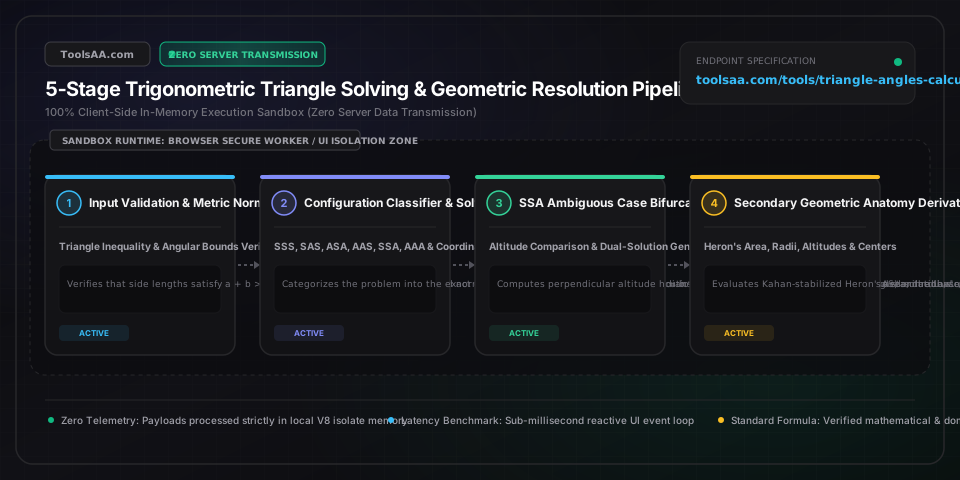
Pro Tips & Best Practices

Always Solve the Largest Angle First When Using the Law of Cosines

When calculating interior angles from three known side lengths (SSS), always use the Law of Cosines to solve for the angle opposite the longest side first. The mathematical inverse cosine function produces a unique value from 0° to 180°, which immediately reveals whether the triangle is obtuse (cos < 0), right-angled (cos = 0), or acute (cos > 0). Once the largest angle is identified, all remaining angles are guaranteed to be strictly acute, allowing you to safely calculate them without arcsine quadrant confusion.

Check the Perpendicular Altitude Before Calculating SSA Configurations

In Side-Side-Angle (SSA) problems where the given angle A is acute and side a is shorter than side b, calculate the perpendicular drop height h = b × sin(A) before applying the Law of Sines. If side a is strictly shorter than h, the swinging side cannot reach the baseline, meaning no physical triangle can exist. When h < a < b, two distinct physical triangles always exist: an acute solution (Angle B1 = arcsin[(b × sin(A)) / a]) and a valid obtuse counterpart (Angle B2 = 180° - B1).

Sort Side Lengths to Protect Precision in Needle-Thin Triangles

Standard Heron's area formula suffers from extreme numerical cancellation when two sides are nearly identical and the third edge is paper-thin (such as a 100 m, 100 m, and 0.05 m surveying wedge). By sorting side lengths such that a ≥ b ≥ c and evaluating Area = 0.25 × √[(a + (b + c)) × (c - (a - b)) × (c + (a - b)) × (a + (b - c))], the subtraction of massive nearly identical totals is eliminated, preserving full mathematical precision for students, builders, and surveyors.

Validate the Triangle Inequality Theorem Before Running Calculations

For any three line segments to form a closed planar triangle, the combined length of any two sides must strictly exceed the length of the third: a + b > c, a + c > b, and b + c > a. If two sides sum to exactly the third side (a + b = c), the three corners collapse onto a single flat line segment with zero area. If the sum is strictly less than the third side, the ends cannot physically connect in two-dimensional space.

Common Gotchas & Troubleshooting

⚠️Inverse Cosine Returns Undefined or Domain Error During SSS Calculation

This error occurs when the input side lengths violate the Triangle Inequality Theorem (such as trying to assemble sides of 2 cm, 3 cm, and 10 cm). In such cases, the mathematical term (b² + c² - a²) / (2bc) falls outside the valid cosine range between -1.0 and +1.0, making an angle calculation impossible. Verify that the sum of your two shorter sides strictly exceeds the longest side. The solver automatically smooths minor decimal rounding drifts within [-1.0, 1.0] to prevent false errors.

⚠️Discrepancy in Angle Measurements When Switching Between Degrees and Radians

Angle measurements describe the exact same corner opening across different mathematical scales: 180 degrees corresponds to exactly π radians (approximately 3.14159 rad) and 200 gradians. If your hand calculations or CAD drawings show a 57.3° discrepancy, your measuring scale is likely set to radians (where 1 radian ≈ 57.2958°). Use Degrees for home drafting, carpentry, and classroom homework, and reserve Radians for calculus and cyclic wave mechanics.

⚠️SSA Mode Reports 'No Triangle Possible' Despite Entering Positive Values

In Side-Side-Angle setups, having positive side lengths does not guarantee physical closure. If the side opposite your known angle (side a) is shorter than the perpendicular drop from the top corner to the base (h = b × sin(A)), side a dangles in midair and cannot reach the bottom line. To create a closed triangle, either increase the length of side a so it is at least equal to b × sin(A), or widen the angle A to lower the required altitude.

⚠️Law of Sines Produces an Acute Angle When the Geometry is Clearly Obtuse

The inverse sine function (arcsin) only returns angles between -90° and +90°, meaning it cannot naturally distinguish between an acute angle θ and its wide supplementary angle (180° - θ), since both share the exact same sine value: sin(θ) = sin(180° - θ). To avoid this blind spot, always solve for the widest corner first using the Law of Cosines, ensuring all remaining unknown corners are acute and safe for the Law of Sines.

Frequently Asked Questions

How do you calculate the angles of a triangle with 3 sides?▼

To calculate all three interior angles from known side lengths (a, b, c), apply the Law of Cosines: cos(A) = (b² + c² - a²) / (2bc), cos(B) = (a² + c² - b²) / (2ac), and cos(C) = (a² + b² - c²) / (2ab). Take the inverse cosine (arccos) of each fraction to reveal the angle in degrees or radians. For example, in a classic 3-4-5 right triangle, cos(C) = (3² + 4² - 5²) / (2 × 3 × 4) = 0 / 24 = 0, giving arccos(0) = 90°. All three resulting angles will always sum to exactly 180°.

How do you solve the ambiguous case (SSA) for a triangle?▼

To solve the ambiguous Side-Side-Angle (SSA) case, first calculate the perpendicular height h = b × sin(A). When angle A is acute (< 90°): if side a < h, zero triangles can form; if a = h, exactly one right-angled triangle forms; if h < a < b, exactly two valid triangles exist—one with an acute angle B1 = arcsin[(b × sin(A)) / a] and an obtuse twin with angle B2 = 180° - B1; and if a ≥ b, exactly one triangle exists. If angle A is obtuse (≥ 90°), a valid triangle exists only if side a is strictly longer than side b.

What is the difference between the Law of Sines and Law of Cosines?▼

The Law of Sines [a / sin(A) = b / sin(B) = c / sin(C)] links side lengths directly to their opposite angle sines, making it ideal when you know two angles and one side (ASA or AAS) or two sides and an opposite angle (SSA). The Law of Cosines [c² = a² + b² - 2ab × cos(C)] generalizes the Pythagorean theorem to all triangles, making it essential when you know all three sides (SSS) or two sides and the included corner between them (SAS). The Law of Cosines eliminates angle ambiguity because arccosine uniquely spans 0° to 180°.

How do you find the missing angle of a triangle given two angles?▼

To find the missing third angle when two angles are known, subtract their sum from 180 degrees (or π radians): Angle C = 180° - (Angle A + Angle B). This simple calculation is guaranteed by Euclid's angle sum theorem for all planar triangles. For instance, if a roof truss has a base pitch angle of 35° and an apex angle of 110°, the remaining corner angle equals 180° - (35° + 110°) = 35°, confirming an isosceles support frame.

Can a triangle have angles greater than 180 degrees?▼

In standard flat Euclidean geometry, no individual interior angle can ever reach or exceed 180 degrees, and all three angles together must sum to exactly 180 degrees. An opening greater than 180 degrees is a reflex angle, which sits entirely outside the triangle's body. However, on curved surfaces such as the Earth in spherical geometry, triangle angles always sum to more than 180° (up to 540°), such as a triangle drawn from the North Pole down to the equator and along 90 degrees of longitude, which contains three 90° corners totaling 270°.

Related Tools & Utilities

All Tools →