Ring Size Converter & Finger Measurer

Badge universal living•Lbl sub zero float

Ring Size Converter & Finger Measurer

Convert ring sizes across US, UK, EU, and Japan instantly. Measure your finger or existing ring on screen with credit card calibration, band width and knuckle fit adjustments.

Lbl quick presets

Parameters & Inputs

Lbl active standard US
Lbl system
Lbl us prefix 6Lbl equivalent 16.51 Unit mm • Lbl circumference abbr 51.87 Unit mm
Lbl size range min
Lbl size range max
Title ergonomic adjustments+0.00 Lbl us size unit
Lbl band width2.0 Unit mm
Lbl metal typeEasily resizable (±2 sizes)
Lbl pure client engine
Lbl raw diameter16.51 Unit mm
Lbl optimal recommended size
Lbl us prefix 6/ Lbl uk prefix L
Lbl physical dims 16.51 Unit mm Lbl diameter word • 51.87 Unit mm Lbl circumference word
Badge iso standard compliant0.00 Unit mmLbl width comp included
Std us nameUS
6Lbl diameter inches 0.650 Unit inches
Std uk nameUK
LLbl alphabetical scale
Std eu nameEU
51.9Lbl circumference mm exact
Std jp nameJIS
12Lbl jis standard
Std de nameDE
16.5 Unit mmLbl inside diameter pure
Std fr nameFR
11.9Lbl french formula
Lbl professional fitting tipTip standard notice
Lbl effective circ51.87 Unit mm
Lbl toleranceLbl tolerance value
Primary MetricLbl us prefix 6 (L)
Efficiency / Capacity16.5 Unit mm / 51.9 Unit mm
Net OutputStat standard comfort

Client-Side Processing

High-performance calculation executed entirely in browser memory.

Zero Server Upload Privacy

All payloads remain strictly local with zero external server communication.

Production Ready Export

Clean, optimized output formats ready for immediate deployment.
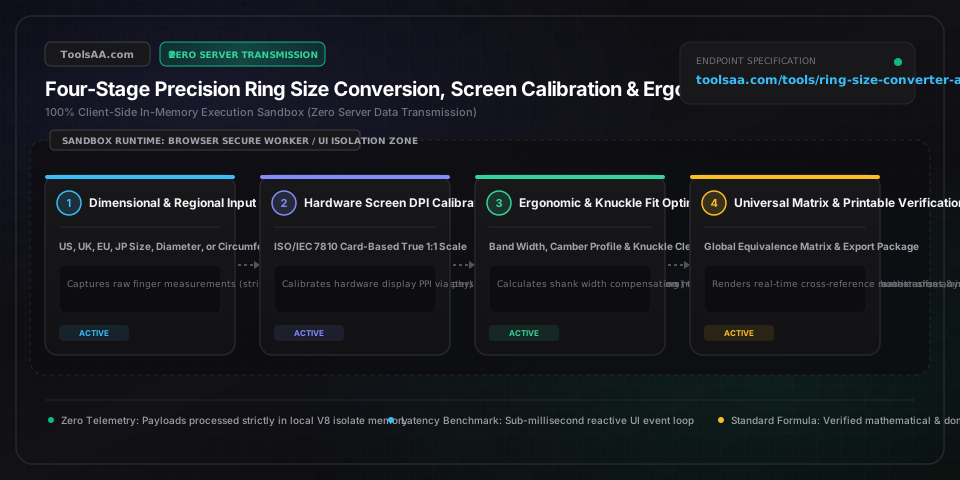
Technical Reference & Architecture Guide

Ring Size Converter & Finger Measurer Guide

Convert ring sizes across US, UK, EU, and Japan instantly. Measure your finger or existing ring on screen with credit card calibration, band width and knuckle fit adjustments.

Ring Size Converter & Finger Measurer Guide — Client-Side In-Memory Architecture & Data Flow

Key Parameters & Controls

Inside Diameter (d)metric length (mm / inches)

The exact straight-line distance across the widest inner circle of the ring, excluding the thickness of the metal band. Standard digital calipers measure this directly.

Default: 16.51 mm / 0.650 in (US Size 6)
Inside Circumference (C)metric length (mm / inches)

The total inner perimeter of the ring band (C = π * d), identical to the ISO 8653 standard European ring size and the distance measured when wrapping paper around a finger.

Default: 51.87 mm / 2.042 in (ISO Size 52)
US & Canada Numerical Ring Size (S_US)numerical scale (1 to 16 with 0.25 steps)

The North American jewelry standard where size 0 has an inside diameter of 11.63 mm and each whole size increment adds exactly 0.8128 mm (0.032 in) to the diameter.

Default: 6.00 (Standard Women's Baseline)
UK & Australia Letter Ring Size (S_UK)alphabetical scale (A to Z+6 with half-sizes)

The British Commonwealth standard where Size A equals 37.8 mm inside circumference and each whole letter increment adds 1.257 mm to circumference (0.628 mm per half-letter).

Default: L 1/2 to M (UK Equivalent of US 6)
European Union & ISO 8653 Size (S_EU)metric integer / decimal (mm)

The official International Organization for Standardization benchmark directly designated by the ring's inside circumference in whole millimeters (e.g., Size 52 = 52.0 mm circumference).

Default: 52 (EU Standard Size)
Japanese & East Asian JIS Ring Size (S_JP)numerical scale (1 to 30)

The Japanese Industrial Standard (JIS S 4700) widely adopted across Japan, China, Hong Kong, and East Asia, benchmarked at Size 1 (13.0 mm diameter) with 1/3 mm diameter increments.

Default: 11 (JIS Equivalent of US 6)
Band Width Sizing Factor (W_adj)width dimension & size offset (mm / steps)

Width of the ring shank across the finger. Wider bands trap more skin and encounter more resistance, requiring an upward size adjustment (+0.25 to +1.0 size for bands over 4.0 mm).

Default: 2.5 mm (Standard Solitaire Baseline)
Fit Interior Profile (Standard vs Comfort Fit)cross-sectional geometry selector

Standard Flat rings feature a cylindrical interior flush with the finger. Comfort Fit rings feature a convex, domed interior that glides smoothly over knuckles, fitting slightly looser.

Default: Standard Flat Interior

Pro Tips & Best Practices

Measure Late in the Afternoon and at Normal Room Temperature

Fingers naturally expand and contract throughout the day. Cold temperatures cause blood vessels to constrict, shrinking fingers by up to half a size, while summer heat, strenuous workouts, or high sodium intake cause swelling. Always measure your finger between 4:00 PM and 7:00 PM at comfortable room temperature (68°F to 72°F / 20°C to 22°C) to capture your finger's true average diameter.

Account for Wide Bands: Add 0.5 to 1.0 Full Size for Shanks Over 6mm

Narrow bands (1.5mm to 3mm) cover minimal surface area and slide easily, but wide wedding bands (6mm to 10mm) cover substantial tissue, creating friction against the finger. If your standard size is US 7.0 for a thin engagement ring, order a 7.5 for a 6mm band or an 8.0 for an 8mm+ wide cigar band. Always ask your jeweler what width they used when sizing your finger.

Comfort Fit Rings Sit Tighter at the Center: Choose Standard or Half Size Down

Comfort fit rings have a domed, rounded inner surface so only the center apex touches your finger. Because the edges flare slightly outward, the ring glides effortlessly over knuckles. For narrow to medium comfort-fit bands (under 5mm), you can typically order a quarter to half size smaller than your standard flat ring size to ensure the ring doesn't slide off when your hands are cold.

Bridge the Knuckle Gap: Average Base and Knuckle Diameters or Use Sizing Beads

If your knuckle is significantly larger than the base of your finger (common with athletes, guitarists, and individuals with arthritis), sizing for the base means the ring won't clear the knuckle, while sizing for the knuckle causes the ring to spin loosely at the base. Calculate the midpoint diameter (d_base + d_knuckle) / 2, or order the knuckle size and have a jeweler solder two interior platinum sizing beads to keep the ring upright.

Common Gotchas & Troubleshooting

⚠️On-screen ring measurer circle does not match physical ring dimensions

Screen pixel densities (PPI/DPI) vary dramatically between monitors, laptops, and mobile screens. A standard CSS pixel does not equal an exact physical millimeter without hardware calibration. Use the Credit Card Calibration slider to adjust the on-screen card outline until a physical credit card, debit card, or driver's license (standard ISO/IEC 7810 ID-1: exactly 85.60 mm wide) aligns edge-to-edge. This guarantees 100% 1:1 true physical scale.

⚠️Ring fits over knuckle but spins loosely and turns upside down at the base

This is the classic 'knuckle gap' dilemma. The ring was sized to clear the larger knuckle, leaving excess room at the finger's base where the center stone's weight pulls it off-center. Rather than resizing the ring smaller (which prevents removal), install a silicone ring guard, a spring hinge shank, or have a jeweler add two interior sizing balls (speed bumps). These compress gently over the knuckle and lock the ring firmly at the base.

⚠️Ring feels uncomfortably tight in summer humidity or after air travel

Human extremities swell during airline flights due to cabin pressure fluctuations, as well as in hot, humid weather and during pregnancy due to water retention (+0.25 to +0.5 size). If your ring feels snug seasonally, check if the band has room for an internal comfort bevel or consider sizing up a quarter size. When in doubt between two adjacent sizes, always choose the larger size; it is far easier and less costly to insert sizing beads than to stretch a ring.

⚠️Inconsistent measurements between paper strip wrap and string method

Never use string, dental floss, or sewing thread to measure ring size. String stretches and twists under tension, producing measurements that are 1 to 2 sizes too small. Paper strips are far more reliable: cut a non-stretchy strip of paper 1/2 inch wide, wrap it snugly (not tightly) around the widest part of your finger, mark the overlap with an ultra-fine pen, and measure the flat length against a precision millimeter ruler.

Frequently Asked Questions

How do I measure my ring size at home without a sizer?▼

To measure your ring size accurately at home without a jeweler's mandrel, wrap a 1/2-inch wide strip of non-stretchy paper or ribbon snugly around the base of your finger and over your knuckle. Mark the exact point where the paper overlaps with an ultra-fine pen, lay the paper flat, and measure the distance in millimeters with a ruler. This gives you your inside circumference. Match this measurement to the ISO/EU ring size (e.g., 52 mm = EU 52 = US 6.0). Alternatively, place an existing well-fitting ring onto our calibrated on-screen circle measurer.

How do US ring sizes convert to UK, European, and Japanese sizes?▼

International ring sizing systems correspond to either inside diameter or inside circumference. US sizes use a numerical scale from 3 to 15 (e.g., US 6 has a 16.51 mm diameter and 51.87 mm circumference). UK sizes use an alphabetical scale from A to Z (US 6 equals UK L 1/2 to M). European Union (ISO 8653) sizes equal the inside circumference in millimeters (US 6 equals EU 52). Japanese (JIS) sizes use a 1 to 30 numerical scale (US 6 equals JP 11). Use our universal conversion table to find exact equivalents across all regions.

Why does a wide ring band require a larger ring size?▼

A standard ring band is 2mm to 3mm wide and covers a small portion of the finger. Wide bands (6mm to 10mm or wider) cover a larger surface area of skin and tissue, creating significantly more friction and trapping flesh as the ring slides on. Because there is less room for tissue displacement under a wide band, jewelers recommend sizing up by 0.25 to 0.5 size for 4mm-6mm bands, and by 0.5 to 1.0 full size for bands 7mm to 10mm wide.

What is the difference between standard fit and comfort fit rings?▼

Standard fit rings have a flat interior surface that sits flush against the skin across the entire width of the band. Comfort fit rings have a rounded, convex interior profile where only the center apex makes direct contact with the finger while the edges curve slightly away. This curvature reduces friction, allows the ring to glide smoothly over knuckles, and makes the ring feel slightly roomier. For narrow comfort-fit bands, buyers often order a quarter size smaller than their standard flat size.

What should I do if my knuckle is larger than the base of my finger?▼

If your knuckle circumference exceeds your finger base by more than 1mm (roughly half a size), a ring sized solely for the base will not pass the knuckle, while a ring sized for the knuckle will spin loosely at the base. To resolve this, measure both the knuckle and the base and calculate the average: Size = (Knuckle + Base) / 2. Alternatively, choose a size that clears the knuckle comfortably and have a jeweler install internal sizing beads (metal bumps soldered inside the shank) or a horseshoe spring insert to hold the ring upright.

How does temperature and time of day affect ring sizing?▼

Finger volume fluctuates by up to half a size throughout the day due to temperature, hydration, and physical exertion. Blood circulation increases in the evening and in warm conditions, causing fingers to swell to their maximum size. Conversely, cold weather and morning hours constrict capillaries and make fingers slimmer. For the most accurate fit, measure your ring size in the late afternoon or early evening in a warm room when your hands are at their normal baseline volume.

Related Tools & Utilities

All Tools →