Sun Exposure Vitamin D Calculator & UV Time

Sun Exposure Vitamin D Calculator & UV Time

Calculate safe sun exposure minutes for vitamin D synthesis by UV index, Fitzpatrick skin phototype, and clothing coverage. Optimize IU yield without sunburn.

Lbl standard unit
Presets label
Card controls title
Mode badge time
Unit uvi 6.0
Uvi nightUvi modUvi highUvi very highUvi extreme
36.5% Unit bsa
Lbl custom anatomical
1,000 Unit iu
Hint iu400Hint iu1000Hint iu2000Hint iu4000
32 Unit years (87% Lbl capacity)
Hint age factor

Solar elevation is high. Stratospheric ozone path length is minimal, allowing peak 290-315 nm UVB photons to trigger rapid vitamin D synthesis.

Hint albedo

Hint bmi

Card cockpit title
Optimal sun window: Target dose reached with generous sunburn safety margin.
Kpi time to target
9Unit minutes
Kpi target subtext 1,000 Unit iu Lbl cholecalciferol
Kpi time to med
39Unit minutes
Type III Kpi med subtext
Kpi serum delta
+0.4Unit ng ml
Kpi target standard us
Gauge title23% Lbl of1 med
1 MED (Lbl sunburn)9Unit min short
Gauge safeGauge optimalGauge tightGauge burn
Shadow rule titleBadge shadow pass
Lbl standing heightLbl shadow length 0.6 Unit times H

Shadow rule scientific note

Disclaimer title

Disclaimer body

Time to Dose9 Unit min short
Burn Time (1 MED)39 Unit min short
Synthesis Velocity113 Unit iu/Unit min short
Skin Coverage36.5% Unit bsa
Shadow StatusPeak UVB
Safety Buffer23% MED
Technical Reference & Architecture Guide

Sun Exposure Vitamin D Calculator & UV Time Guide

Calculate safe sun exposure minutes for vitamin D synthesis by UV index, Fitzpatrick skin phototype, and clothing coverage. Optimize IU yield without sunburn.

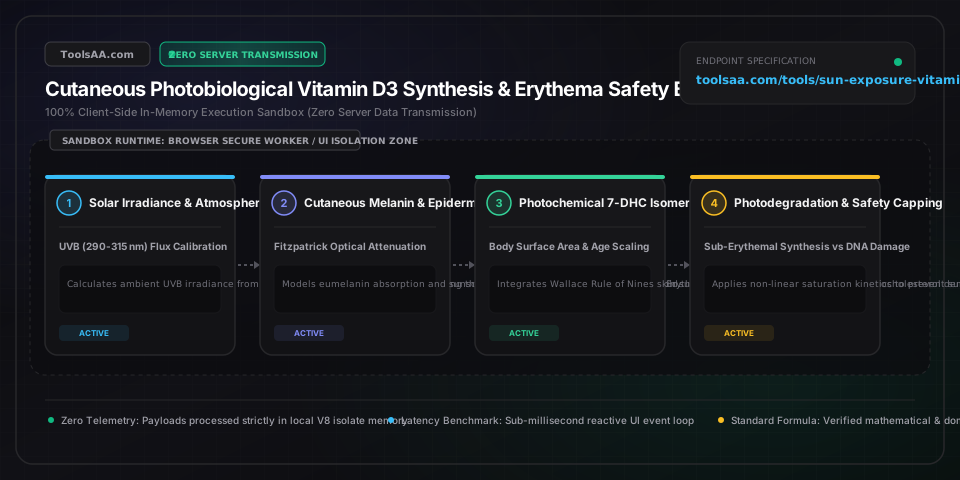
Sun Exposure Vitamin D Calculator & UV Time Guide — Client-Side In-Memory Architecture & Data Flow

Key Parameters & Controls

Minimal Erythemal Dose (1 MED)Photobiological Radiant Exposure Threshold (J/m2)

The lowest radiant exposure of ultraviolet radiation that produces perceptible, uniform erythema (skin reddening with distinct margins) 24 hours post-exposure. Ranges from ~200 J/m2 in fair Type I skin to ~1,000 J/m2 in deeply pigmented Type VI skin.

Default: 200 - 1000 J/m2
Standard Vitamin D Dose (SDD)Physiologic Synthesis Equivalence Unit

The equivalent radiant exposure needed to produce circulating 25(OH)D levels comparable to an oral dose of 1,000 IU vitamin D3. Established by Holick and Webb as approximately 0.25 to 0.33 of 1 MED when 25% of body surface area is exposed.

Default: 0.25 - 0.33 MED
Fitzpatrick Phototype ClassificationMelanin Optical Attenuation Scale

Clinical scale (Types I through VI) categorizing constitutive epidermal eumelanin density and genetic susceptibility to cutaneous DNA damage and erythema versus melanin synthesis under UV irradiance.

Default: Scale I to VI
Body Surface Area Exposure (Wallace Rule of Nines)Anatomical Percentage (%)

Cutaneous surface area exposed directly to unscattered direct and diffuse solar irradiance: head and neck (9%), upper limbs (18%), anterior and posterior trunk (36%), and lower limbs (36%).

Default: 8.5% to 75.0%
Atmospheric UVB Cutoff (Shadow Rule)Solar Zenith Angle Optical Boundary

When solar elevation drops below 35-45 degrees (when a standing individual's shadow exceeds their standing height), stratospheric ozone path length exceeds optical air mass 1.5, absorbing virtually 100% of 290-315 nm UVB photons.

Default: Sun elevation > 45 deg
Epidermal 7-DHC Age Attenuation FactorCutaneous Substrate Depletion Factor

Concentrations of the vitamin D precursor 7-dehydrocholesterol in the basal and spinous layers of human skin decline exponentially with age, reducing photochemical synthesis capacity by over 50% between age 20 and 70.

Default: 1.00 at age 20, 0.50 at age 65

Pro Tips & Best Practices

The Glass Window UVB Extinction Trap

Standard architectural and automotive soda-lime window glass transmits up to 75% of UVA radiation (320-400 nm) but absorbs virtually 100% of UVB photons (290-315 nm). Sitting behind a bright, warm sunlit window produces premature collagen degradation, reactive oxygen species, and photoaging with exactly 0 IU of vitamin D synthesis.

Cutaneous Photolysis Self-Regulation (Zero Overdose Risk)

Sunlight exposure cannot induce hypervitaminosis D or hypercalcemia. Once total epidermal previtamin D3 reaches approximately 10-15% equilibrium (typically at 0.75-1.0 MED), subsequent UVB exposure isomerizes previtamin D3 into biologically inert lumisterol and tachysterol, capping daily endogenous synthesis at ~15,000 to 20,000 IU.

The Midday Solar Efficiency Paradox

While conventional dermatological advice often recommends avoiding sun exposure between 10:00 AM and 3:00 PM, this is precisely when the ratio of beneficial UVB (which synthesizes vitamin D) to harmful UVA (which penetrates deep into the dermis) is highest. Short, sub-erythemal exposures around solar noon yield maximum vitamin D in the minimum number of minutes, minimizing cumulative UVA photon load.

Real-World Sunscreen Attenuation Factor

Laboratory SPF ratings assume a dense application of 2.0 mg/cm2. In everyday consumer usage, individuals typically apply 0.5 to 0.8 mg/cm2, which exponentially reduces protection: an SPF 30 sunscreen applied at 0.75 mg/cm2 delivers an effective SPF of roughly 3.6 to 4.6 (~75% UVB block instead of 96.7%), permitting partial cutaneous synthesis while still protecting against acute erythema.

Common Gotchas & Troubleshooting

⚠️UV Index 1 or 2 Shows Infinite Time to Synthesize Dose

When the local UV Index is below 3 (common in autumn/winter at latitudes above 35 deg N or 35 deg S), atmospheric path length filters out 290-315 nm UVB wavelengths. This seasonal phenomenon, known clinically as 'Vitamin D Winter', means zero cutaneous synthesis occurs regardless of exposure duration; oral dietary supplementation or fortified nutrition is required.

⚠️Synthesis Discrepancy for Fitzpatrick Type V and VI

High eumelanin concentrations in darkly pigmented skin act as a natural optical photoprotective filter with an intrinsic SPF of 10 to 15. In low UV environments (UVI 3-4), reaching 1,000 IU may require 60-90 minutes of exposure, which can be clinically impractical; increasing exposed BSA (e.g. wearing shorts and a t-shirt instead of long pants) proportionally reduces the necessary exposure window.

⚠️Severe Overheating Before Reaching Target Dose in Humid Climates

Thermal stress from high ambient temperature and humidity does not accelerate photochemical isomerization. Divide the daily calculated exposure into two brief sub-erythemal sessions, or increase the exposed skin surface area (e.g. from 20% to 50%) to halve the required duration.

⚠️Indoor Tanning Bed or Solarium UV Discrepancy

Commercial cosmetic tanning beds emit 95% to 99% UVA radiation to induce rapid immediate pigment darkening without acute burning, providing less than 1-3% UVB. They produce severe photoaging and melanoma risk with negligible vitamin D3 synthesis compared to natural solar radiation.

Frequently Asked Questions

How to calculate sun exposure time for vitamin D?▼

Sun exposure time is calculated using the formula: Time (min) = (Target_IU / Baseline_Yield_Per_MED) * [Time_to_1_MED / (BSA_Exposed_Percent / 25%) * Age_Factor]. At solar noon under UV Index 6, a young adult with Fitzpatrick Type II skin exposing 25% BSA (arms and legs) requires approximately 10 to 12 minutes (roughly one-third of their 28-minute burn threshold) to synthesize 1,000 IU of vitamin D3.

How many minutes of sun do I need a day for vitamin D?▼

For fair to light skin (Fitzpatrick Types I-III) during spring and summer at midday (UV Index 6+), 10 to 15 minutes of unshielded sun on the face, arms, and legs 2 to 3 times per week delivers approximately 1,000 to 2,000 IU per session. Darker skin (Types IV-VI) contains higher melanin concentrations that compete with 7-dehydrocholesterol for UVB photons, requiring 25 to 45 minutes under identical conditions to achieve equivalent serum 25(OH)D response.

Can you get vitamin D through a window or on cloudy days?▼

You cannot synthesize vitamin D through window glass because commercial glass absorbs virtually 100% of UVB wavelengths (290-315 nm) while transmitting skin-damaging UVA. Light cloud cover allows up to 80% of UV rays to penetrate via atmospheric scattering, whereas heavy overcast clouds attenuate UVB irradiance by 50% to 80%, extending required exposure times substantially.

Can you get vitamin D toxicity from too much sunlight?▼

No. Excessive sunlight exposure cannot cause vitamin D toxicity or hypercalcemia. The human epidermis possesses an intrinsic photochemical safety mechanism: once circulating previtamin D3 levels reach approximately 10-15% of total dermal sterols (reached after ~20-30 minutes of peak sun), excess previtamin D3 is irreversibly photodegraded into inert photoproducts lumisterol, tachysterol, and suprasterol.

Does sunscreen prevent vitamin D synthesis in the sun?▼

In clinical laboratory trials where sunscreen is applied at the official standard density of 2.0 mg/cm2, SPF 30 blocks 96.7% of UVB photons, reducing vitamin D synthesis by roughly 95-98%. However, real-world observational studies show that typical users apply only 0.5 to 0.8 mg/cm2, resulting in an effective SPF of roughly 3.5 to 5.0, which permits significant cutaneous vitamin D3 synthesis while still protecting against acute erythema.

What is the shadow rule for vitamin D synthesis?▼

Disclaimer: This tool is provided strictly for educational and informational purposes only and does not constitute formal financial advice or a binding loan commitment. Please consult a qualified financial advisor before making decisions. The Shadow Rule is a practical dermatological guideline: when your shadow is shorter than your standing height, the sun's elevation angle is greater than 45 degrees, indicating sufficient atmospheric UVB penetration for cutaneous vitamin D synthesis. When your shadow is longer than your standing height (early morning, late afternoon, or winter months at higher latitudes), atmospheric Rayleigh scattering and stratospheric ozone absorption filter out virtually all 290-315 nm UVB radiation.

Related Tools & Utilities

All Tools →