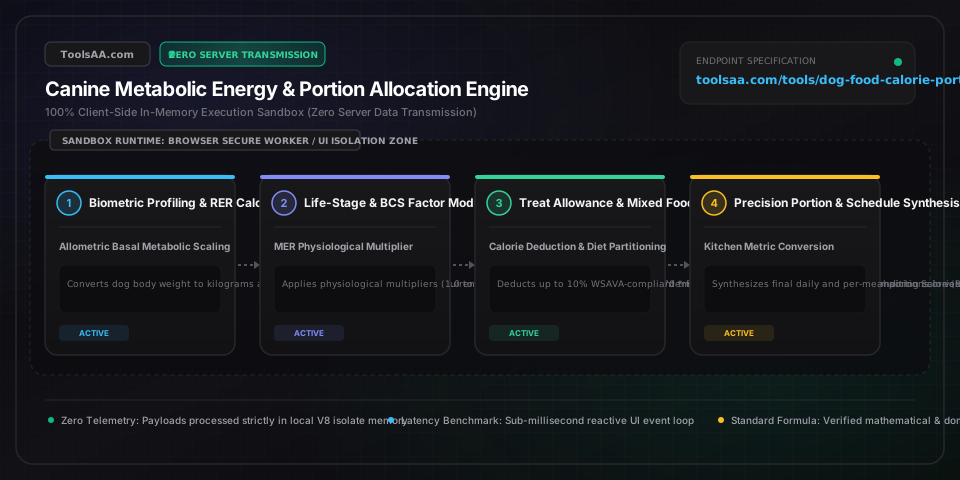
Dog Food Calorie & Portion Calculator
Calculate your dog's daily calorie needs (MER & RER) and exact food portions in cups or grams. Supports dry kibble, wet food, treats, and weight management.
Hint weight
Calculate your dog's daily calorie needs (MER & RER) and exact food portions in cups or grams. Supports dry kibble, wet food, treats, and weight management.
Hint weight
Disclaimer title: Disclaimer text
Calculate your dog's daily calorie needs (MER & RER) and exact food portions in cups or grams. Supports dry kibble, wet food, treats, and weight management.
Basal caloric expenditure needed for vital physiological functions (respiration, circulation, cellular homeostasis) at complete rest, calculated via the WSAVA exponential allometric equation 70 × (Weight in kg)^0.75 across toy to giant dog breeds.
Clinical multiplier applied to RER to account for physical activity, neuter status, age, thermoregulation, and life stage demands, ranging from 1.0 for therapeutic weight loss to 3.0+ for puppy growth or active sporting performance.
Standardized clinical assessment metric where score 5/9 represents ideal body composition (~20% body fat); scores above 5 indicate ~10% to 15% surplus body fat per point requiring a therapeutic caloric deficit.
The usable nutritional energy remaining after subtracting digestive and urinary losses, declared on AAFCO-compliant packaging (averaging 320 to 450 kcal/cup for dry kibble and 150 to 450 kcal/can for wet food).
Veterinary clinical threshold capping all treats, biscuits, table scraps, and training rewards to a maximum of 10% daily calories to avoid diluting essential vitamins, calcium, phosphorus, and trace minerals.
The proportional caloric partition between dry extruded kibble and moisture-rich canned wet food, balancing mechanical chewing benefits with urinary hydration (wet food averages 75% to 82% moisture).
Volumetric measuring cups introduce a 15% to 25% feeding error due to variations in kibble diameter, air spaces between irregular shapes, and scoop rounding. Using a digital kitchen scale set to grams ensures exact caloric intake and prevents unintentional overfeeding.
Commercial complete-and-balanced dog foods contain precisely calibrated ratios of vitamins and minerals like calcium, phosphorus, and taurine. Feeding more than 10% of your dog's daily calories as unfortified treats, biscuits, or table scraps dilutes these essential micronutrients, creating subclinical dietary deficiencies over time.
When placing an overweight dog on a weight-loss plan, always calculate daily calories using their veterinarian-estimated ideal target weight—or feed at 1.0 × RER of their current weight. Calculating portions using their current obese mass maintains their excess body fat rather than stimulating healthy fat mobilization.
Dogs exercising or dwelling outdoors in sub-freezing winter weather require an additional 15% to 40% caloric intake for shivering thermogenesis and body heat regulation. Conversely, hot summer humidity suppresses appetite and spontaneous activity, requiring a seasonal 10% portion reduction to prevent unwanted weight gain.
Perform an exhaustive treat and table scrap audit; hidden calories from dental chews (often 100–150 kcal each), training bites, and peanut butter for medications frequently account for 200+ unlogged calories daily. If food intake is verified at a strict deficit for 4 weeks with zero loss, consult your veterinarian to evaluate for underlying metabolic conditions like canine hypothyroidism or hyperadrenocorticism (Cushing's disease).
Use the veterinary Modified Atwater equation to compute metabolizable energy directly from the guaranteed analysis: Estimate Nitrogen-Free Extract (Digestible Carbs %) = 100 - (Crude Protein % + Crude Fat % + Crude Fiber % + Moisture % + Ash % [assume 7.5% if unlisted]), then compute Metabolizable Energy (kcal/100g) = (3.5 × Protein %) + (8.5 × Fat %) + (3.5 × Carbs %). Multiply by 10 to obtain kcal/kg, or multiply by the measured gram weight of your cup.
Never transition food formulas or drastically alter feeding volumes overnight. Introduce new portions or food formulations gradually over a 7 to 10-day window (Days 1–3: 75% old food / 25% new; Days 4–6: 50% old / 50% new; Days 7–9: 25% old / 75% new; Day 10: 100% new) to allow intestinal microflora to adapt. If loose stools persist, divide the daily ration into 3 smaller meals to reduce osmotic stress on the digestive tract.
A dog's daily calorie requirement is determined by calculating their Resting Energy Requirement (RER = 70 × [weight in kg]^0.75) and multiplying it by a life-stage factor (MER). For a typical 50 lb (22.7 kg) neutered adult dog, RER is 616 kcal/day, which multiplied by the standard 1.6 adult maintenance multiplier yields approximately 986 kcal per day. Sedentary or senior dogs need fewer calories (multiplier 1.1 to 1.4, or ~700–860 kcal), whereas growing puppies require 2.0 to 3.0 times RER (~1,200–1,850 kcal).
RER (Resting Energy Requirement) represents the baseline energy burned by a resting dog in a neutral temperature to sustain vital organs like the heart, brain, and lungs, while MER (Maintenance Energy Requirement) represents total daily energy including physical activity, digestion, and life stage demands. RER is calculated via the exponential formula 70 × (weight in kg)^0.75, and MER multiplies RER by a factor ranging between 1.0 (strict therapeutic weight loss) and 4.0+ (lactation or intense working conditions).
To convert daily calories into measuring cups, divide your dog's total daily calorie target by the caloric density printed on the dog food label (Daily Cups = Daily Calories ÷ kcal per cup). For example, if a dog needs 800 kcal/day and the kibble contains 400 kcal/cup, feed exactly 2.0 cups daily. To convert to grams on a digital scale, divide daily calories by kcal/kg and multiply by 1,000, or multiply cup volume by the gram weight per cup (standard dry kibble averages 95g to 110g per cup).
To feed a combination of dry kibble and canned wet food, establish a caloric percentage split (such as 50% kibble and 50% wet food), multiply your dog's total daily calories by each percentage, and divide by the respective caloric density. For example, if a dog requires 700 kcal/day on a 50/50 split (350 kcal kibble and 350 kcal wet food): with 350 kcal/cup kibble, feed exactly 1.0 cup (approx. 100g); with a 13.2 oz can containing 350 kcal, feed exactly 1.0 can per day, divided across regular meals.
Disclaimer: This tool is provided strictly for educational and informational purposes only and does not constitute formal financial advice or a binding loan commitment. Please consult a qualified financial advisor before making decisions. Safe canine weight reduction proceeds at a rate of 1.0% to 2.0% of total body weight per week. Under veterinary supervision, calculate daily caloric intake using the formula MER = 1.0 × RER of your dog's ideal target weight, or reduce current maintenance intake by 20% to 25%. Never starve a dog or cut calories drastically below resting RER without clinical monitoring, as rapid restriction triggers muscle loss, metabolic slowing, and vital nutrient deficiencies.
Plan your jet lag sleep schedule and circadian shift with precision light exposure, melatonin timing, sleep shift intervals, and timezone adaptation tables.
Calculate candle wax, fragrance oil load, and dye quantities per jar or batch. Convert container water weight using wax density shrinkage factors accurately.
Calculate how many pizzas to order for your party by guest headcount, appetite, and crust style. Compare pizza sizes, deal pricing, and slices per person.
Calculate your subscription annual cost and recurring monthly bills with this free audit tool. Track streaming, SaaS, and hidden fees plus 10-year investment drag.
Scientific notation converter to convert between standard decimal form, E-notation, and engineering notation. Includes SI metric prefixes and step-by-step math.
Prevent digital eye strain with our screen time 20-20-20 timer. Follow the 20-20-20 rule with automated audio alerts, blink cues, and ergonomic rest intervals.