Candle Making Calculator (Wax & Fragrance)

Candle Making Calculator (Wax & Fragrance)

Calculate candle wax, fragrance oil load, and dye quantities per jar or batch. Convert container water weight using wax density shrinkage factors accurately.

100% In-Browser & Private
Chemical Load Balance
Shrinkage Calibrated
Quick Presets:

Formulation Controls

Standard Batch

Calculate exact wax and fragrance needed to pour a specific quantity of candle jars.

8 oz

Place empty jar on scale, tare to 0, fill to brim with water, and record weight.

-12% Fill Deduction
8%
Studio Standard Optimal (6% - 8.5%)Max safe: 10%

Perfect balance between hot scent throw, clean flame, and wax binding.

4
5%

Covers pitcher cling and droplet spillage.

1 chips

Master Studio QA Checklist

0/6 Done
Wax Flakes
23.5
oz flakes
Fragrance Oil
1.9
oz @ 8%
Batch Mass
25.4
oz poured
Batch Units
4
6.1 oz / jar
75%50%25%
1/2" HeadspaceSingle Wick

Calibrated Thermal Milestones

1
Melt Temperature185°F

Melt flakes slowly on double boiler until completely clear and translucent.

2
Add Fragrance Oil185°F

Remove from heat, add oil, and stir gently for full 2 minutes without whipping air.

3
Pouring Window135°F

Pour steadily into preheated vessels to prevent sinkholes and frosted tops.

Commercial Batch Formula SpecBATCH-SOY4-4V-8P
Flakes Mass23.54 oz
Fragrance Mass1.88 oz
Dye Count1 chips
Cure Duration10-14 days
QA Calibrated Batch ID: BATCH-SOY4-4V-8P
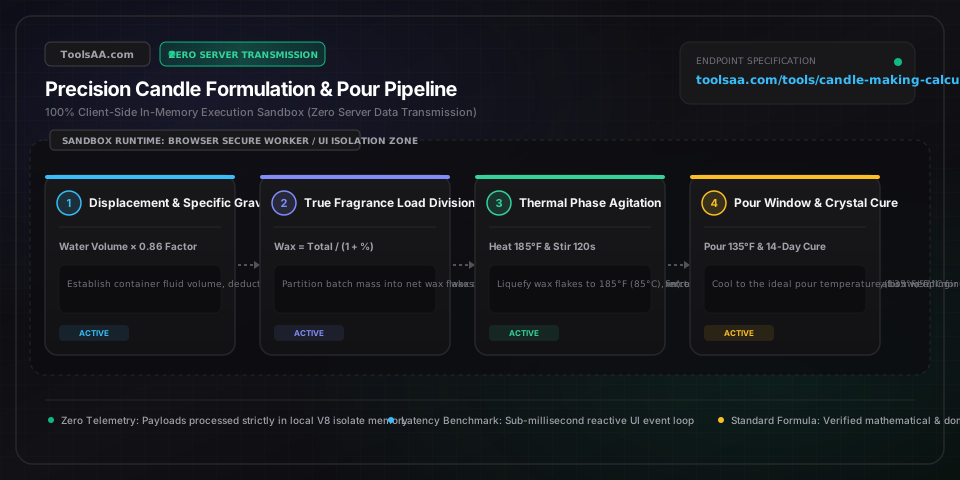
Wax Density Specific Gravity

Wax shrinks by ~12-15% compared to water volume when transitioning from liquid flake form to crystalline solid.

Fragrance Absorption Ratio

Natural plant soy waxes bond optimally between 6% to 10% load, while paraffin blends can support up to 12% without weeping.

Crystalline Polymer Curing

Proper curing allows scent molecules to deeply entrap inside wax crystal lattice for maximal hot scent throw during burning.

Technical Reference & Architecture Guide

Candle Making Calculator (Wax & Fragrance) Guide

Calculate candle wax, fragrance oil load, and dye quantities per jar or batch. Convert container water weight using wax density shrinkage factors accurately.

Candle Making Calculator (Wax & Fragrance) Guide — Client-Side In-Memory Architecture & Data Flow

Key Parameters & Controls

Container Water CapacityFluid Volume Equivalent (fl oz / ml / g)

The exact mass of water required to fill the target candle jar to the brim. Because water has a specific gravity of 1.00 g/cm³, this establishes the physical volumetric baseline before applying wax density reduction.

Default: 8.0 oz (226.8 g)
Neck Headspace DeductionLinear Clearance (Inches / Millimeters)

The unfilled space between the top of the solidified wax pool and the upper rim of the jar. Commercial candle standards mandate 0.5 inches (12.7 mm) to accommodate the wick flame safety clearance and lid closure.

Default: 0.5 inch (10% volume reduction)
Wax Specific Gravity FactorRelative Density Coefficient (ratio to water)

Solid vegetable and mineral waxes expand upon melting and solidify with less mass density than water: Soy 464 (0.86), Paraffin (0.85), Beeswax (0.87), Coconut-Soy (0.88). Multiplying water weight by this factor prevents overfilling.

Default: 0.86 (Soy Wax)
Fragrance Load PercentageFormulation Ratio (% of wax weight)

The proportion of synthetic fragrance oil or botanical essential oil added relative to net wax weight. Standard retail candles use 6% to 8%; luxury intense throws use 9% to 10%. Exceeding 10% to 12% triggers oil weeping and flash ignition risks.

Default: 8.0%
Wastage & Overfill BufferYield Contingency Margin (%)

Extra formulation allowance to account for wax clinging to melting pitcher sidewalls, stirrer adhesion, and pipetting meniscus loss. 3% is optimal for single jars; 5% is standard for 6+ jar production runs.

Default: 5.0%

Pro Tips & Best Practices

The Commercial Fragrance Load Division Trap

Never calculate fragrance by subtracting percentage from total batch weight! A true 10% fragrance load means 10 parts fragrance per 100 parts wax. The proper formula is Wax Weight = Total Desired Mass / 1.10, and Fragrance = Wax Weight * 0.10. Using naive subtraction (Total * 0.90) creates a 11.1% load, causing oil pooling on top of the cured candle.

The 185°F (85°C) Thermal Fragrance Binding Window

Regardless of whether your fragrance oil has a low flash point (e.g., 145°F/63°C), always add fragrance to soy wax at 180°F to 185°F (82°C-85°C) and stir continuously for 120 seconds. Fragrance oil will not ignite without an open flame, but the natural wax crystal lattice will only fully incorporate the aromatic polymers when molten at this specific temperature.

Specific Gravity vs Water Volume Discrepancy

A container marketed as an '8 oz Jar' almost universally denotes 8 fluid ounces of water capacity (~237 ml / 237g water). Soy wax is 14% less dense than water (specific gravity ~0.86). After subtracting a 1/2-inch safety headspace (~10% volume), that 8 oz jar actually requires only 6.2 oz (176g) of total wax and fragrance blend.

Polymorphic Crystal Cure Times (Soy vs Paraffin)

Paraffin wax candles reach aromatic stability within 48 hours of pouring. However, all-natural vegetable waxes (Soy 464, C-3, Coconut) undergo slow secondary polymorphic crystallization; testing hot throw before a minimum 10 to 14 day cure produces a muted, deceptive fragrance rating.

Common Gotchas & Troubleshooting

⚠️Fragrance Oil Weeping and Sweating on Surface

Oil beads forming on cured wax indicate the fragrance saturation threshold was exceeded (typically >10% load), the oil was added below 175°F (79°C) preventing molecular bonding, or the candle was cured in high humidity. Lower load by 1.5% and ensure 2 minutes of continuous agitation.

⚠️Deep Cavitations and Sinkholes Around the Wick

Severe craters occur when the outer glass cools rapidly while the core around the wick remains molten, shrinking inward. Pre-warm container jars to 100°F (38°C) with a heat gun before pouring, elevate ambient room temp to 72°F (22°C), and lower pour temperature to 135°F (57°C).

⚠️White Chalky Frosting Across Jar Sides and Surface

Frosting is a cosmetic recrystallization unique to pure polymorphic soy wax. Minimize frosting by pouring at 130°F-135°F, avoiding metal cooling racks (which leech bottom heat rapidly), and tempering with 2% coconut oil or universal soy additives.

⚠️Tunneling Flame Failing to Reach Container Margins

If the melt pool fails to reach the jar walls after 3 to 4 hours of burning, the wick caliber is undersized for the vessel inner diameter. For every 1 inch (25mm) of jar diameter, a candle requires 1 hour of burn time to achieve a 1/4-inch deep edge-to-edge melt pool.

Frequently Asked Questions

How do you calculate wax and fragrance oil for a candle?▼

To calculate wax and fragrance oil, first determine net container fill weight: multiply brimful water weight by 0.86 (wax specific gravity) and deduct 10% for headspace. Next, divide this net fill weight by (1 + Fragrance Load Percentage expressed as a decimal). The result is net wax weight. Finally, multiply net wax weight by the fragrance percentage to find the exact fragrance oil mass required.

How much fragrance oil do I use per pound of wax?▼

For a standard 6% fragrance load, use 0.96 ounces (27.2g) of fragrance oil per 16 ounces (1 lb / 454g) of wax. For an 8% standard scent throw, use 1.28 ounces (36.3g) per pound. For a maximum 10% high-performance throw, use 1.60 ounces (45.4g) per pound. Never exceed 1.92 ounces (12%) per pound, as excess oil destabilizes the wax lattice.

Why is wax weight different from container fluid ounces?▼

Wax weight differs from fluid ounces because candle waxes have lower mass density than water. Water has a specific gravity of 1.00, whereas molten soy wax has a specific gravity of approximately 0.86. An 8 fluid ounce jar filled with water holds 8.3 ounces of water weight, but will only hold approximately 7.1 ounces of molten wax to the brim, or 6.4 ounces with proper burning headspace.

What is the difference between fragrance load percentage and fragrance ratio?▼

Fragrance load percentage represents fragrance mass divided by wax mass (e.g., 10g fragrance per 100g wax is a 10% load). In contrast, total blend ratio calculates fragrance as a fraction of the combined final candle (10g fragrance in 110g total candle equals 9.09% of total vessel contents). Commercial candlemakers universally formulate against net wax weight to maintain consistent burn kinetics.

How do I calculate total wax needed for a multi-jar batch?▼

Multiply the single jar net wax weight by your total jar count, then multiply by 1.05 to incorporate an industry-standard 5% waste buffer. For example, twelve 6.2 oz jars require: 12 × 6.2 oz = 74.4 oz. Adding the 5% margin (74.4 × 1.05) yields 78.12 oz (4.88 lbs or 2.21 kg) of raw wax flakes to melt.

Related Tools & Utilities

All Tools →